
About the Bedlington Terrier
The Bedlington Terrier is a distinctive breed of dog known for its unique, lamb-like appearance and curly, crisp coat. Originating in Northumberland, England, this breed was initially developed for hunting vermin in mines but quickly gained popularity as a companion and show dog. Bedlington Terriers are agile, energetic, and good-natured, making them excellent family pets. Their non-shedding coat and hypoallergenic qualities further add to their appeal among dog lovers.
Fascinating facts
Lamb-like Appearance
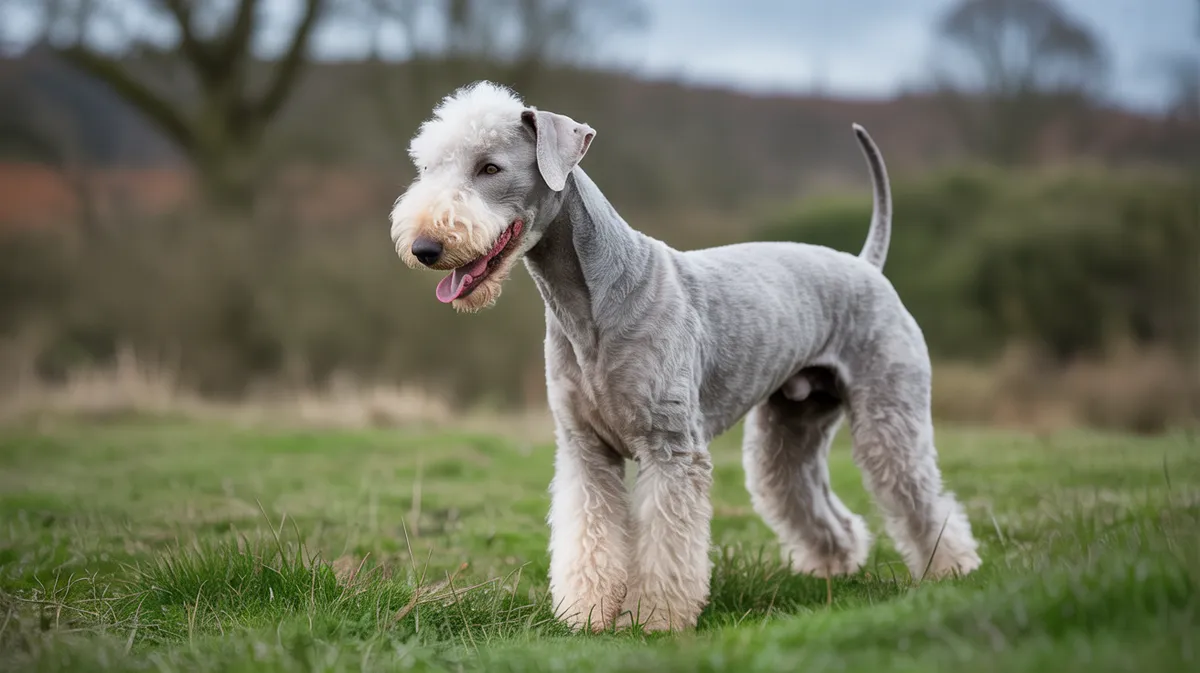
Bedlington Terriers are famous for their soft, curly coat and arched back, giving them a silhouette similar to that of a lamb.
Fast and Agile
Despite their delicate looks, these terriers are fast runners and were historically used in racing and hunting competitions.
Copper Toxicosis Risk
Bedlington Terriers are genetically predisposed to copper toxicosis, a liver disease caused by excess copper accumulation.
Detailed description
The Bedlington Terrier is a small to medium-sized breed, typically weighing between 7.7 and 10.4 kg (17–23 lbs) and standing 38–44 cm (15–17.5 in) at the shoulder, with males slightly larger than females. Its most distinctive anatomical feature is its arched, lamb-like back and pear-shaped head, crowned with a prominent, silky topknot. The coat is a unique blend of hard and soft hair, forming tight, crisp curls that are virtually non-shedding and hypoallergenic, with minimal odor. The breed exhibits a deep chest, muscular hindquarters, and a flexible, springy gait, reflecting its heritage as a swift and agile hunter. Bedlington Terriers have almond-shaped eyes, often described as keen and alert, and their ears are triangular with rounded tips, set low and carried close to the cheeks. Behaviorally, they are known for their intelligence, curiosity, and affectionate nature, bonding closely with family members while remaining reserved with strangers. They are highly energetic and require regular exercise, excelling in activities such as lure coursing, agility, and obedience trials. Socially, Bedlingtons can coexist well with other dogs if properly socialized, though their strong prey drive may make them less compatible with small non-canine pets. Their lifespan averages 12–16 years, with some individuals living longer under optimal care.
Did you know?
The Bedlington Terrier was originally bred to hunt rats and other vermin in mines and is one of the few terrier breeds with a 'hare foot' shape rather than the typical 'cat foot.'
Research & sources
Wikipedia summary
The Bedlington Terrier is a breed of small dog named after the mining town of Bedlington, Northumberland in North East England. Originally bred to hunt, the Bedlington Terrier has since been used in dog racing, numerous dog sports, as well as in conformation shows and as a companion dog. It is closely related to the Dandie Dinmont Terrier, Whippet and Otterhound.
Behaviour & social structure
Bedlington Terriers display a blend of terrier tenacity and sighthound speed. Historically, they were prized for their ability to hunt vermin, rabbits, and even badgers, using both scent and sight. They exhibit strong chasing instincts and may pursue small animals if not supervised. At home, Bedlingtons are generally calm and affectionate, often forming strong attachments to their owners and displaying a gentle demeanor with children. However, they can be assertive with other dogs, especially of the same sex, due to their territorial instincts. Daily routines should include ample mental and physical stimulation to prevent boredom-related behaviors such as digging or excessive barking. They are known for their 'terrier dash,' a sudden burst of energy and speed, and enjoy interactive games and structured training sessions. Bedlingtons are intelligent and respond well to positive reinforcement, though they may exhibit independent streaks typical of terriers.
Reproduction & life cycle
Bedlington Terriers reach sexual maturity between 8 and 12 months, though responsible breeding is typically delayed until at least 18 months of age. The breed exhibits no pronounced seasonality in breeding, with litters commonly produced year-round. The average litter size ranges from 3 to 6 puppies. The gestation period is approximately 63 days. Females display attentive maternal behaviors, providing intensive care for the first three weeks post-partum, after which puppies begin to explore and socialize. Early socialization is crucial for healthy behavioral development. Bedlington Terriers are susceptible to certain hereditary conditions, such as copper toxicosis, so ethical breeders routinely screen breeding pairs for genetic health.
Adaptations & survival
The Bedlington Terrier's unique coat is an adaptation to the harsh, damp climate of Northumberland, providing insulation and protection from the elements while minimizing shedding. Its arched back and deep chest facilitate efficient running and maneuverability, traits inherited from sighthound ancestors like the Whippet. The breed's strong jaws and elongated head are specialized for grasping and dispatching prey. Behaviorally, Bedlingtons combine the independence and persistence of terriers with the speed and agility of coursing dogs, allowing them to excel in both hunting and competitive dog sports. Their hypoallergenic coat is an unintended adaptation, resulting from selective breeding for show and companionship.
Cultural significance
The Bedlington Terrier holds a unique place in British canine history, originally developed in the mining communities of Northumberland for vermin control. Its distinctive appearance has led to nicknames such as 'Rothbury's Lamb' and 'Rodbery Terrier.' The breed has been featured in dog shows since the 19th century and is recognized for its elegance and athleticism. Bedlingtons have appeared in literature, art, and even as mascots for local sports teams. Their hypoallergenic qualities have made them popular among allergy sufferers, and they are valued as both working dogs and companions. While not associated with specific myths or folklore, their lamb-like appearance has contributed to their gentle and approachable reputation.
Recent research
Recent genetic studies have clarified the Bedlington Terrier's ancestry, confirming close relationships with the Dandie Dinmont Terrier, Whippet, and Otterhound. Ongoing research focuses on the genetic basis and management of copper toxicosis, with advances in DNA testing allowing breeders to reduce the incidence of this disorder. Behavioral studies have highlighted the breed's intelligence and adaptability, supporting their success in a variety of canine sports. Veterinary research continues to monitor breed-specific health trends, emphasizing the importance of early screening and preventive care. The Bedlington Terrier's hypoallergenic coat has also been the subject of dermatological studies, contributing to broader understanding of canine allergies.
Videos
Habitat
Domestic; originally rural and mining communities
 Various Continental Regions
Grassland
Open areas dominated by grasses rather than trees, supporting numerous herbivores and their predators.
 Elevated Terrain
Mountain
High-altitude environments with varying climates and specialized wildlife adapted to rugged terrain and thin air.
 Global
Forest
Wooded areas with significant tree cover and diverse plant and animal communities.
Conservation
The Bedlington Terrier is currently classified as Domesticated on the IUCN Red List.
Threats & challenges
As a domesticated breed, Bedlington Terriers do not face natural predators or habitat loss, but they are subject to several breed-specific health challenges. The most significant is copper toxicosis, a genetic disorder affecting liver function, which can be managed through genetic screening and responsible breeding. Other health concerns include retinal dysplasia, patellar luxation, and kidney disease. The breed's population is stable but relatively small, making genetic diversity a concern among breeders. Human impact is primarily positive, with most Bedlingtons living as cherished pets, though irresponsible breeding and lack of awareness about health screening can pose ongoing challenges.
Taxonomy
Scientific name
Canis lupus familiaris
- Kingdom
- Animalia
- Phylum
- Chordata
- Class
- Mammalia
- Order
- Carnivora
- Family
- Canidae
- Genus
- Canis
- Species
- lupus familiaris
Community notes
Share your observations about the Bedlington Terrier.
No community notes yet. Be the first!
Discover more wildlife
More fascinating animals from the encyclopedia.