
About the Tonkinese Cat
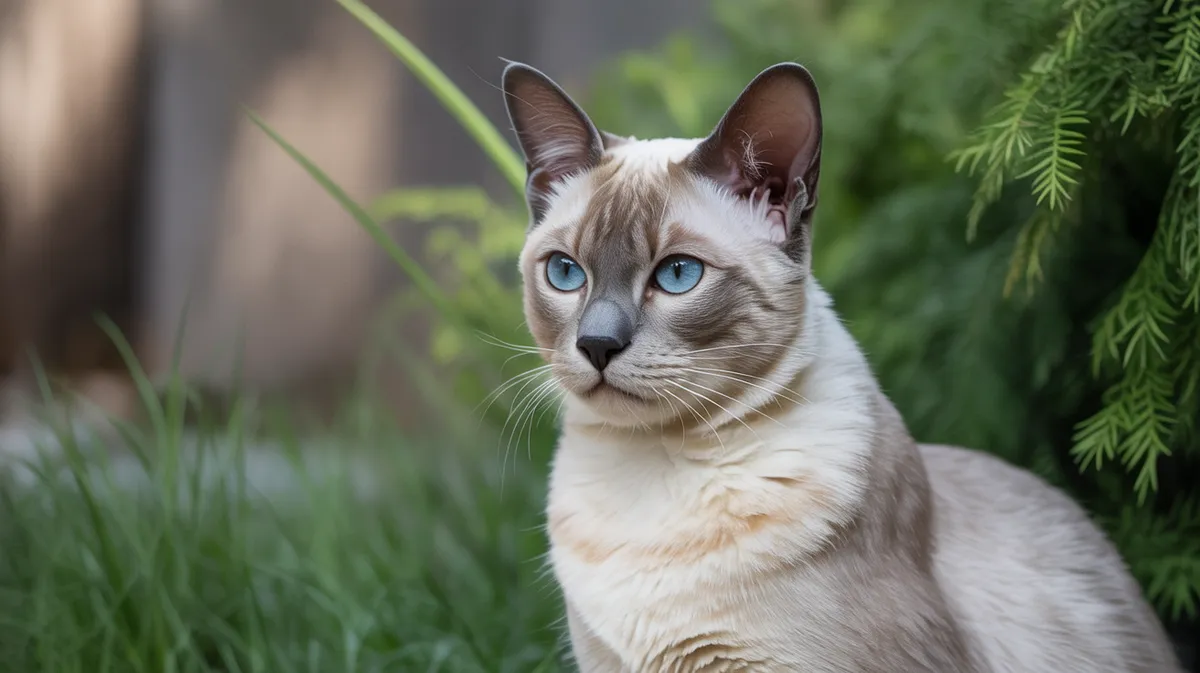
The Tonkinese cat is a distinctive domestic breed created by crossing Siamese and Burmese cats, resulting in a playful, affectionate, and highly social feline. Recognized for its medium-sized, muscular body, striking aqua or green eyes, and soft, short coat that comes in a variety of colorpoints, the Tonkinese is both elegant and robust. This breed is known for its outgoing and interactive nature, often forming strong bonds with family members and thriving in active households. Tonkinese cats are intelligent and curious, enjoying games, puzzles, and plenty of human interaction. Their vocalizations are moderate, often described as softer and less persistent than their Siamese ancestors.
Fascinating facts
Aqua Eyes
The Tonkinese is famous for its striking aqua-colored eyes, a rare trait in the cat world resulting from its Siamese and Burmese ancestry.
Highly Social
This breed thrives on companionship and dislikes being left alone for long periods, often bonding closely with all family members and even other pets.
Playful Intelligence
Tonkinese cats are intelligent and playful, excelling at interactive games and sometimes learning to fetch or perform tricks.
Detailed description
The Tonkinese cat is a medium-sized domestic breed, typically weighing between 2.5 and 5.5 kilograms (5.5–12 lbs), with males generally larger than females. Its body is muscular yet graceful, with a gently rounded chest, slender legs, and an elegant, tapering tail. The head is a modified wedge shape, featuring high cheekbones, a gently contoured muzzle, and large, expressive almond-shaped eyes that range from vivid aqua to green or gold, depending on coat color. The short, fine coat is soft and silky, lying close to the body, and displays a variety of colorpoints including natural, champagne, blue, and platinum, each with subtle shading between the body and extremities. Tonkinese cats are renowned for their lively, inquisitive temperament; they are highly social, preferring the company of humans and other pets, and often seek out interactive play. Their intelligence is notable, with individuals quickly learning tricks, puzzle toys, and even responding to clicker training. Tonkinese are moderately vocal, communicating with a gentle, melodic voice, and are known for their affectionate, people-oriented nature, often following their owners from room to room. They thrive in stimulating environments and may become bored or anxious if left alone for extended periods. Unlike some breeds, Tonkinese cats tend to retain playful, kitten-like behaviors well into adulthood, making them engaging companions throughout their lifespan, which typically ranges from 12 to 16 years, with some individuals living even longer under optimal care.
Did you know?
Did you know that the Tonkinese is one of the few cat breeds with an officially recognized 'mink' coat pattern, which is a blend between the pointed (Siamese) and solid (Burmese) patterns?
Research & sources
Behaviour & social structure
Tonkinese cats are highly interactive and thrive on social engagement, both with humans and other animals. They exhibit a strong desire for companionship, often greeting family members at the door and participating actively in household routines. Their play behavior is energetic and inventive, involving fetching, climbing, and manipulating toys; they are adept at problem-solving and enjoy mentally stimulating activities. While not typically aggressive, Tonkinese cats may display assertive play and can become mischievous if understimulated. Their feeding behavior reflects their carnivorous ancestry, preferring frequent small meals and showing interest in hunting-style games. Tonkinese cats are known to form strong social hierarchies with other pets, often assuming a leadership role. They communicate through a range of vocalizations, body language, and tactile signals, such as head-butting and kneading. Daily routines include periods of intense activity interspersed with restful lounging, often in elevated or warm spots.
Reproduction & life cycle
Tonkinese cats reach sexual maturity between 5 and 9 months of age. They are seasonally polyestrous, with breeding peaks typically in spring and summer, though indoor cats may breed year-round due to artificial lighting. Estrus cycles last 4–7 days, and females exhibit increased vocalization and affectionate behavior during this period. Mating is similar to other domestic cats, with induced ovulation triggered by copulation. Gestation lasts approximately 63–65 days, after which litters of 4–6 kittens are common. Queens provide intensive maternal care, nursing and grooming their offspring for the first 8–10 weeks. Kittens are born with lighter coats that darken as they mature, and their eye color develops over several months. Both parents may display nurturing behaviors, especially in multi-cat households.
Adaptations & survival
Tonkinese cats exhibit several adaptations suited to domestic and semi-natural environments. Their short, dense coat provides protection and requires minimal grooming, while their muscular build and flexible spine allow for agile climbing and leaping. The breed's highly developed social intelligence is an evolutionary advantage, facilitating strong bonds with humans and other animals, which can enhance survival in domestic settings. Their moderate vocalization is less likely to attract predators or annoy humans compared to more vocal breeds. Tonkinese cats also display heightened curiosity and problem-solving abilities, enabling them to adapt quickly to new environments and challenges. Their colorpoint pattern, inherited from Siamese and Burmese ancestors, provides camouflage in dappled light, though this is less relevant in domestic contexts.
Cultural significance
The Tonkinese cat holds a unique place in cat breeding history, representing a deliberate blend of Siamese and Burmese traits to create a balanced, affectionate companion. While not associated with ancient myths like its progenitor breeds, the Tonkinese has become a symbol of companionship and adaptability in modern pet culture. The breed is often featured in cat shows and has been recognized by major cat registries such as the Cat Fanciers' Association (CFA) and The International Cat Association (TICA). Its playful, affectionate nature has made it a favorite in therapy animal programs and as a family pet.
Recent research
Recent genetic studies have confirmed the Tonkinese as a hybrid breed, with distinct alleles inherited from both Siamese and Burmese lineages, particularly affecting coat color and eye pigmentation. Ongoing research is investigating the breed's predisposition to certain hereditary diseases, with efforts to map and reduce the incidence of genetic disorders through selective breeding. Behavioral studies have highlighted the breed's advanced social cognition and problem-solving abilities, making it a model for research into feline intelligence and human-animal interactions. There is also interest in the breed's vocalization patterns, which are intermediate between the Siamese and Burmese, providing insight into the genetics of feline communication.
Sources
The Genetics of Cat Breeds: Relationships and Origins
Leslie A. Lyons et al., University of Missouri (2016)
scientificThe Genetics of Cat Breeds: Relationships and Inheritance Patterns
Leslie A. Lyons et al., University of Missouri (2016)
scientificFelis catus (Domestic Cat) – IUCN Red List Assessment
IUCN Red List of Threatened Species
conservationThe Genetics of Cat Breeds: Relationships and Inheritance Patterns
Leslie A. Lyons, et al. (2021)
scientificVideos
Habitat
Domestic
Conservation
The Tonkinese Cat is currently classified as Least Concern on the IUCN Red List.
Threats & challenges
As a domestic breed, Tonkinese cats face few natural threats, but they are susceptible to common feline health issues such as periodontal disease, obesity, and inherited conditions like progressive retinal atrophy and hypertrophic cardiomyopathy. Overbreeding and loss of genetic diversity are potential concerns in some breeding lines. Accidental injury, exposure to toxins, and predation by larger animals (when allowed outdoors) are additional risks. The breed is not threatened in the wild, and its conservation status is 'Least Concern,' but responsible breeding and owner education are important for long-term health and welfare. Population trends are stable, with the breed enjoying moderate popularity in North America, Europe, and Australasia.
Taxonomy
Scientific name
Felis catus
- Kingdom
- Animalia
- Phylum
- Chordata
- Class
- Mammalia
- Order
- Carnivora
- Family
- Felidae
- Genus
- Felis
- Species
- catus
Community notes
Share your observations about the Tonkinese Cat.
No community notes yet. Be the first!
Discover more wildlife
More fascinating animals from the encyclopedia.