
Humans are obsessed with words, but we are the exception, not the rule. Across the animal kingdom, communication happens through an astonishing range of channels — sound we can't hear, scents we can't smell, colours we can't see, and movements we rarely notice. Once you understand these hidden languages, the natural world reveals itself as a place in constant, sophisticated conversation.
Sounds Beyond Our Hearing
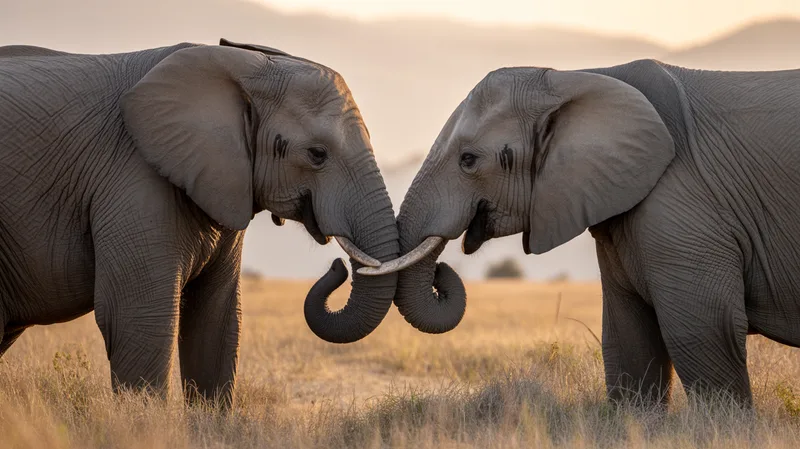
Some of the most important animal signals happen entirely outside the human range. The African elephant produces deep infrasonic rumbles — vibrations so low we feel them more than hear them — that travel for kilometres through both air and ground, allowing scattered family groups to coordinate and reunite. In the oceans, whales and dolphins fill the water with clicks, whistles, and songs that carry across vast distances, building a soundscape far richer than anything we perceive at the surface.
The Language of Scent
For a huge number of mammals and insects, the world is written in chemistry. Scent-marking broadcasts identity, territory, health, and readiness to mate, and a single sniff can carry a paragraph of information. Ants and other social insects lay down pheromone trails that organise entire colonies without a single sound — a chemical language so precise it can summon thousands of workers to food or war.
Talking in Colour and Light
Vision-based signals are everywhere once you look. Birds flash brilliant plumage and perform elaborate courtship displays; reptiles flare colourful throats to warn rivals; and many animals use bold patterns to advertise that they are toxic or dangerous. Some species even communicate in wavelengths invisible to us — ultraviolet markings that turn a drab-looking bird into a glowing billboard to others of its kind.
Dances, Gestures, and Body Language
Movement is a language all its own. Honeybees famously perform a "waggle dance" that encodes the direction and distance of food relative to the sun — a symbolic message passed from one insect to another. Primates lean on rich repertoires of facial expressions and gestures, while a flick of a tail, a raised crest, or a frozen posture can speak volumes about fear, threat, or invitation.
Why Animal Communication Matters
- It coordinates survival — finding mates, raising young, avoiding predators, and managing territory.
- It reveals intelligence and social complexity we are only beginning to map.
- Human noise, light, and chemical pollution can drown out these signals, disrupting feeding, breeding, and navigation.
Do Animals Have Names?
One of the most striking discoveries in animal communication is that some species appear to use something very like names. Bottlenose dolphins develop a unique "signature whistle" early in life and use it to identify themselves.
More remarkably, other dolphins will copy that whistle to get a specific individual's attention — effectively calling them by name.
Research has since suggested elephants may do something similar, directing distinctive rumbles at particular individuals. It is a way of addressing another being that we long assumed was uniquely human.
Lies, Mimicry, and Eavesdropping
Communication is not always honest. The fork-tailed drongo, an African bird, gives false alarm calls that send meerkats and other animals fleeing from their food — which the drongo then swoops in and steals.
It can even mimic the alarm calls of the very species it is robbing, switching to a fresh imitation when its victims stop falling for the old one. That is deception of an impressively strategic kind.
Many animals also eavesdrop, listening in on the alarm calls of entirely different species. A forest full of birds and monkeys effectively shares a single warning system, whether or not each species meant to broadcast to the others.
Is Any of It Really Language?
This is where scientists tread carefully. Human language has features — grammar, and the ability to discuss things distant in time and space — that most animal signalling lacks.
Yet the line is blurrier than it once seemed. The honeybee's waggle dance describes a place the other bees cannot see, and prairie dog alarm calls appear to encode surprisingly specific descriptions of an intruder, including size and colour.
The honest answer is that these are extraordinary communication systems rather than full languages. Their sophistication should humble us — but nothing yet discovered matches the open-ended flexibility of human speech.
Talking Through Touch and Vibration
Some conversations travel through solid ground rather than air. Elephants send infrasonic rumbles that ripple through the earth for kilometres, and appear to detect them through sensitive cells in their feet and trunks.
On a far smaller scale, a male spider announces himself by drumming a precise rhythm on a female's web — a vibrational courtship song. Get the rhythm wrong and he may be eaten instead of accepted.
Treehoppers vibrate plant stems to call to one another, and honeybees use tiny buzzes and shakes inside the dark hive. An entire layer of animal communication is happening beneath our feet and fingertips, completely unheard.
What Happens When We Drown Them Out
Because so much animal communication depends on subtle signals, human noise and light are quietly jamming it. Shipping traffic fills the ocean with low-frequency noise that masks whale calls, shrinking the distance over which whales can hear one another.
On land, birds in noisy cities sing louder and at higher pitches to be heard over traffic, which can distort the very songs used to attract mates and defend territory.
Artificial light disrupts fireflies, whose entire courtship is a coded exchange of flashes. Noise and light pollution are not just nuisances — they are a direct assault on how animals find food, mates, and safety.
Frequently Asked Questions
Can animals really "talk"? Not in human language, but many use structured, meaningful signals to share specific information — a genuine form of communication.
What is infrasound? Sound below the range of human hearing (under ~20 Hz), used by elephants and other animals to communicate over long distances.
Do animals have dialects? Yes — whales, birds, and some primates show regional "accents" that vary between populations.
The more closely we listen, the clearer it becomes: communication is not a human invention but a thread running through all of life. Discover how different species sense and signal to one another across the Creature Atlas encyclopedia.