
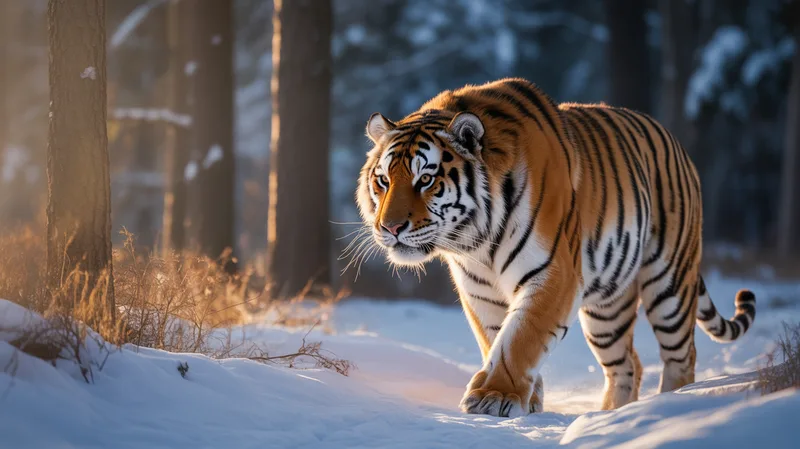
Few animals stir the imagination like the big cats. Silent, powerful, and breathtakingly adapted, they have prowled human myth and memory for millennia — and today they sit at the very top of their food chains across four continents. But "big cat" means something specific to scientists, and the family is more varied, and its fortunes more mixed, than most people realise. Here is your evidence-based field guide to the planet's most magnificent predators.
What Actually Makes a Cat a "Big Cat"?
In the strictest sense, the big cats are the members of the genus Panthera — the tiger, lion, leopard, jaguar, and snow leopard — joined in common usage by the cheetah. The classic dividing line is sound: true Panthera cats can roar, thanks to a specially adapted voice box and a flexible hyoid bone, while smaller cats can only purr. Size, strength, and a place at the apex of the ecosystem complete the picture.
A Tour of the Titans
- Tiger — the largest cat of all. The Siberian (Amur) tiger endures the frozen forests of the Russian Far East, its pale, sparsely striped coat dissolving into snow and shadow.
- Lion — the only truly social big cat, living in prides where lionesses hunt as a coordinated team.
- Leopard — the supreme generalist, hauling prey into trees to dine in safety and thriving from rainforest to city fringe.
- Jaguar — the powerhouse of the Americas, with a bite strong enough to pierce skulls and turtle shells.
- Snow leopard — the "ghost of the mountains." The elusive snow leopard uses smoky, rosette-dappled fur and a metre-long tail to vanish across Himalayan rock.
- Cheetah — built for pure speed rather than power, and a marvel of biomechanics in its own right.
The Science of the Cheetah's Speed
The cheetah is the fastest land animal alive. A captive cheetah named Sarah was reliably clocked at around 104 km/h (64 mph), and the animal can accelerate from a standstill to roughly 96 km/h in about three seconds — out-accelerating most sports cars. Fascinatingly, a GPS-collar study of wild cheetahs found that their hunting success owes less to raw top speed (the wild cats averaged bursts around 93 km/h) than to breathtaking acceleration, braking, and cornering (BBC — Cheetah tracking study, Wilson et al., Nature). A flexible, spring-like spine and semi-retractable claws that grip like running spikes make it all possible.
Masters of the Hunt
What unites the big cats is a toolkit refined over millions of years. Forward-facing eyes give pinpoint depth perception; a reflective layer behind the retina sharpens night vision; and muscle-packed bodies are engineered for the explosive ambush rather than the long chase. Most big cats stalk to within metres before a final decisive rush. They are not reckless killers but careful strategists — a single failed hunt can cost more energy than a cat can afford to lose.
Why Big Cats Matter — and a Rare Good-News Story
As apex predators, big cats are umbrella species: protect enough wild land for a tiger or jaguar to roam, and you automatically safeguard thousands of other species living under that same umbrella. And there is genuine hope. After a century of catastrophic decline, the wild tiger is rebounding: numbers have climbed from roughly 3,200 in 2010 to about 5,574 in 2024 — a 74% increase, with countries including India, Nepal, Bhutan, China, and Russia driving the recovery (WWF / Global Tiger Forum). It is proof that determined conservation can reverse even a decades-long slide.
Kings and Queens Still Under Pressure
The progress is real but fragile. Habitat loss fragments territories, poaching feeds an illegal trade in skins and body parts, and the decline of prey leaves cats hungry and more likely to clash with people. Several species have lost the majority of their historic range. The tiger's comeback shows what's possible — but only sustained effort will keep big cats roaming wild.
Key Takeaways
- True big cats belong to the genus Panthera and can roar; the cheetah is a specialised speed outlier.
- A cheetah can hit ~104 km/h, but wild hunting success depends most on acceleration and agility.
- Big cats are umbrella species — protecting them protects whole ecosystems.
- Wild tiger numbers rose ~74% from 2010 to 2024, a landmark conservation success.
The Cats That Came Back
Big cat news is relentlessly grim, so the exceptions are worth dwelling on — because they show, precisely, what works.
The Iberian lynx is the standout. In the early 2000s fewer than a hundred remained, and it was the most endangered cat on Earth. A combined programme of captive breeding, rebuilding the rabbit population it depends on, buying up and restoring habitat, and building wildlife crossings over the roads that were killing it has driven numbers into the thousands. It has now been formally downlisted — an outright reversal, achieved within a single human generation.
Amur tigers tell a similar story on a colder scale. Down to a few dozen animals in the 1940s, hard anti-poaching enforcement in the Russian Far East pulled them back to several hundred. India's tigers, too, have climbed steadily under sustained reserve protection.
What every one of these recoveries has in common is worth stating plainly, because it is never a single clever intervention. It is protected habitat, restored prey, real enforcement against poaching, compensation for farmers who lose livestock, and — the part that fails most often — money that keeps arriving for decades rather than for the length of a grant. Big cats are not difficult to save. They are just expensive, and slow, and easy to give up on.
Frequently Asked Questions
Which big cat is the largest? The tiger, with the Siberian (Amur) tiger the biggest of all living cats.
How fast can a cheetah run? Up to about 104 km/h (64 mph) in short bursts, with extraordinary acceleration.
Why can't cheetahs roar? They lack the specialised voice box of Panthera cats; instead they chirp, purr, and growl.
Are big cat numbers recovering? Tigers are rebounding strongly, though several other big cats remain under serious threat.
Big cats remind us that true wildness still exists — and that it is worth every effort to protect. Explore detailed profiles of these remarkable predators across the Creature Atlas encyclopedia.
Which cats are true "big cats"? Strictly, the roaring cats: lion, tiger, leopard, jaguar, and snow leopard — though cheetahs and pumas are usually included.
Why can't cheetahs roar? Their throat anatomy differs. They chirp, purr, and growl instead.
Which big cat is most endangered? The Amur leopard, with only a very small population remaining in the wild.
Has any big cat genuinely recovered? Yes — the Iberian lynx came back from fewer than a hundred animals to thousands.
What do big cats need to survive? Protected habitat, healthy prey, enforcement against poaching, and tolerance from the people living alongside them.