
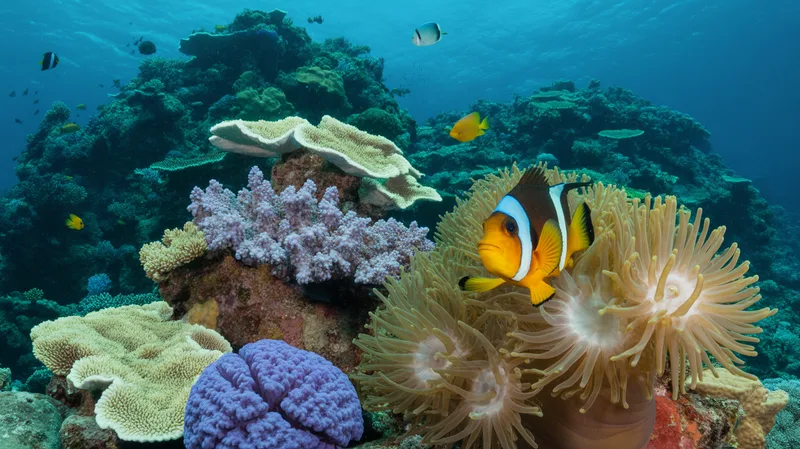
Often called the rainforests of the sea, coral reefs are among the most dazzling and crowded places on Earth. Though they cover less than one percent of the ocean floor, they shelter around a quarter of all known marine species — an explosion of colour, shape, and behaviour packed into a single living structure. To dive a reef is to witness one of nature's greatest concentrations of life.
The Animal That Builds a City
A reef begins with the coral itself — not a rock, but a colony of tiny animals called polyps. Each polyp builds a hard limestone skeleton, and over centuries those skeletons accumulate into vast reef structures. Remarkably, corals owe their survival to a partnership: microscopic algae called zooxanthellae live inside their tissues, photosynthesising sunlight into food and giving corals their vivid colours. It's one of the ocean's most important symbioses — and its most fragile.
A Metropolis Beneath the Waves
The reef the corals build becomes a bustling city. The clownfish shelters among the stinging tentacles of a sea anemone, protected by a special mucus that lets it live where other fish cannot — a textbook example of mutual benefit. Cleaner fish run "cleaning stations" where larger animals queue to have parasites removed; predators patrol the edges; and every crevice is a home, a nursery, or a hunting ground. Nothing on a reef lives alone.
Why Reefs Matter to All of Us
- They support around 25% of all marine species despite their tiny footprint.
- They protect coastlines from storms and erosion by absorbing wave energy.
- They feed hundreds of millions of people and underpin fishing and tourism economies.
- They are a frontier for medicine, with reef organisms yielding promising new compounds.
Beautiful but Fragile
Reefs are also among the most threatened habitats on the planet. When the water grows too warm, stressed corals expel their algae and turn ghostly white — a process called coral bleaching. Without their algal partners, corals starve, and if the heat persists they die. Pollution, overfishing, and ocean acidification pile on the pressure. Because so many species depend on the reef, a dying reef takes an entire community down with it.
The Reef's Recyclers — and Where Sand Comes From
Corals build the reef, but other animals constantly reshape it. Parrotfish scrape algae from the coral with beak-like teeth, grinding up rock as they feed and excreting it as fine white sand.
A single large parrotfish can produce hundreds of kilograms of sand a year. Much of the postcard-perfect beach around a tropical island was, quite literally, once inside a fish.
Grazers like parrotfish and sea urchins also perform a vital service by keeping fast-growing algae in check, stopping it from smothering the corals and taking over the reef entirely.
The Night Shift
A reef by day and the same reef by night are almost different worlds. As the light fades, the daytime fish retreat into crevices to sleep and an entirely new cast emerges.
The corals themselves come alive after dark, extending their tentacles to catch drifting plankton — the reef's rock-like surface suddenly blooming into a carpet of tiny, waving animals.
Moray eels slide out to hunt, octopuses prowl the coral heads, and some creatures glow with their own light, making a night dive on a reef one of the strangest experiences in nature.
Hope for the Reefs
Despite the grim outlook, the fight for reefs is far from lost. Around the world, "coral gardeners" grow fragments in underwater nurseries and transplant them onto damaged reefs, where they can knit back together.
Scientists are also identifying and breeding heat-tolerant "super corals" that may survive warmer seas, and studying the algal partnerships that make some corals more resilient than others.
Marine protected areas, limits on destructive fishing, and cuts to carbon emissions remain the most powerful tools. Reefs can and do recover — but only if the heat stress they face is reduced.
How a Reef Is Born
Every reef begins with a single coral larva drifting in the current until it finds a hard surface, settles, and transforms into a polyp. That polyp clones itself again and again, and the colony slowly begins to build.
Reefs grow astonishingly slowly — often just a centimetre or two a year — so the great structures we see today have taken thousands of years to accumulate. A reef is, in effect, a monument built by generations.
Charles Darwin himself worked out how coral atolls form: a reef grows around a volcanic island, and as the island slowly sinks, the coral keeps growing upward, until only a ring of reef and a lagoon remain where the mountain once stood.
The Reef's Great Synchronised Night
Once a year, on cues from the moon, the water temperature, and the fading light, entire reefs do something extraordinary: they spawn all at once.
In a single night, corals across kilometres of reef release countless bundles of eggs and sperm, which drift upward in a slow-motion blizzard that turns the water into what divers describe as an underwater snowstorm.
Releasing everything simultaneously overwhelms the predators waiting to eat the eggs and dramatically improves the odds of fertilisation. It is one of the greatest mass reproductive events on the planet — and almost nobody sees it.
The Reef's Strangest Residents
Beyond the postcard fish, a reef teems with genuine oddities. The mantis shrimp strikes with a club so fast it briefly boils the water around it and can crack a snail's shell — and it sees the world through some of the most complex eyes in nature.
Nudibranchs — shell-less sea slugs — crawl the coral in psychedelic colours, many of them stealing the stinging cells of their prey and repurposing them for their own defence.
Sea cucumbers vacuum the sand clean and, if threatened, can eject their own internal organs to distract a predator before regrowing them. On a reef, almost nothing is as simple as it looks.
Frequently Asked Questions
Is coral a plant or an animal? An animal — a colony of tiny polyps — though it partners with algae that photosynthesise like plants.
What causes coral bleaching? Mainly heat stress, which makes corals expel the algae that feed and colour them.
Why are reefs so biodiverse? Their complex structure provides countless niches for food, shelter, and breeding.
The reef is proof that the ocean's greatest wonders can come in the smallest packages — and that they need our protection. Discover its inhabitants in the Creature Atlas encyclopedia.