
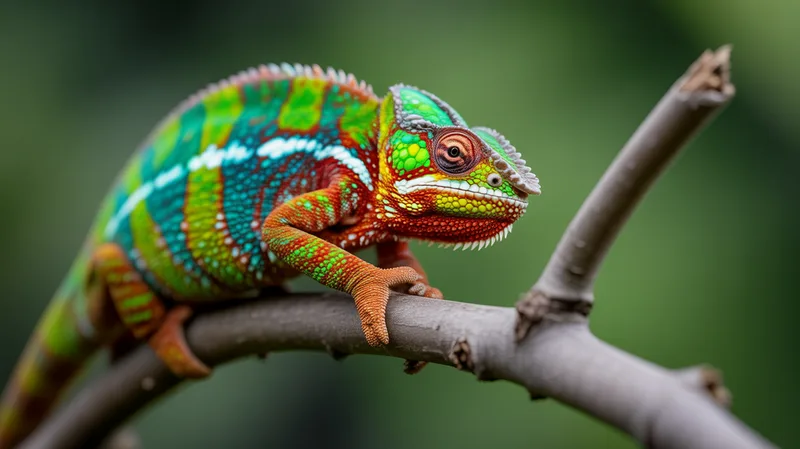
Everyone "knows" that a chameleon changes colour to blend into its background — turn it loose on a chessboard and it will go checkered, right? It is one of the most widespread animal myths there is, and it is mostly wrong. The truth, revealed by a landmark physics-meets-biology study, is far stranger and more elegant: chameleons change colour by physically rearranging microscopic crystals inside their skin — and they usually do it to talk, not to hide.
Busting the Camouflage Myth
Chameleons are already well camouflaged by their baseline green or brown colouring, which helps them disappear among leaves without changing a thing. When they do shift colour dramatically, it is rarely to match a surface. Instead, the big, vivid changes are tied to mood and social life: defending territory, intimidating a rival, courting a mate, or signalling stress. Colour, for a chameleon, is mostly a language.
The Real Mechanism: Tunable Nanocrystals
So how does the colour actually change? In 2015, researchers at the University of Geneva cracked it. Chameleon skin contains a layer of cells called iridophores, packed with a lattice of tiny guanine nanocrystals. The spacing of those crystals determines which wavelengths of light they reflect — this is structural colour, the same physics that makes a soap bubble shimmer, not pigment. The chameleon can actively change the geometry of that lattice, and that is what shifts its colour (Nature Communications, 2015).
Stretching the Lattice to Change the Hue
The detail is beautiful. When a chameleon is calm, its nanocrystals sit in a dense, tightly packed network that reflects short, blue-ish wavelengths (which, combined with yellow pigment, reads as green). When the animal becomes excited, it relaxes the skin and the lattice expands by around 30%; the wider spacing reflects longer wavelengths instead, so the chameleon flushes through yellows, oranges, and reds (University of Geneva). It is changing colour by stretching a microscopic mirror.
A Second Layer for Beating the Heat
The same study found something else remarkable: chameleons have a second, deeper layer of iridophores with larger crystals that reflect a lot of near-infrared light. This appears to act as built-in thermal protection, bouncing away the sun's heat. So the chameleon's skin is doing two jobs at once — a tunable signalling display on top, and passive sun protection underneath.
The Same Trick, All Over Nature
A chameleon's colour is structural, not pigmented — it comes from the way nanoscale crystals bend light, not from a dye. Once you know that, you start seeing the same trick everywhere.
The blue of a morpho butterfly is structural. So is the shimmer of a peacock's tail, the iridescence of a beetle's wing case, and the blue of a jay's feather. Grind any of them to powder and the colour vanishes, because there was never any blue pigment there at all. There was only architecture.
It is also worth saying that not every chameleon is a virtuoso. The dramatic, high-contrast displays belong mostly to adult males of a handful of species; females and juveniles are usually far more muted, and some chameleons barely shift at all. The internet's idea of a lizard flowing through the rainbow is a highlight reel.
The technology that follows from this is the interesting part. If colour can be produced by structure alone, and if that structure can be stretched to tune the hue, then you can build a surface that changes colour with no ink, no power, and no fading. Researchers are already prototyping exactly that — strain sensors that show damage as a colour shift, and displays that never run out of pigment.
Why It Matters
Beyond settling a famous myth, the discovery is a window into structural colour, one of nature's most efficient ways of making vivid, fade-proof hues without any pigment at all. Engineers studying these living photonic crystals hope to design new colour-changing materials, displays, and coatings inspired by the chameleon's skin. Not bad for an animal we long misunderstood.
Key Takeaways
- Chameleons mostly change colour to communicate (mood, mating, threats), not to match backgrounds.
- Colour comes from structural physics — a lattice of guanine nanocrystals in skin cells called iridophores.
- Calm chameleons have a dense lattice (blue/green); excited ones expand it ~30% to reflect reds and yellows.
- A second, deeper crystal layer reflects infrared for passive thermal protection.
Frequently Asked Questions
Do chameleons change colour to camouflage? Rarely — their base colour already camouflages them. Big colour shifts are mainly for communication.
How do they change colour? By actively spacing out a lattice of nanocrystals in their skin, which alters the light it reflects.
Is the colour from pigment? The dramatic changes are structural colour from nanocrystals, combined with some pigment, not pigment alone.
Why do they turn bright when stressed or excited? Relaxing the skin widens the crystal lattice, shifting reflection toward yellows and reds.
The chameleon turns out to be a living lesson in physics — and proof that the most famous "facts" about animals are sometimes the most wrong. Explore more colour-shifting creatures in the Creature Atlas encyclopedia.
Do chameleons change colour to match their surroundings? Mostly no. Colour change is chiefly about signalling and temperature.
How do they actually do it? By stretching a lattice of nanocrystals in their skin, which changes the wavelength of light it reflects.
Why do chameleons turn dark? Usually to absorb heat when cold — or to signal submission or stress.
Are chameleons good at camouflage at all? Their resting colours are genuinely well matched to their habitat; it is the dramatic shifts that are not camouflage.
Can any chameleon turn any colour? No. Each species has a limited palette, and males are typically far more expressive than females.
What is structural colour? Colour produced by the physical architecture of a surface, which bends and reflects specific wavelengths of light — rather than by any pigment.
Which animals use structural colour? Blue morpho butterflies, peacocks, jays, and countless iridescent beetles. Crush any of them and the colour disappears, because there was never a pigment to begin with.
How fast can a chameleon change? A dramatic shift can unfold in a matter of seconds, far too fast to be explained by moving pigment around.