
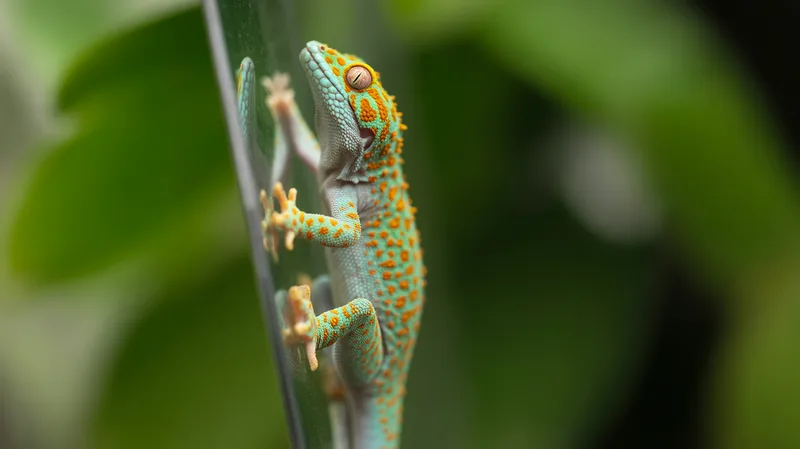
Watch a gecko sprint straight up a pane of glass, dart across a ceiling, and hang from a single toe, and it looks like a magic trick. For centuries, no one could explain it. It is not glue, it is not suction, and it is not tiny hooks. The real answer, finally pinned down in the early 2000s, is one of the most elegant pieces of biomechanics in nature — and it relies on a force most of us have never knowingly felt.
Not Glue, Not Suction
People have proposed all sorts of explanations for gecko grip: sticky secretions, suction cups, friction, even microscopic claws. Careful testing knocked them all down. Geckos leave no residue, stick just as well in a vacuum (ruling out suction), and cling to surfaces far too smooth for claws. The truth turned out to be stranger and far more interesting — and it lives at a scale you need a powerful microscope to see.
A Forest of Microscopic Hairs
The underside of a gecko's toes is covered in ridges packed with tiny hairs called setae. Each foot carries roughly 500,000 setae, and every seta — just 30 to 130 micrometres long — splits at its tip into hundreds of even finer structures called spatulae, each only a few hundred nanometres wide (PNAS, 2002). A single gecko foot ends in hundreds of millions of these spatula tips. It is this almost unimaginable subdivision that holds the secret.
The Power of van der Waals Forces
In 2002, biologist Kellar Autumn and colleagues showed that geckos stick through van der Waals forces — the faint electrostatic attraction that arises between any two surfaces when their molecules are brought close enough together (Nature). On their own these forces are vanishingly weak, but a gecko brings so many spatulae into intimate contact with a surface that the tiny attractions add up. A single seta generates around 20 millionths of a newton; multiplied across the foot, the whole animal can theoretically support well over 100 newtons — many times its own body weight.
Stick, Then Unstick — Instantly
Adhesion is only half the problem. A gecko also has to release its feet in milliseconds as it runs. It manages this with geometry: by changing the angle of its toes, it peels the setae off the surface, switching the van der Waals bond on and off with each step. Tellingly, gecko toes are highly water-repellent and grip equally well on both water-loving and water-hating surfaces — exactly what you would expect from a dry, molecular force rather than glue or moisture.
From Lizards to Lab Benches
This discovery launched an entire field of bio-inspired adhesives. Engineers have created "gecko tape" and climbing pads that mimic the branched-hair structure, sticking firmly yet peeling away cleanly and reusably — with potential uses from robotics and space hardware to medical bandages. The gecko, it turns out, solved a materials-science problem millions of years before we even knew it existed.
Key Takeaways
- Geckos do not use glue, suction, or claws to climb.
- Each foot has ~500,000 hairs (setae) that split into hundreds of nanoscale tips (spatulae).
- They stick via van der Waals forces — weak molecular attractions multiplied across millions of contacts.
- Changing toe angle peels the hairs off, letting them release instantly.
- The mechanism has inspired reusable "gecko tape" and climbing robots.
The Surfaces That Defeat a Gecko
Van der Waals adhesion sounds unbeatable, and it very nearly is. But the physics has limits, and knowing where they fall is what makes the effect useful to engineers.
The force depends on getting the gecko's microscopic hairs extremely close to a surface — within molecular distance. Anything that prevents that contact breaks the grip. Teflon is the famous defeat: its molecules interact so weakly that a gecko slides straight down it. Wet, oily, or heavily dusty surfaces cause problems too, though geckos are remarkably good at shedding dirt, because each step peels the setae clean.
Then there is the scaling problem. Adhesion depends on contact area, which grows with the square of an animal's size, while its weight grows with the cube. Double a gecko and you have roughly four times the stickiness holding eight times the mass. This is precisely why there are no gecko-footed elephants — and why building a human-sized version was so hard.
Engineers got around it by re-engineering the geometry rather than simply enlarging it, and the payoff arrived: dry adhesive pads strong enough for a person to climb a glass wall, and grippers now used to handle satellites and delicate components in space, where suction and glue are useless.
Frequently Asked Questions
Do geckos have sticky glue on their feet? No — their grip is dry, from van der Waals forces between millions of microscopic hairs and the surface.
Can geckos stick in a vacuum? Yes, which is one reason scientists ruled out suction.
Why don't geckos stay stuck? They change the angle of their toes to peel the hairs off, switching the adhesion on and off.
Has this helped technology? Yes — it inspired reusable adhesives and wall-climbing robots.
The gecko's wall-walking is not magic but molecular physics, scaled up half a million hairs at a time. Explore more remarkable reptiles in the Creature Atlas encyclopedia.
How do geckos stick to walls? Van der Waals forces — weak molecular attractions, multiplied across billions of microscopic hairs.
Do geckos use glue or suction? Neither. Their feet are completely dry.
How do they unstick so quickly? By changing the angle of the hairs, which collapses the adhesion instantly.
Can geckos stick to Teflon? Barely. Teflon is the classic surface that defeats them.
Has this been copied by engineers? Yes — into climbing pads, reusable dry adhesives, and grippers designed for use in space.
What are setae? The microscopic hairs covering a gecko's toe pads. Each splits into hundreds of even finer tips, multiplying contact with the surface enormously.
Do gecko feet get dirty? Barely. The feet are self-cleaning — dirt particles are shed with each step rather than accumulating.