
In the wild, being seen can be the difference between life and death. Over millions of years, animals have evolved an extraordinary toolkit for vanishing in plain sight — fooling the sharp eyes of predators and the wary glances of prey alike. Scientists call it crypsis, but most of us know it simply as camouflage. And it is far more than just "blending in." From a gecko that becomes a dead leaf to an octopus that rewrites the color of its own skin, camouflage comes in at least six distinct scientific strategies. Here is how nature's greatest disappearing acts actually work.
Camouflage Is an Evolutionary Arms Race
Camouflage does not exist in a vacuum. Every time a predator's vision sharpens, prey species are pushed to hide a little better — and vice versa. This back-and-forth, repeated across countless generations, sculpts some of the most precise adaptations in the animal kingdom. The result is a stunning variety of techniques, each suited to a particular habitat, lifestyle, and set of enemies.
Camouflage is not about being invisible. It is about being uninteresting — about giving an observer no reason to look twice.
1. Background Matching: Disappearing Into the Scenery
The most intuitive form of camouflage is simply resembling your surroundings in color, brightness, and pattern. In the snowbound Arctic, white is the winning strategy. The Arctic Fox grows a thick, pure-white coat each winter that renders it nearly invisible against the snow — then sheds it for a brown or gray summer coat as the tundra thaws. This seasonal switch means the fox stays hidden year-round, not just in one season.
The Snowy Owl plays the same game from the air. Its white plumage, lightly flecked with dark bars, lets it melt into the snowy tundra while it watches for lemmings — proof that background matching works just as well for a hunter avoiding detection by its prey as for prey avoiding a hunter.
2. Disruptive Coloration: Breaking Up the Body
Sometimes the goal is not to match the background but to shatter the outline that gives an animal away. Bold stripes, spots, and patches draw the eye to high-contrast edges within the body, making it hard for an observer to perceive the telltale shape of a whole animal. The Siberian Tiger is a textbook case: its pale orange coat and dark vertical stripes dissolve its massive frame into the dappled light and shadow of a snowy forest, letting the world's largest cat stalk within striking distance unseen.
High in the mountains of Central Asia, the Snow Leopard uses the same principle with smoky-gray fur and black rosettes that fragment its body against bare rock and snow. So effective is this disguise that the cat is famously nicknamed the "ghost of the mountains" — frequently sensed, rarely seen.
3. Masquerade: Pretending to Be Something Inedible
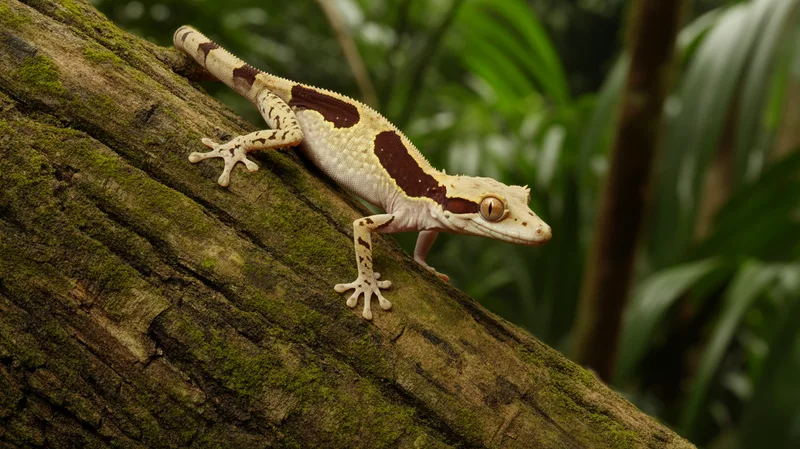
Masquerade is camouflage's theatrical cousin: instead of blending into the background, the animal impersonates a specific, boring object that no predator would bother eating — a twig, a stone, a dead leaf. Few creatures do this better than the Uroplatus leaf-tailed gecko of Madagascar. Its mottled brown, gray, and green skin mimics dead leaves and bark, while a broad, fringed tail and skin flaps along its body erase the shadow line that would otherwise betray it against a tree trunk.
The Thorny Devil Stick Insect takes the same approach in the rainforest undergrowth of Papua New Guinea. Armored with spines and tubercles, it looks like a piece of thorny vegetation — a disguise that both hides it from hungry eyes and makes it deeply unappealing to anything that does notice.
4. Mimicry: Borrowing Someone Else's Identity
Where masquerade copies objects, mimicry copies other living things — often something dangerous or distasteful. The Mantisfly is a small predatory insect that has evolved the raptorial, prey-grabbing forelegs of a praying mantis combined with the delicate wings of a lacewing. By borrowing the look of more formidable insects, it gains a measure of protection while ambushing its own small prey, blurring the line between camouflage and outright disguise.
5. Active Camouflage: Changing on Demand
The most sophisticated hiders do not wait for the seasons — they transform in real time. Cephalopods are the undisputed champions, and the Coconut octopus shows why. Its mottled brown-and-white body lets it blend instantly into sandy and muddy sea floors, and when even that is not enough, it does something almost unique in the animal world: it carries coconut and clam shells across the seabed and assembles them into a portable hideout. It is camouflage and tool use rolled into one — a level of behavioral cunning that continues to astonish marine biologists.
6. Hiding With Light: Counter-Illumination
In the open ocean there is nowhere to hide — except, paradoxically, by glowing. Looking up from below, a predator sees prey as a dark silhouette against the faint light filtering down from the surface. The Firefly Squid of Japan's Toyama Bay erases that silhouette by producing its own blue light from thousands of tiny organs called photophores, matching the brightness of the water above so its body seems to vanish. This remarkable strategy — known as counter-illumination — turns the squid's famous bioluminescent glow into one of the sea's most elegant cloaking devices.
When Camouflage Starts to Fail
Camouflage is finely tuned to a particular environment — and that makes it fragile in a rapidly changing world. As snow seasons grow shorter and less predictable, animals that rely on white winter coats face a dangerous mismatch: a brilliant-white Arctic Fox or Snowy Owl standing out against bare brown ground is suddenly an easy target rather than a hidden one. Habitat loss compounds the problem, stripping away the specific backdrops that disruptive patterns and masquerade evolved to exploit. Protecting camouflaged species therefore means protecting the very landscapes their disguises were built for.
See It For Yourself
- Look for edges, not animals. Disruptive patterns hide shape — scan for the wrong texture or a misplaced shadow instead of an obvious silhouette.
- Watch for movement. Almost no camouflage survives motion; a still "leaf" that suddenly shifts is often a masquerading insect or gecko.
- Consider the predator's view. Counter-illumination only makes sense when you imagine looking up from the deep — camouflage is always relative to who is watching.
From the tundra to the deep sea, camouflage is one of evolution's most creative answers to a single, universal problem: how to survive when everything around you is hungry. Explore more of these hidden masters across the Creature Atlas encyclopedia — and next time you walk through a forest or peer into a tide pool, remember that the most fascinating animals are often the ones you never see at all.