
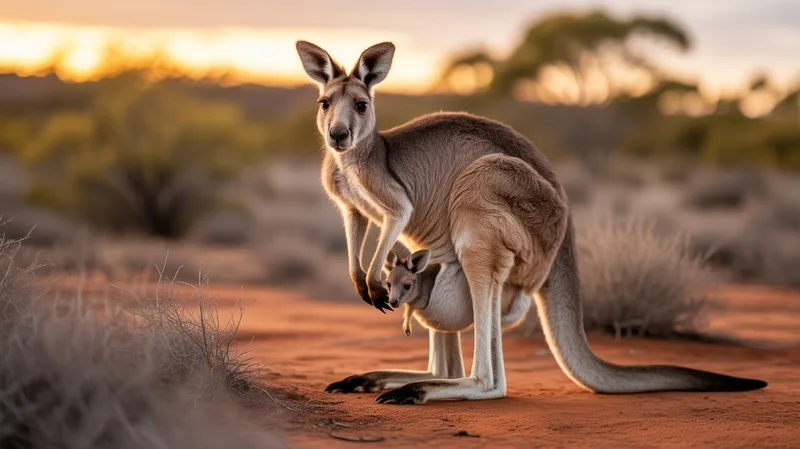
Most mammals carry their young inside the womb for months before birth. Marsupials do something altogether stranger and more wonderful: their babies are born tiny, blind, and barely formed, then crawl to a pouch where they finish growing in safety. It's one of the most distinctive reproductive strategies in the animal kingdom — and it has produced some of the most unforgettable creatures on Earth.
What Makes a Marsupial?
The defining feature is that pouch, known as a marsupium. A marsupial newborn is astonishingly undeveloped — often no bigger than a jellybean — and completes its development latched to a teat inside the pouch rather than in the womb. This early birth means marsupial mothers invest less up front and more during the long pouch-rearing stage, a completely different parenting strategy from placental mammals.
A Family Like No Other
- The kangaroo is the marsupial icon, bounding across the outback on powerful hind legs — an energy-efficient gait that lets it cover huge distances — with a joey riding in its pouch.
- The wombat is a stocky, powerful burrower with a backward-facing pouch, so it doesn't fill with soil as the animal digs; it even produces famously cube-shaped droppings.
- The koala survives on a diet of toxic eucalyptus leaves that few other animals can stomach, sleeping up to 20 hours a day to conserve energy.
- The Tasmanian devil, a feisty carnivorous marsupial, has one of the most powerful bites for its size of any mammal.
Evolution's Parallel Universe
Because marsupials evolved largely in isolation on Australia and South America, they offer a stunning natural experiment. Again and again, they evolved to fill the same roles as placental mammals elsewhere — gliders that mirror flying squirrels, marsupial "moles," and once even a marsupial "wolf," the thylacine. This convergent evolution shows how similar pressures can sculpt similar animals from entirely separate branches of the family tree.
Living Treasures Worth Protecting
That same isolation makes marsupials especially vulnerable. Many are found nowhere else on Earth, and they face habitat loss, introduced predators like foxes and cats, road deaths, and devastating bushfires. The thylacine was hunted to extinction within living memory — a stark warning. Conserving marsupials means safeguarding a unique branch of mammal evolution that has no backup anywhere on the planet.
Pressing Pause on Pregnancy
Marsupials have a reproductive trick that borders on science fiction. A female kangaroo can hold a fertilised embryo in a state of suspended development — embryonic diapause — keeping it in reserve until conditions improve.
That means a mother can have a joey at heel, another growing in the pouch, and a paused embryo waiting its turn: three offspring at three different stages at once.
She can even produce two different kinds of milk from different teats simultaneously, each tailored to the age of the young drinking it. In Australia's unpredictable droughts, that flexibility is a powerful survival strategy.
The Marsupials You've Never Heard Of
Beyond the famous few lies a huge cast of lesser-known marsupials. The quokka, with its permanent grin, has become an internet star, while the bilby is a delicate, long-eared burrower that serves as Australia's answer to the Easter bunny.
The numbat is a striped termite specialist that hunts by day, and the sugar glider soars between trees on flaps of skin, while quolls and bandicoots fill the roles of small predators and diggers.
Many are in serious trouble. The Tasmanian devil has been ravaged by a contagious facial tumour disease — one of only a handful of transmissible cancers known anywhere in nature.
Marsupials Beyond Australia
Despite the association with Australia, marsupials are not exclusively Australian. The Americas are home to around a hundred species of opossum, including the Virginia opossum, the only marsupial found in the United States and Canada.
The opossum's famous habit of "playing possum" is not clever acting but an involuntary shock response, in which the animal collapses, stiffens, and even produces a foul smell.
The reason for this split geography lies deep in the past: marsupials likely originated in the Americas and spread to Australia across Antarctica, back when all three were joined in the supercontinent Gondwana.
The Thylacine: A Warning from History
The Tasmanian tiger, or thylacine, was a striped, wolf-like marsupial predator — and one of the starkest cautionary tales in modern conservation.
Branded a sheep-killer, it was hunted under a government bounty until the wild population collapsed. The last known individual died in a Hobart zoo in 1936, just weeks after the species was belatedly granted legal protection.
Its loss still haunts Australia, and it has become the poster animal for "de-extinction" projects that hope to resurrect it from preserved DNA. Whether or not that ever works, the thylacine is a permanent reminder of how quickly a unique lineage can be erased.
Living with Fire and Drought
Australia swings between drought and flood, and marsupials have evolved for the boom-and-bust. Embryonic diapause lets kangaroos pause reproduction in hard years and surge in good ones.
Digging marsupials such as bilbies and bettongs are ecological engineers, turning over tonnes of soil a year. That churning traps water and seeds, spreads fungi, and helps the bush regenerate after fire.
But the modern pressures are severe. The catastrophic 2019–20 bushfires killed or displaced billions of animals, and introduced foxes and cats have driven many small marsupials to extinction — losses that fire-adapted species were never built to absorb.
Marsupial Milk: A Recipe That Changes
Marsupial milk is one of the most sophisticated substances in mammal biology. Because the newborn is so undeveloped, the mother's milk must do the work that a placenta does in other mammals — and it changes composition dramatically as the young grows.
Early milk is thin, watery, and rich in carbohydrates; later milk becomes far fattier and packed with protein to fuel a rapidly growing joey. A kangaroo can even produce two recipes at once, from different teats, for young of different ages.
The milk also carries powerful antimicrobial compounds that protect a pouch-young with barely any immune system of its own — compounds now being investigated as possible sources of new antibiotics.
Frequently Asked Questions
Are all marsupials found in Australia? No — most live in Australia and New Guinea, but the opossums of the Americas are marsupials too.
Why are marsupials born so early? They complete their development in the pouch rather than the womb, a different but successful strategy.
Is a koala a bear? No — despite the nickname "koala bear," it's a marsupial, not a bear.
Marsupials are a vivid reminder of just how creative evolution can be. Meet more of these pouched wonders in the Creature Atlas encyclopedia.