
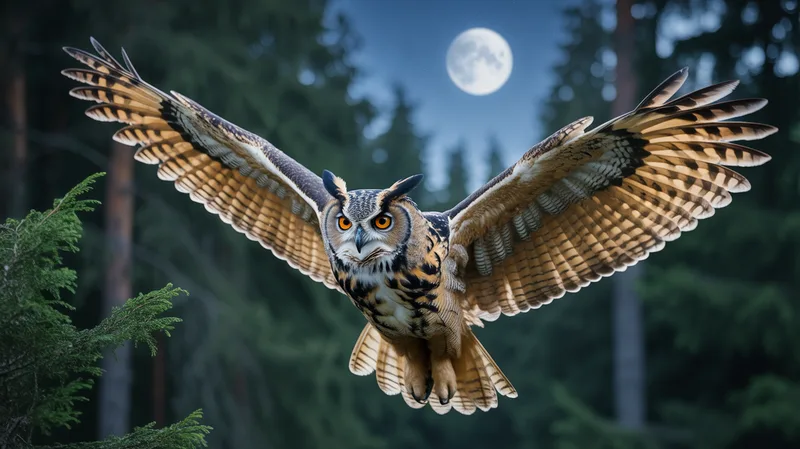
When the sun goes down and most birds fall silent, the owls take over. These nocturnal raptors are equipped with a suite of adaptations so refined that they can locate and catch prey in near-total darkness — and strike without making a sound. They are, quite simply, among the most perfectly engineered hunters on Earth.
Eyes Built for the Dark
An owl's enormous, forward-facing eyes gather what little light remains at night, granting excellent night vision and sharp depth perception for judging a strike. Those eyes are so large they can't move in their sockets — which is why owls evolved to rotate their heads up to about 270 degrees, with extra neck bones and special blood vessels that prevent the blood supply from being cut off as they swivel.
Hearing That Maps the World
An owl's true superpower is its hearing. In many species the ears are set at slightly different heights on the skull, so a sound reaches one ear a fraction before the other. The owl's brain reads that tiny difference to pinpoint prey in three dimensions — meaning a hunting eagle-owl or barn owl can locate a mouse rustling beneath snow or leaves by sound alone. The flat, dish-shaped face acts like a satellite antenna, funnelling the faintest noise toward those ears.
The Gift of Silent Flight
Then there is the flight. The wing feathers of an owl such as the snowy owl have soft, comb-like serrations on their leading edge and a velvety surface that break up and absorb the rush of air. The result is near-silent flight: to its prey, an attacking owl is effectively invisible to the ears, robbing them of the last warning that might have saved them. Engineers now study owl wings to design quieter aircraft and wind turbines.
Owl Facts That Surprise
- Owls swallow prey whole and later cough up "pellets" of indigestible bones and fur.
- Not all owls are nocturnal — some hunt at dawn, dusk, or even in daylight.
- Their camouflaged plumage lets them roost in plain sight, nearly invisible against bark.
- An owl's "ear tufts" aren't ears at all — they're feathers used for display and camouflage.
The Weapons: Talons and Beak
An owl's silent approach ends with a precise, brutal strike. Its feet carry four powerful talons, and one toe can swivel backwards, letting the owl clamp down in a pincer-like grip that few animals escape.
The grip of a large owl is formidable enough to kill prey on impact, and the hooked beak makes short work of anything too big to swallow whole.
Smaller prey goes down entire, and the owl later coughs up a neat pellet of indigestible bones and fur. Scientists prize these pellets: dissecting one reveals exactly what an owl has been eating.
Owls Around the World
There are well over 200 owl species, and they are far more varied than the classic image suggests. They range from the tiny elf owl, small enough to perch in a palm, to giants like the Eurasian eagle-owl and Blakiston's fish owl.
They have colonised nearly every habitat on Earth, from Arctic tundra to desert. The burrowing owl nests underground in abandoned rodent holes and often hunts by day, while the snowy owl thrives on open Arctic wastes.
Not all of them fit the nocturnal stereotype, either — many hunt at dawn and dusk, and a number are fully active in broad daylight.
Owls, Myth, and Modern Threats
Few birds carry as much cultural baggage. In ancient Greece the owl was the companion of Athena and a symbol of wisdom; in other traditions it has long been feared as an omen of death.
The dangers owls face today are far more prosaic. They are struck by cars while hunting roadside verges, poisoned indirectly when they eat rodents that have swallowed rat bait, and squeezed by the loss of the old, hollow trees they nest in.
Simple actions help enormously. Avoiding rodenticides, leaving dead trees standing, and putting up nest boxes have all brought owls back to places from which they had vanished.
How Owls Raise Their Young
Most owls are not builders. They nest in tree cavities, cliff ledges, barns, or the abandoned nests of other birds, laying their eggs directly onto whatever surface they find.
Their eggs hatch asynchronously — a few days apart — so the brood contains chicks of noticeably different sizes. It sounds cruel, but in a lean year it means the oldest, strongest chick survives rather than the whole brood starving together.
Owlets leave the nest before they can properly fly, clambering out onto nearby branches in a stage known as "branching". Their parents keep feeding them there for weeks while they learn to hunt for themselves.
Owl Pellets and Free Pest Control
The pellets an owl coughs up are more than a curiosity — they are a scientific goldmine. Because bones survive intact, dissecting a pellet reveals exactly which species an owl has eaten, and how many.
Ecologists use pellets to track rodent populations and monitor the health of whole habitats, and schoolchildren the world over have reconstructed tiny skeletons from them.
That diet also makes owls extraordinarily valuable neighbours. A single family of barn owls can consume thousands of rodents in a year, and many farmers now put up nest boxes precisely to get that free, chemical-free pest control.
What an Owl Can't Do
For all their gifts, owls have real limitations, and they are revealing. Their retinas are dominated by rod cells, superb in low light but poor at distinguishing colour, so an owl's night-time world is largely a landscape of contrast rather than hue.
They are also strikingly far-sighted. An owl cannot focus clearly on anything within a few centimetres of its face, which means the moment it seizes prey, it effectively cannot see it.
The solution is touch. Bristle-like feathers around the beak and feet, called filoplumes, act as whiskers, letting the owl feel what its talons have caught — a reminder that even the most refined hunter relies on more than one sense.
Frequently Asked Questions
Can owls really turn their heads all the way around? Not a full circle, but up to about 270 degrees, thanks to extra neck vertebrae.
How do owls fly so silently? Specialised feather edges break up and muffle the sound of air over their wings.
Are owls related to other birds of prey? They're raptors, but only distantly related to hawks and eagles; their similarities come from convergent evolution.
Owls reveal a world perfectly tuned to the dark. Explore these silent hunters in the Creature Atlas encyclopedia.