
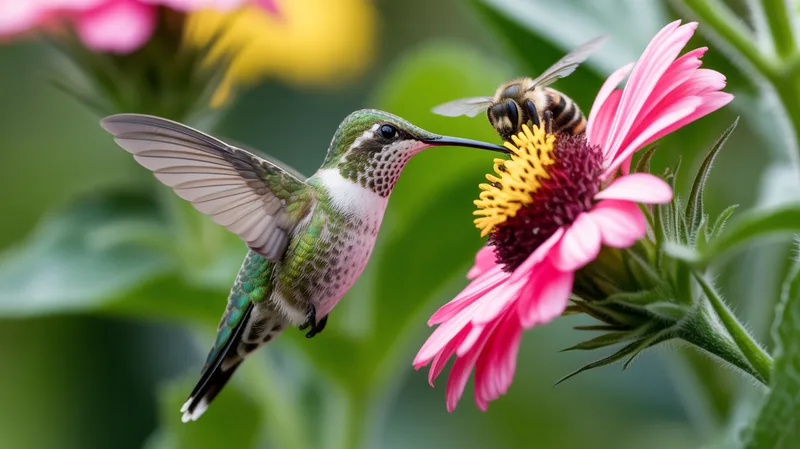
Look at your next meal. The apple, the coffee, the chocolate, the almonds — a remarkable share of it exists only because a small animal carried pollen from one flower to another. Pollinators are among the hardest-working and most undervalued creatures on Earth, and the science is now unambiguous: many of them are in steep decline. Their fate is quietly becoming one of the most consequential conservation stories of our time.
Just How Much Do We Owe Them?
The numbers are staggering. According to the landmark global assessment by IPBES — the UN-backed science panel on biodiversity, drawing on more than 3,000 studies — about 75% of the world's leading food crops depend at least in part on animal pollination, and pollinators directly underpin between US$235 billion and US$577 billion of global food production every year (IPBES, 2016). A useful nuance: while three-quarters of crop types benefit, only around 35% of global crop production by volume depends on pollinators, because staples like wheat and rice are wind-pollinated (Our World in Data). Either way, the diversity and nutrition of our diets leans heavily on them.
The Unsung Workforce of Nature
Bees rightly take centre stage, but the pollinator workforce is wonderfully varied. The hummingbird transfers pollen as it hovers to sip nectar; butterflies and moths carry it between blooms; beetles and flies do unglamorous but vital work; and in many tropical regions bats pollinate night-blooming plants, including those behind agave and many wild fruits. Together this army of animals sustains both wild ecosystems and human agriculture.
How Pollination Actually Works
Most flowering plants can't move, so they strike a bargain: they offer nectar and pollen as food, and in return their visitors ferry pollen between flowers, fertilising them so they can set seed and fruit. This partnership has been refined over roughly 100 million years of co-evolution, which is why flower shapes, colours, scents, and even ultraviolet patterns are so often precisely tuned to attract a particular kind of pollinator.
A Crisis in the Making
The IPBES assessment delivered a stark warning: more than 40% of invertebrate pollinator species — particularly bees and butterflies — face extinction, alongside about 16.5% of vertebrate pollinators such as some birds and bats (World Economic Forum). The causes stack on top of one another:
- Habitat loss — wildflower meadows and hedgerows replaced by monocultures and concrete.
- Pesticides — chemicals that can kill pollinators outright or impair their ability to navigate, forage, and reproduce.
- Disease and parasites — spread between managed and wild populations.
- Climate change — shifting the timing of flowering so plants and pollinators fall out of sync.
It Is Not Just About Honeybees
Almost every campaign to "save the bees" pictures a honeybee. It is the wrong poster child, and the confusion is doing real damage.
The western honeybee is a managed, farmed animal — livestock, essentially, kept in hives and moved around by people. It is not endangered. Meanwhile the pollinators that genuinely are in trouble are wild: bumblebees, solitary mining bees, hoverflies, moths, beetles, and in the tropics bats and birds. There are around 20,000 bee species in the world, and the vast majority are solitary, live in the ground, and never make a drop of honey.
They also do the harder work. Many crops are pollinated far more efficiently by wild insects than by honeybees, and some — tomatoes among them — need the buzz pollination that only certain wild bees perform. Fields with diverse wild pollinators consistently produce better yields than fields relying on hives alone.
There is even a sting in the tail: cramming more honeybee hives into a landscape can crowd out wild bees, competing with them for a limited supply of flowers and spreading disease. Keeping bees is a hobby, not a conservation act. What actually helps wild pollinators is unglamorous — more flowers, for longer in the year, fewer pesticides, and messier ground for them to nest in.
Why It Matters — and What Actually Helps
Fewer pollinators means fewer seeds and fruits, which ripples outward into less food for wildlife and people, and weaker, less resilient ecosystems. The encouraging news is that pollinators respond quickly to help. Planting native flowering species, avoiding pesticides, leaving patches of "messy" wild growth, and protecting natural corridors can rebuild populations remarkably fast — making this one of the rare global problems where individual action genuinely moves the needle.
Key Takeaways
- ~75% of leading food crops, and up to $577 billion in annual production, depend on pollinators.
- The workforce includes bees, hummingbirds, butterflies, moths, beetles, and bats.
- Over 40% of invertebrate pollinators and ~16.5% of vertebrate pollinators face extinction (IPBES).
- Native plants, fewer chemicals, and wild corridors help pollinators bounce back fast.
Frequently Asked Questions
Do only bees pollinate crops? No — birds, butterflies, moths, beetles, flies, and bats are important pollinators too.
How much of our food depends on pollinators? About 75% of crop types and roughly 35% of global crop production by volume.
How threatened are pollinators? IPBES estimates over 40% of invertebrate pollinator species face extinction.
What can I do to help? Plant native flowers, skip pesticides, and leave some wild, flowering growth.
Protecting the smallest animals turns out to be one of the biggest things we can do for the planet — and our own food supply. Meet more of these vital creatures in the Creature Atlas encyclopedia.
How much of our food depends on pollinators? Roughly three-quarters of leading food crops benefit from animal pollination.
Are honeybees endangered? No. They are managed livestock. It is wild pollinators that are declining.
Does keeping bees help conservation? Not really — and adding hives can compete with the wild bees that actually need help.
What is buzz pollination? Some bees vibrate flowers to shake pollen loose. Honeybees cannot do it; tomatoes depend on it.
What actually helps pollinators? Flowers across the whole season, fewer pesticides, and undisturbed ground for nesting.