
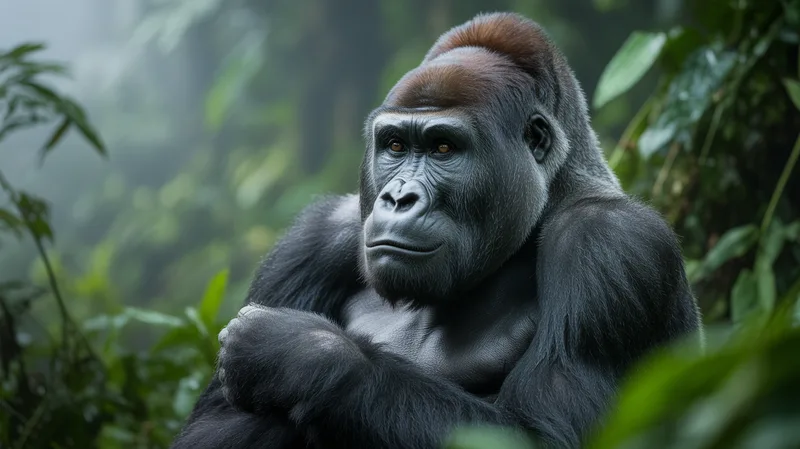
Look into the eyes of a great ape and you'll catch a flicker of something familiar. Primates — the group that includes monkeys, apes, lemurs, and us — are among the most intelligent and socially complex animals on Earth. Studying them is, in a very real sense, studying ourselves: our origins, our minds, and the roots of culture.
What Makes a Primate?
Primates share a distinctive toolkit: grasping hands (and often feet) with sensitive fingertips, forward-facing eyes for excellent depth perception, and unusually large, complex brains relative to body size. These traits trace back to ancestors that lived in the trees, where gripping branches and judging distances between them were matters of life and death. The result is a group built for dexterity, vision, and intelligence.
Minds and Societies
Primates are famous for their brainpower. The gorilla lives in tight-knit family groups led by a dominant silverback, communicating through an expressive vocabulary of gestures, expressions, and sounds. The chimpanzee, one of our closest living relatives, makes and uses tools, hunts cooperatively, forms shifting political alliances, and even wages something like warfare. Across the primate world, animals solve problems, recognise themselves, and pass learned behaviours down the generations — the very building blocks of culture.
A Family of Astonishing Variety
- Great apes — gorillas, chimpanzees, bonobos, and the orange-haired orangutan, the largest tree-dwelling animal on Earth.
- Monkeys — from agile, tool-using capuchins to the high-altitude specialists of Asia and Africa.
- Prosimians — the older branch, including the wide-eyed lemurs of Madagascar, found nowhere else on the planet.
Why Primates Matter
Beyond their kinship to us, primates are vital to their ecosystems — especially as seed dispersers that help regenerate the tropical forests they call home. Lose the primates, and the forests themselves begin to change. They are also irreplaceable windows into the evolution of intelligence, cooperation, and communication.
An Ancient Family in Danger
Tragically, a large share of primate species are now threatened, driven toward the edge by deforestation, hunting, and the pet trade. Many of the most remarkable — great apes and lemurs especially — are among the most endangered mammals alive. Protecting them isn't just about saving charismatic animals; it's about preserving our own evolutionary story, written in the lives of our closest relatives.
The Language of Primates
Primates rely on rich, layered communication. Vervet monkeys are famous for giving different alarm calls for different predators — one for an eagle, another for a leopard, another for a snake — and their companions respond appropriately to each.
That is remarkably close to sounds carrying specific meanings, and it upended old assumptions about how sophisticated animal signalling could be.
Grooming matters just as much as sound. Beyond hygiene, the hours spent picking through a companion's fur build and maintain the alliances that determine status, safety, and access to food.
Tools and Culture
Primates do not merely use tools — different groups use different tools, and pass the knowledge on. Chimpanzees in one forest strip leaves from twigs to fish termites from mounds; those in another crack nuts using carefully chosen stone hammers and anvils.
Neighbouring groups of the same species can have completely different toolkits, learned from their elders rather than written into their genes.
This is culture in the truest sense — traditions invented, taught, and inherited — and it makes primates the clearest window we have into how human culture may have begun.
Where Primates Live
Almost all primates are creatures of warm forest, concentrated in the tropics of Africa, Asia, and Central and South America, plus the island of Madagascar, whose lemurs are found nowhere else on Earth.
A few remarkable exceptions push far beyond the tropics. The Japanese macaque — the famous "snow monkey" — endures freezing winters and bathes in volcanic hot springs, while the Barbary macaque clings on in North Africa and Gibraltar.
Because so many primates depend on intact forest, the fate of the world's rainforests and the fate of our closest relatives are effectively the same question.
The Long Primate Childhood
Primates take a strikingly long time to grow up, and that is no accident. Big, flexible brains are not much use without the years of learning needed to fill them.
A young orangutan may stay with its mother for seven or eight years, learning which of hundreds of forest foods are safe and how to build a fresh sleeping nest each night. Chimpanzees take years to master termite-fishing or nut-cracking.
This extended dependence is expensive — mothers can raise only a handful of offspring in a lifetime — but it is exactly what makes culture possible, because it creates the time for one generation to teach the next.
Conservation: What Actually Works
The picture is not hopeless, and one case proves it. Mountain gorillas were once written off as doomed; today, after decades of intensive protection, their numbers have climbed back above a thousand, and they were downgraded from "critically endangered" to "endangered".
What worked was a combination: relentless anti-poaching patrols, veterinary care, and — crucially — ecotourism that gave local communities a direct financial stake in keeping gorillas alive.
That is the pattern that succeeds elsewhere too. Protected habitat, corridors linking fragmented forests, and conservation that pays the people who live alongside primates are worth more than any amount of distant goodwill.
Do Primates Have Emotions?
Anyone who has watched primates for long comes away convinced they feel deeply, and the science increasingly agrees. Chimpanzees reconcile after fights, embracing and grooming former opponents, and bystanders will move in to console the loser.
They appear to grieve, too. Mothers have been seen carrying dead infants for days, and groups fall silent and subdued around a dead companion.
Apes even laugh — a breathy, panting chuckle during play and tickling that is thought to share an evolutionary root with human laughter. The emotional gulf between us and our closest relatives is far narrower than we once liked to believe.
Frequently Asked Questions
What is the difference between a monkey and an ape? Apes (like gorillas and chimps) have no tails and larger brains; most monkeys have tails.
Are humans primates? Yes — humans are part of the primate family, most closely related to chimpanzees and bonobos.
Why are so many primates endangered? Mainly habitat loss from deforestation, plus hunting and the illegal pet trade.
To know primates is, in a sense, to know ourselves. Meet the family in the Creature Atlas encyclopedia.