
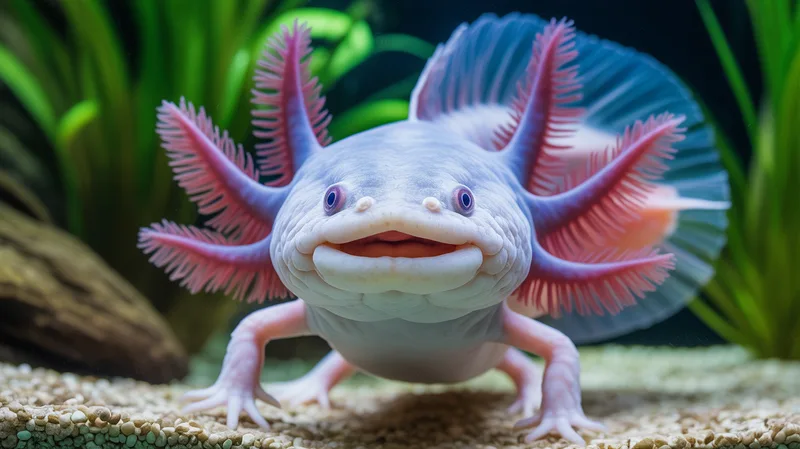
With its feathery gills, upturned mouth, and permanent smile, the axolotl looks like a creature invented for a cartoon. But this Mexican salamander hides one of the most astonishing abilities in the animal kingdom: it can regrow entire body parts, perfectly, again and again. Scientists believe understanding how could transform human medicine, even as the axolotl teeters on the edge of extinction in the wild.
The Animal That Never Grows Up
The axolotl is famous for neoteny: unlike most amphibians, it never undergoes metamorphosis. It keeps its larval, aquatic form, gills and all, for its entire life, reaching adulthood and breeding while still looking like a giant tadpole (Natural History Museum). Staying young is closely tied to its regenerative gifts.
Regrowing Limbs — and So Much More
If an axolotl loses a leg, it grows a new one, complete with bone, muscle, nerves, blood vessels, and skin, in the right shape and orientation. And limbs are only the start: axolotls can regenerate parts of the heart, the spinal cord, and even portions of the brain, often without scarring. Recent research, including a 2025 study in Nature Communications, has begun to reveal how the animal knows exactly which structures to rebuild and where (National Geographic).
Why It Could Change Medicine
Humans heal wounds with scar tissue; we cannot regrow a finger, let alone a heart wall. By decoding how axolotls reactivate growth programs at an injury site, researchers hope to unlock new approaches to healing, from repairing damaged organs to regrowing nerves. The axolotl has become one of the most important animals in regenerative-medicine laboratories worldwide.
A Wonder on the Brink
The cruel irony is that this near-magical animal is critically endangered in the wild. Native only to the lake system around Mexico City, wild axolotls have been devastated by urban expansion, pollution, and invasive fish such as tilapia and carp; some estimates put the remaining wild population at just 50 to 1,000 adults (Natural History Museum). Millions live in labs and aquariums, but the wild population that holds the species' natural diversity is vanishing.
How Regeneration Actually Works
When an axolotl loses a limb, the wound does not simply scar over. Instead, cells at the stump shed their specialised identity and gather into a mass called a blastema — essentially a fresh construction site.
Within that blastema, cells appear to "know" where they sit on the body and what is missing, rebuilding precisely the parts that were lost and nothing more. Amputate at the wrist and it grows a hand; amputate at the shoulder and it grows the entire arm.
Understanding this positional memory is one of the central puzzles of regenerative biology — and the reason axolotls occupy so many laboratory tanks around the world.
Why Can't We Do This?
Humans and axolotls share most of the same genes; the difference lies in how we respond to injury. Our bodies prioritise sealing a wound fast, and the inflammation and scar tissue that achieve this actively block regeneration.
The axolotl's immune response is different, damping down the scarring reflex long enough for a blastema to form. Intriguingly, human embryos and very young children can heal some wounds without scarring, hinting that the ability is not entirely lost — merely switched off.
Researchers are now probing whether those growth programs might be reawakened in us, which could transform the treatment of spinal injuries, heart damage, and lost limbs.
Remarkably Resistant to Cancer
Rapid, repeated cell growth ought to be a recipe for cancer, yet axolotls develop tumours far less often than mammals do — by some measures dramatically so.
Even when tumours are experimentally induced, the axolotl's tissues have been observed to bring the runaway growth back under control rather than letting it spread.
That combination — grow aggressively, but never lose control — is exactly what medicine wants to understand, which is why the axolotl now interests cancer researchers as much as regenerative ones.
The Rest of the Family
The axolotl is the star, but it is not alone. Salamanders as a group are the champions of vertebrate regeneration, and newts can regrow limbs, tails, jaws, and even parts of the eye.
What sets the axolotl apart is the sheer scale and reliability of the feat, and the fact that it stays permanently in its larval form — which appears to keep its regenerative machinery switched on for life.
Comparing axolotls with newts, frogs, and mammals is one of the most productive strategies in the field, because the differences between them help pinpoint exactly which genetic switches matter.
Kept by Millions, Vanishing in the Wild
The axolotl's situation is one of the strangest in conservation. Millions live in laboratories, aquarium shops, and living rooms around the world, while the wild population teeters on the edge of extinction.
Those captive animals are not a safety net. Most descend from a small number of lineages bred for generations, so they carry only a sliver of the species' natural genetic diversity — and many are hybridised with other salamanders.
Saving the axolotl therefore means saving its home: the canals and wetlands of Xochimilco. Restoration projects are now creating refuges free of invasive fish, working with local farmers to bring back water clean enough for a wild axolotl to live in.
Key Takeaways
- Axolotls stay in their larval form for life (neoteny) and breed without metamorphosing.
- They regrow limbs, heart tissue, spinal cord, and parts of the brain, often scar-free.
- Their biology is a leading model for human regenerative medicine.
- They are critically endangered in the wild, with perhaps only 50 to 1,000 adults left.
Frequently Asked Questions
Can axolotls really regrow limbs? Yes, fully, including bone, muscle, nerves, and skin, multiple times.
Why don't humans regenerate like that? We heal with scar tissue instead of reactivating the growth programs axolotls use; understanding the difference is an active research field.
Are axolotls endangered? Critically endangered in the wild, though abundant in captivity.
The axolotl is living proof that nature has already solved problems we are only beginning to understand. Meet more remarkable amphibians in the Creature Atlas encyclopedia.