
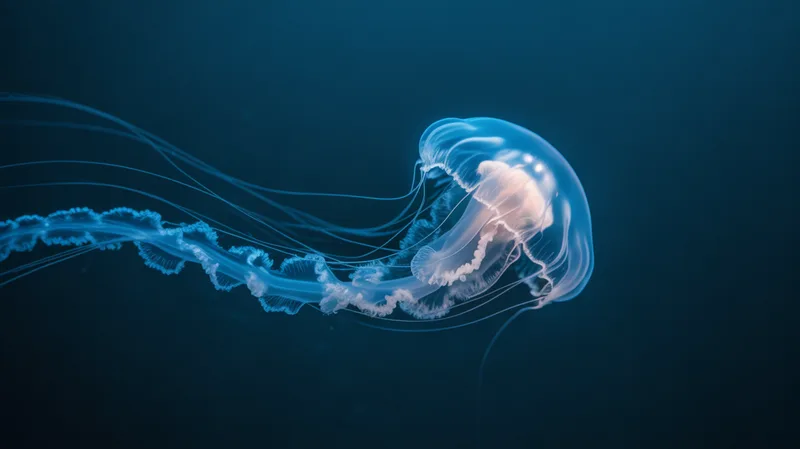
Somewhere in the world's oceans drifts an animal that, in principle, never has to die of old age. It is not a whale or a giant tortoise but a jellyfish barely the size of a fingernail. Known as Turritopsis dohrnii — the "immortal jellyfish" — it has evolved a trick that sounds like science fiction: when faced with death, it can rewind its own life cycle and start again.
Meet Turritopsis dohrnii
At first glance, the immortal jellyfish is unremarkable. It measures only about 4.5 millimetres across, is transparent, and trails fine tentacles as it pulses through warm and temperate seas around the globe. Like other jellyfish, it has a life cycle that runs from a larva to a bottom-dwelling polyp, and finally to the familiar swimming bell, the medusa. For most jellyfish, that journey is a one-way street that ends in death. For this species, it is a loop.
The Biological Rewind Button
When an adult Turritopsis dohrnii is injured, starved, or otherwise stressed, it does something almost no other animal can: instead of dying, it sinks to the seafloor and transforms back into a polyp — an earlier stage of its own life (American Museum of Natural History). It is, as biologists like to put it, the equivalent of a butterfly turning back into a caterpillar. From that rejuvenated polyp, brand-new, genetically identical medusae bud off, and the cycle begins again.
The Secret: Transdifferentiation
The mechanism behind this is a remarkable cellular process called transdifferentiation, in which fully mature, specialised cells switch directly into entirely different cell types. Most animal cells, once committed to being muscle or nerve or skin, stay that way. The immortal jellyfish can reprogram them on the fly, effectively rebuilding a young animal from the cells of an old one. In theory this can repeat indefinitely, which is why the species is described as biologically immortal.
"Immortal" Comes With an Asterisk
It is important to be precise: biologically immortal does not mean unkillable. In the wild these jellyfish are still eaten by predators, struck down by disease, or killed by environmental stress before they ever get the chance to reset (Natural History Museum). What makes them extraordinary is that they have no fixed expiry date — they can, in principle, escape death by old age, the one fate almost every other animal cannot avoid.
Why Scientists Are Fascinated
The immortal jellyfish has become a star of aging and regeneration research. Transdifferentiation closely echoes the behaviour of human stem cells, and understanding how this tiny cnidarian reprograms its cells without forming cancers could offer clues for regenerative medicine and the biology of aging. An animal we might once have dismissed as a speck of jelly may help us understand one of humanity's oldest questions: why we grow old at all.
Key Takeaways
- Turritopsis dohrnii is a tiny jellyfish (~4.5 mm) found in oceans worldwide.
- When stressed, it reverts from an adult medusa back into a juvenile polyp.
- This works through transdifferentiation, where mature cells switch into other cell types.
- It is biologically immortal in principle, but can still die from predation or disease.
- Its biology is a valuable model for stem-cell, regeneration, and aging research.
Why It Hasn't Taken Over the Ocean
If an animal can genuinely reset its own life cycle, the obvious question is why the sea is not wall-to-wall with them. The answer is that immortality is not the same as invulnerability.
Turritopsis dohrnii is a few millimetres across and almost defenceless. It gets eaten by fish, by other jellyfish, and by anything that filters the plankton. It succumbs to disease and to sudden changes in its environment. It only performs its rewind when it is stressed, injured, or starving — and if the damage is severe enough, or the predator quick enough, it simply dies like anything else.
What it has done instead is spread. Genetically near-identical populations now turn up in seas around the world, almost certainly carried in the ballast water of ships. It is one of the quietest invasions in the ocean, accomplished by an animal most people have never seen.
The scientific payoff is not a fountain of youth. When researchers sequenced its genome, they found an unusual set of genes governing DNA repair, telomere maintenance, and the suppression of the "senescent" state that ageing cells fall into. That is a list of the same processes that go wrong in human ageing and in cancer — which makes this jellyfish less a source of eternal life than a very unusual instruction manual.
Frequently Asked Questions
Is the immortal jellyfish really immortal? It can avoid death from old age by resetting its life cycle, but it can still be killed by predators, disease, or injury.
How does it cheat death? Through transdifferentiation — reverting to its polyp stage and growing new adults from the same cells.
Could this help humans live longer? Not directly, but studying it may inform regenerative medicine and aging research.
How big is it? Tiny — only about 4.5 millimetres across.
The immortal jellyfish is a reminder that some of nature's biggest secrets come in the smallest packages. Discover more astonishing ocean life in the Creature Atlas encyclopedia.
Is the immortal jellyfish really immortal? Only in principle. It can reverse its life cycle, but it is easily eaten or killed.
What is transdifferentiation? The process by which an already-specialised cell converts directly into a different cell type.
How big is it? Tiny — roughly 4.5 millimetres across, about the size of a pinky nail.
Where is it found? Originally the Mediterranean, but it has now spread to seas worldwide, likely via ship ballast water.
Could this help humans live forever? No — but the genes involved in its DNA repair and cell renewal are of real interest to ageing research.