
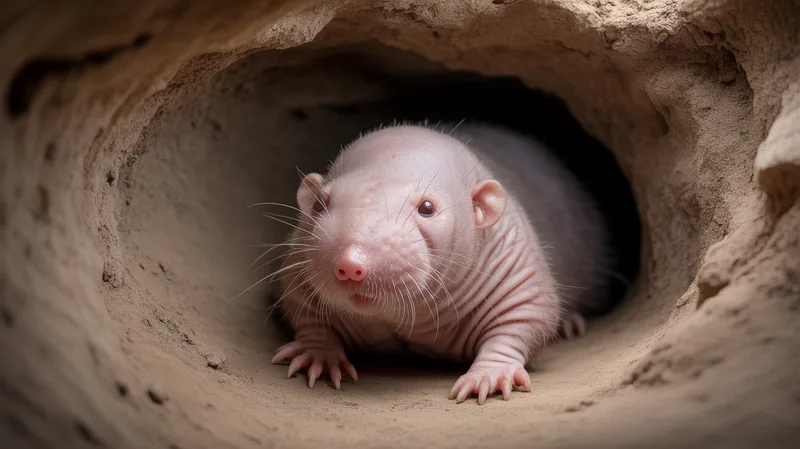
It is wrinkled, nearly blind, almost hairless, and lives in the dark in vast underground colonies. The naked mole-rat will never win a beauty contest — but it might just hold the keys to two of medicine's biggest goals: defeating cancer and slowing ageing. This odd little rodent breaks rules that almost every other mammal obeys, and scientists are paying very close attention.
A Rodent That Lives Like an Insect
Naked mole-rats are eusocial — they live in colonies of dozens to hundreds, ruled by a single breeding queen, with the rest serving as workers and soldiers, much like ants or bees. It is a social structure almost unheard of in mammals. They spend their lives in oxygen-poor tunnels and can even survive long stretches with almost no oxygen by switching their metabolism to run on fructose, like a plant.
Decades Without Ageing
Most rodents live two or three years. The naked mole-rat can live more than 30 years — and some have surpassed 37 — making it by far the longest-lived rodent known. Even more astonishing, it shows what biologists call negligible senescence: unlike almost every other animal, its risk of dying does not noticeably climb as it gets older (Nature, 2013). An old naked mole-rat is, statistically, about as likely to die as a young one — a near-defiance of the normal rules of ageing.
The Cancer Mystery
Then there is cancer. In long-term studies of large colonies, researchers have observed remarkably few cases of cancer in naked mole-rats. The leading explanation is a substance called high-molecular-mass hyaluronan (HMW-HA) — a molecule their cells secrete that is more than five times larger than the version found in humans or mice. This super-sized hyaluronan appears to make their tissues resistant to the runaway cell growth that causes tumours (Nature, 2013).
Borrowing the Secret for Mice — and Maybe Us
The most exciting step came when researchers transferred the naked mole-rat's hyaluronan gene into mice. The engineered mice produced the large hyaluronan, developed fewer tumours, showed less age-related inflammation, and lived longer than normal mice (Nature, 2023). It was a striking proof of principle: a longevity trait from one species could be ported into another. The dream — still distant — is that understanding these mechanisms could one day inform anti-cancer and healthy-ageing therapies for people.
Life Without Pain — and Almost Without Oxygen
Ageing and cancer are only two of the naked mole-rat's impossibilities. It has a third and a fourth, and they are just as strange.
It appears to feel no pain from acid or from capsaicin, the compound that makes chillies burn. This is not stoicism; a mutation in a key sodium channel effectively switches off that pain pathway. In a crowded, poorly ventilated burrow, carbon dioxide builds up and acidifies the tissues, and an animal that felt that as pain would be in constant agony. So it evolved not to.
The oxygen trick is stranger still. Deprived of oxygen entirely, a naked mole-rat can survive for around eighteen minutes — long enough to kill a mouse many times over. It does it by switching its metabolism to run on fructose, a fuel pathway plants use and mammals essentially abandoned.
That single fact is why cardiologists pay attention. A heart attack or a stroke is, at bottom, a piece of tissue starved of oxygen. An animal that can shrug that off for a quarter of an hour is holding a chemical answer to a question that kills millions of people a year.
Why It Matters
The naked mole-rat has quietly become one of the most important animals in biology. It demonstrates that the "rules" of cancer and ageing we once thought universal are not fixed — that evolution has already engineered an animal which sidesteps them. Studying how it does so is one of science's most promising routes into the biology of staying healthy for longer.
Key Takeaways
- Naked mole-rats are eusocial rodents that can live 30+ years — the longest-lived rodent known.
- They show negligible senescence: their death risk barely rises with age.
- They rarely develop cancer, linked to high-molecular-mass hyaluronan in their tissues.
- Adding their hyaluronan gene to mice reduced tumours and extended lifespan.
Frequently Asked Questions
How long do naked mole-rats live? Over 30 years, with some exceeding 37 — extraordinary for a rodent.
Why don't they get cancer? Largely thanks to an unusually large form of hyaluronan that resists tumour growth.
What is negligible senescence? A pattern where the risk of death does not rise with age the way it does in most animals.
Could this help humans? Possibly in the long term — their genes have already extended lifespan in mice in the lab.
The unassuming naked mole-rat may teach us more about living long and well than almost any other animal. Discover more biological marvels in the Creature Atlas encyclopedia.
How long do naked mole-rats live? Over 30 years — extraordinary for a rodent the size of a mouse.
Do naked mole-rats get cancer? Almost never, which is why cancer researchers study them so intensely.
Are they really cold-blooded? Effectively. They barely regulate their own temperature, relying on the stable warmth of the burrow.
Do they have a queen? Yes — a single breeding female suppresses the rest, much like a termite or ant colony.
Why are they hairless? Bare skin suits a warm, humid burrow; sparse hairs act as feelers in the dark instead.
What does "barely ages" actually mean? Their risk of dying does not rise as they get older — which is the technical definition of negligible senescence, and something almost unheard of in mammals.
How do they avoid cancer? Several mechanisms appear to work together, including an unusually large sugar molecule in their tissues that keeps cells from crowding together and dividing out of control.
Has any of this been transferred to other animals? Yes. Researchers have inserted the relevant gene into mice, and those mice showed improved health and lived longer.