
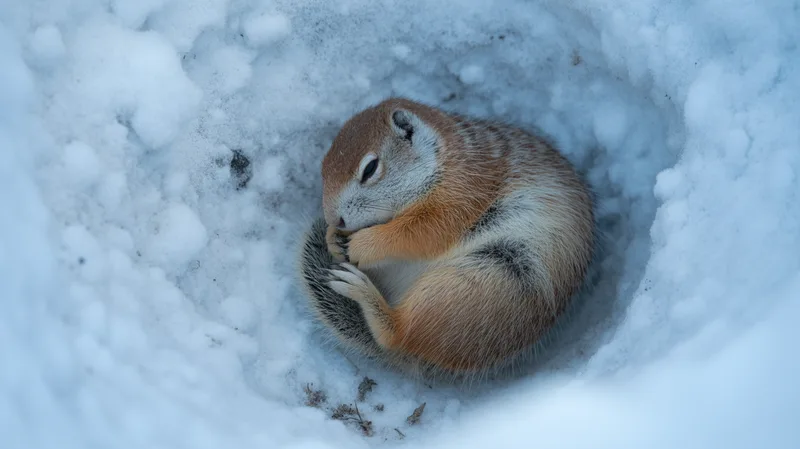
When winter strips the world of food and warmth, some animals do something almost unbelievable: they switch themselves off. We casually call it "hibernation," as though it were just a long winter nap. In reality it is one of the most extreme physiological feats in nature — a controlled, reversible shutdown of the body that pushes some animals right to the edge of death and back. Here is what is really happening inside a hibernating animal.
Hibernation Is Not Just Deep Sleep
True hibernation is a state called torpor, and it is a world away from sleep. During torpor an animal's metabolic rate can crash to just a few percent of normal. The heart slows to a crawl, breathing becomes faint and intermittent, and body temperature plunges toward the temperature of the surroundings. The goal is brutal arithmetic: by spending almost no energy, an animal can ride out months when there is simply nothing to eat. Sleep rests the brain; hibernation nearly stops the whole machine.
The Squirrel That Supercools Its Own Blood
No animal illustrates the extremes better than the Arctic ground squirrel. During hibernation it lets its body temperature fall below the freezing point of water — to around −2.9 °C — yet its tissues do not freeze. It pulls off this trick through supercooling: by purging its body of the tiny particles that ice crystals need to form around, it keeps its fluids liquid below 0 °C. It is the only mammal known to do this, and it makes the Arctic ground squirrel the coldest-bodied mammal ever recorded (University of Alaska Fairbanks).
The Frog That Freezes Solid — and Lives
Some animals go even further and actually freeze. The wood frog spends winter as a "frogsicle": up to two-thirds of the water in its body turns to ice, its heart stops, and its brain activity ceases entirely. The secret is chemistry. As the freeze begins, the frog's liver floods its body with glucose (and urea), which acts as a natural antifreeze, drawing water out of its cells and protecting them from the lethal damage that ice normally causes (EarthDate). When spring arrives, the frog thaws from the inside out, its heart restarts, and it hops away as if nothing happened.
Are Bears Even Really Hibernating?
Curiously, the animal most people picture — the bear — is the subject of a long scientific debate. Bears do enter a winter dormancy and slash their metabolism, but their body temperature drops only modestly, and they can rouse relatively quickly if disturbed (a female even gives birth mid-winter). Some researchers call this "true" hibernation by a different route; others prefer the term denning or simply a deep torpor. Either way, it shows that "hibernation" is not one thing but a spectrum of strategies for surviving scarcity.
Why Hibernation Science Could Save Human Lives
These abilities are not just biological curiosities. Researchers are studying hibernators in the hope of borrowing their tricks: protecting organs for transplant, shielding the brain and heart during strokes and cardiac arrest, and even inducing a safe, low-metabolism state in patients — or one day in astronauts on long space voyages (PBS NewsHour). The animals that master winter may help us master medicine.
Key Takeaways
- Hibernation is torpor — metabolism, heart rate, and body temperature crash to save energy.
- The Arctic ground squirrel supercools its body below freezing without turning to ice.
- The wood frog freezes solid and survives by flooding its cells with glucose antifreeze.
- Bears enter a milder, rousable dormancy — hibernation is a spectrum, not a single state.
- Hibernation research may improve organ preservation and stroke and cardiac care.
The Animals That Do the Opposite
Winter is not the only season worth sleeping through. In much of the world the deadly season is the hot one, and evolution has produced a near-perfect mirror image of hibernation to survive it.
It is called aestivation, and its practitioners are some of the strangest animals alive. When its river dries to dust, the African lungfish burrows into the mud and secretes a cocoon of mucus around itself, leaving only a small tube to breathe through. There it waits — its metabolism collapsed to a fraction of normal, its body slowly consuming its own muscle tissue for fuel — for months, and in some cases for years, until the rains return and it swims out of the earth.
Desert frogs do something similar, sealing themselves underground in a waterproof skin and storing water in their bladder like a canteen. Snails glue themselves to walls behind a plug of dried mucus. The Madagascan fat-tailed dwarf lemur, oddly, hibernates in the tropics — through the dry season, in a tree hole, in warm weather.
The underlying logic is identical to hibernation's. When the environment cannot support the cost of being awake, the cheapest possible strategy is to stop being awake — and to survive by being, for a while, barely alive at all.
Frequently Asked Questions
Is hibernation the same as sleeping? No — it is a far deeper state called torpor, with metabolism and body temperature dropping dramatically.
Can an animal really freeze and come back to life? Yes — the wood frog freezes much of its body solid and thaws back to life in spring.
Do bears truly hibernate? They enter a winter dormancy, but with a smaller temperature drop and the ability to wake quickly, so scientists debate the label.
Why do animals hibernate? To survive long stretches when food is scarce and staying active would burn more energy than they can find.
Hibernation is proof that survival sometimes means doing almost nothing — spectacularly well. Explore more cold-weather survivors in the Creature Atlas encyclopedia.
Is hibernation just deep sleep? No. It is a profound drop in body temperature, heart rate, and metabolism — physiologically nothing like sleep.
Do bears really hibernate? They enter a lighter state called torpor; their temperature falls much less than a true hibernator's.
What is aestivation? The hot-weather equivalent — animals shutting down to survive heat and drought instead of cold.
Can any animal survive being frozen? The wood frog can. Much of its body water freezes solid, and it thaws out alive in spring.
Why does hibernation interest doctors? Because an animal that can drop its metabolism safely may hold clues for trauma care and organ preservation.