
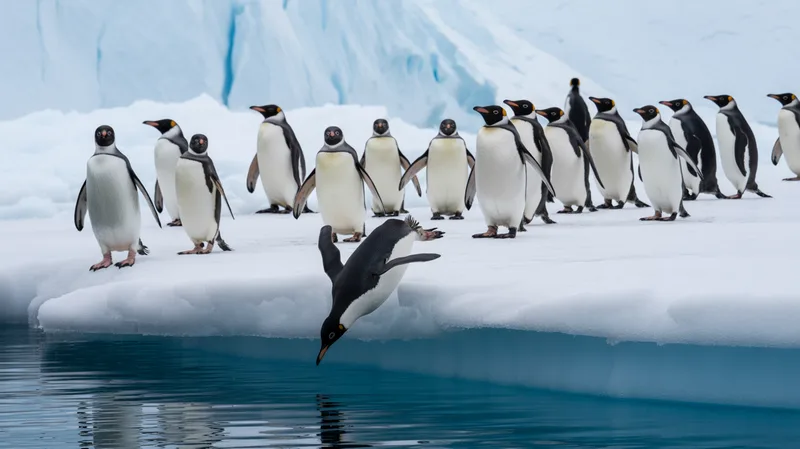
With their upright stance and crisp "tuxedo" plumage, penguins are among the most instantly recognisable — and beloved — animals on the planet. But behind the charming waddle is a bird superbly engineered for a life most creatures could never survive, full of adaptations and behaviours that are far stranger and tougher than their cartoonish reputation suggests.
Birds That Traded the Sky for the Sea
Penguins are birds, but they gave up flight long ago in exchange for mastery of the water. Their wings evolved into stiff, powerful flippers, their bones grew dense to reduce buoyancy, and their bodies streamlined into living torpedoes. The result is breathtaking: the penguin can "fly" underwater with astonishing agility, and the deepest-diving species plunge hundreds of metres and hold their breath for many minutes while hunting.
Built for the Big Freeze
Many penguins endure some of the harshest conditions on Earth. They're insulated by a dense, overlapping coat of feathers and a thick layer of fat, and they conserve heat through clever tricks of circulation that keep their core warm while their feet stay just above freezing. In the most extreme cold, some species famously huddle in tight, rotating crowds — individuals taking turns on the chilly outer edge — to share warmth and survive the wind.
Devoted, Determined Parents
Penguin parenting is the stuff of legend. In many species, parents take turns guarding a single precious egg or chick while the other treks vast distances to feed at sea, then returns to swap duties. Some males endure months of fasting in brutal weather, balancing an egg on their feet beneath a flap of warm skin. It's an extraordinary investment, and it reflects just how hard-won each new generation is.
Surprising Penguin Facts
- Not all penguins live in the cold — some thrive on temperate and even near-tropical coasts.
- They drink seawater, filtering out the salt with a special gland above the eyes.
- Many species recognise their mate or chick by voice alone, even in a colony of thousands.
- Their black-and-white colouring is camouflage — countershading that hides them from predators above and below.
Masters of the Underwater Hunt
Penguins are formidable predators. Most feed on fish, squid, and krill, chasing them down in fast, agile bursts. The emperor penguin can dive beyond 500 metres and stay submerged for over twenty minutes — deeper and longer than any other bird.
Their tongues and the roofs of their mouths are lined with backward-pointing spines that grip slippery prey and funnel it down the throat. Once a penguin has hold of a fish, escape is almost impossible.
Some species hunt cooperatively, herding shoals of fish into tight balls. Their countershaded plumage helps too, hiding them from predators looking down into the gloom and from prey looking up toward the light.
Life in the Colony
Penguins are intensely social, breeding in colonies that can number in the hundreds of thousands. The noise is extraordinary, yet a returning parent can pick out the single voice of its own mate or chick from the din.
Courtship can be elaborate. Adélie penguins famously build nests of pebbles and present them as gifts, and good stones are so valuable that neighbours will steal them from unattended nests.
In many species the chicks gather into "crèches" — nursery groups that huddle together for warmth and safety while both parents are away hunting at sea.
The Threats Penguins Face
Despite living far from most people, penguins sit squarely in the path of human impact. Warming seas and shrinking sea ice are disrupting the krill that many species depend on, and emperor penguins in particular need stable ice on which to raise their chicks.
Industrial fishing competes directly for their food, while oil spills, plastic pollution, and introduced predators threaten colonies on land.
More than half of all penguin species are now considered threatened, making these familiar birds a genuine conservation priority rather than a safe cartoon icon.
How Penguins Move on Land, Ice, and Sea
That famous waddle looks comical, but it is not clumsiness — it is efficiency. Studies of penguin gait have found that rocking from side to side actually conserves energy, recovering momentum with each step in a way that a straight-legged walk never could.
On snow and ice they abandon walking altogether and "toboggan", flopping onto their bellies and pushing themselves along with their feet in a fast, effortless slide.
In the water they are transformed. Many species "porpoise", leaping clear of the surface in arcs as they swim, which lets them breathe without slowing down, and they can rocket out of the sea and land upright on an ice ledge well above the waterline.
Eighteen Species, One Icon
There are around eighteen species of penguin, and they are far more varied than the Antarctic stereotype suggests. The emperor penguin stands over a metre tall and can weigh 40 kilograms; the little blue penguin of Australia and New Zealand is barely 33 centimetres and weighs about one.
The crested penguins — macaroni, rockhopper, and their relatives — sport flamboyant yellow head plumes, while the Galápagos penguin lives right on the equator, the only penguin found in the northern hemisphere at all.
Between them, penguins have colonised everything from Antarctic ice shelves to African beaches and South American deserts, which is precisely why the "all penguins live on ice" assumption is so wide of the mark.
Who Hunts the Hunters?
For all their skill in the water, penguins are prey as well as predators. At sea their great enemies are leopard seals, orcas, sea lions, and sharks, all of which patrol the waters around colonies.
This is why penguins so often crowd at the ice edge, hesitating and jostling before anyone enters the water — nobody wants to be the first in, and the first one in is the most likely to be taken.
On land the danger shifts to the air. Skuas, giant petrels, and sheathbills patrol colonies constantly, snatching unguarded eggs and chicks, which is exactly why a penguin parent so rarely leaves its nest unattended.
Frequently Asked Questions
Can penguins fly? Not through the air — but they "fly" underwater using their flippers with remarkable speed and agility.
Do all penguins live in Antarctica? No. Penguins live across the Southern Hemisphere, including temperate coasts; only a few species are true ice-dwellers.
How do penguins stay warm? Dense feathers, a fat layer, specialised blood flow, and group huddling.
There's far more to these birds than their waddle and their formal wear. Get to know them in the Creature Atlas encyclopedia.