
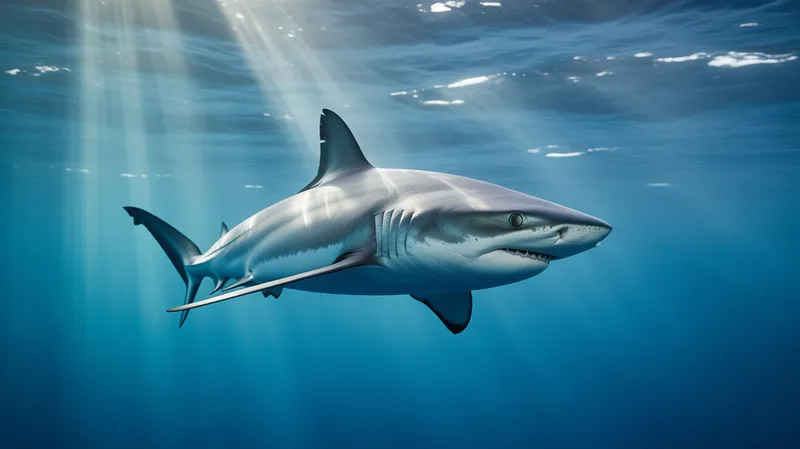
Few animals carry a worse reputation than the shark. Decades of frightening films and breathless headlines have cast them as mindless killing machines lurking off every beach. The science tells a very different — and far more urgent — story: sharks are ancient, extraordinarily sophisticated, and absolutely essential to the health of the oceans. They are also disappearing at a staggering rate. Here is the evidence-based truth about the sea's most misunderstood predator.
Older Than the Dinosaurs — and the Trees
Sharks are almost unimaginably ancient. The first sharks appeared roughly 450 million years ago, while the earliest trees didn't arrive until around 390 million years ago — meaning sharks predate forests by some 60 million years, and have outlasted the dinosaurs many times over (Natural History Museum). In that vast span they have survived multiple mass extinctions that erased countless other groups. The shark is not a primitive relic; it is one of evolution's most battle-tested designs.
A Sixth Sense for Hunting
Far from being crude brutes, sharks possess senses that border on the supernatural. Alongside acute smell and hearing, they have electroreception: a network of jelly-filled pores called the ampullae of Lorenzini that detects the faint electrical fields generated by all living things. This lets a shark sense a heartbeat or a muscle twitch — even of prey buried in sand or hidden in murky water. Combined with a lateral line that feels distant movement and pressure changes, this sensory suite makes sharks precise, calculating hunters rather than random attackers.
Architects of Ocean Health
As apex and mid-level predators, sharks keep entire marine ecosystems in balance. They remove the sick and the weak, prevent any single prey species from dominating, and shape where and how other animals feed. When sharks vanish, the effects cascade downward: mid-level predators surge, and the fish, shellfish, and habitats beneath them can collapse. Healthy shark populations are, quite literally, a sign of a healthy ocean.
The Real Body Count
Here is the statistic that should reframe the entire conversation. A landmark 2024 study in the journal Science estimated that humans killed around 80 million sharks in 2017, and that the toll rose toward 100 million per year by the end of the decade — with roughly 25 million of them threatened species (Science, 2024). Troublingly, mortality kept climbing even as anti-finning laws expanded tenfold, partly because keeping the whole animal opened new markets for shark meat. Most of these deaths happen in coastal waters, not the distant open ocean where protection has traditionally focused.
A Third of Species at Risk
The cumulative pressure has pushed sharks to the brink. A comprehensive IUCN reassessment found that more than one-third (about 37.5%) of all sharks, rays, and chimaeras are now threatened with extinction, including roughly 36% of shark species (IUCN Red List / Dulvy et al., 2021; Smithsonian). Sharks are especially vulnerable because they grow slowly, mature late, and produce few young — so once a population crashes, it can take decades to recover, if it recovers at all.
More Endangered Than Dangerous
Against this backdrop, the risk sharks pose to people is vanishingly small — global shark bites number only a few dozen a year, and fatalities are rarer still. The danger runs overwhelmingly in the other direction. For every person harmed by a shark, humans kill millions of sharks. The fearsome predator of popular imagination is, in reality, a slow-reproducing animal being removed from the oceans faster than it can replace itself.
Key Takeaways
- Sharks have existed for ~450 million years — older than trees and the dinosaurs.
- Electroreception lets them detect the electrical fields of hidden prey.
- As predators they keep entire marine ecosystems balanced.
- Humans kill an estimated 80–100 million sharks a year; ~37.5% of sharks and rays are threatened with extinction.
What Actually Reduces Risk — and What Doesn't
Shark bites are vanishingly rare, but the fear is not going anywhere, so it is worth separating the measures that work from the ones that are theatre.
What genuinely lowers risk is unglamorous. Avoid swimming at dawn and dusk, when many sharks hunt. Stay out of murky water and river mouths, where a shark is more likely to mistake you for something else. Do not swim near fishing activity, seal colonies, or baitfish schools. Leave shiny jewellery on the beach, since it flashes like fish scales. And swim in groups, because a lone silhouette looks far more like prey.
What does not work is the response most governments reach for first: culls and nets. Shark nets do not enclose a beach — they are gill nets that simply kill whatever swims into them, and they drown enormous numbers of turtles, dolphins, and rays alongside sharks that were never a threat. Decades of data show no clear evidence that culling makes beaches safer.
The alternatives are better and already working: drone patrols that spot sharks from the air, tagged-shark alert systems that notify lifeguards, personal electronic deterrents, and smart drumlines that catch a shark, tag it, and release it offshore alive. Perspective helps too. Sharks kill a handful of people a year worldwide. Humans kill somewhere in the region of a hundred million sharks in the same period. The mismatch is not close.
Frequently Asked Questions
How many sharks do humans kill each year? Scientific estimates put it at roughly 80 million and rising toward 100 million annually, including about 25 million threatened species.
Are sharks really dangerous to humans? Serious incidents are extremely rare — only a handful of fatalities worldwide each year.
What is electroreception? A sense, via the ampullae of Lorenzini, that detects the tiny electrical fields of living creatures, helping sharks locate hidden prey.
Why are sharks so vulnerable? They grow slowly and produce few young, so depleted populations recover very slowly.
It's time to trade fear for respect. Discover the ocean's misunderstood guardians in the Creature Atlas encyclopedia.
How likely is a shark attack? Extraordinarily unlikely. A tiny handful of people die from shark bites worldwide each year.
Do shark nets keep beaches safe? There is little evidence they do, and they kill large numbers of turtles, dolphins, and harmless sharks.
Why do sharks bite people at all? Almost always mistaken identity. Most bites are exploratory, and the shark does not return.
How many sharks do humans kill? On the order of a hundred million a year, largely through fishing and the fin trade.
Are sharks important to the ocean? Critically. As top predators they keep populations in check and keep whole ecosystems stable.