
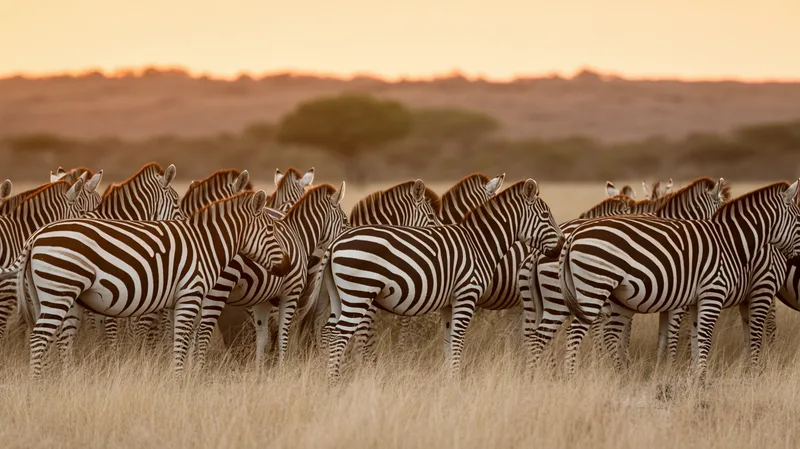
It is one of the oldest questions in biology: why does the zebra wear such bold black-and-white stripes? Charles Darwin argued about it, generations of naturalists guessed at it, and for more than a century it stayed an open mystery. Now, after a run of clever field experiments, scientists are converging on an answer — and it is not the one most people expect.
The Old Theories That Didn't Hold Up
For decades, the leading explanations sounded intuitive. Maybe stripes are camouflage that breaks up the body in tall grass. Maybe they dazzle and confuse charging lions. Maybe they help zebras recognise one another, or keep them cool. One by one, careful testing weakened each idea: lions catch zebras about as readily as other prey, the cooling effect proved negligible, and stripes do little to hide an animal on the open plains.
The Hypothesis That Won: Biting Flies
The strongest evidence points somewhere unexpected — small, blood-sucking flies. Biologist Tim Caro and colleagues compared horses and zebras and found that biting flies (horseflies and their relatives) approached both at similar rates, but landed on the striped zebras far less often (UC Davis). A separate behavioural study of tabanid flies around zebras and horses reached the same conclusion: stripes sharply reduce successful landings (PLOS One).
How the Stripes Actually Work
The flies aren't repelled from a distance — they're foiled up close. As a fly closes in, the high-contrast stripes seem to disrupt its ability to decelerate and make a controlled landing, so it overshoots, bumps into the animal, or veers away at the last moment. Stripes don't hide the zebra; they jam the fly's final approach. It's a tiny advantage with big stakes, because biting flies drain blood and carry diseases that can sicken or kill.
Why Flies Are Such a Deadly Enemy
It may seem strange that an animal hunted by lions would evolve its most striking feature to fend off insects — until you understand what those insects carry.
Biting flies such as tabanids and tsetse transmit devastating diseases, including animal trypanosomiasis, African horse sickness, and equine influenza, any of which can kill a zebra outright.
Zebras are especially vulnerable because their hair is unusually short, giving a fly's mouthparts easy access to skin that thicker-coated animals keep protected. For a zebra, a biting fly is not an irritation — it is a lethal threat.
How Scientists Actually Tested It
The breakthrough came from wonderfully simple experiments. Researchers dressed plain horses in black, white, and striped coats, then filmed the flies that approached them.
The flies homed in on all the horses equally from a distance — but when a horse wore stripes, they failed to land, overshooting, colliding, or veering off at the last second. The stripes only worked up close.
The result has since been repeated in surprising places. In Japan, researchers painted white stripes onto black cows and recorded roughly half as many biting flies landing on them, giving the hypothesis independent, real-world support.
What Zebra Stripes Could Do for Us
This is a rare case where solving an ancient natural-history riddle carries immediate practical value. If stripes really do jam a fly's landing, then we can borrow the trick.
The painted-cow experiments point toward a cheap way of protecting livestock from biting flies without dousing them in insecticide, cutting both costs and chemical use.
Similar thinking is now being applied to clothing and outdoor gear in fly-heavy regions. A century-old zoological puzzle, it turns out, may end up out in the field and on our backs.
What About the Cooling Idea?
The suggestion that stripes keep zebras cool has not vanished entirely, and it deserves an honest hearing. The idea is that black and white surfaces heat at different rates, setting up tiny convection currents that stir the air just above the skin.
Some researchers have reported small temperature differences and even movement of the zebra's hairs that might assist cooling. It is a genuinely interesting proposal.
But the measured effects are small and inconsistent, and controlled tests have not shown striped animals staying meaningfully cooler. Any cooling benefit looks like a modest bonus rather than the reason stripes evolved.
No Two Zebras Are Alike
Every zebra's stripe pattern is unique, as individual as a human fingerprint. Researchers exploit this, photographing flanks and using pattern-recognition software to identify and track individual animals over years without ever fitting a collar.
Foals appear to learn their own mother's pattern, which helps them find her again in a milling, dust-clouded herd of near-identical bodies.
The three living zebra species are strikingly different, too: Grevy's zebra wears fine, densely packed pinstripes, the plains zebra bold broad bands, and the mountain zebra a distinctive gridiron pattern across its rump.
Why You Can't Just Ride a Zebra
If stripes are the zebra's great puzzle, its temperament is the other. People have certainly tried to domesticate them — the eccentric Lord Rothschild famously drove a carriage pulled by zebras through London to prove it could be done.
But a stunt is not domestication. Zebras are jumpy, aggressive, and notoriously prone to panic, with a vicious kick and a habit of biting and not letting go. They also lack the strong follow-the-leader hierarchy that made horses so easy for humans to manage.
It is a neat illustration of a broader rule: very few wild animals have the precise combination of temperament, social structure, and diet that domestication requires. The zebra keeps both its stripes and its independence.
Key Takeaways
- Classic theories (camouflage, predator confusion, cooling) don't hold up well to testing.
- Experiments show biting flies land far less often on striped surfaces.
- Stripes appear to disrupt a fly's controlled landing rather than deter its approach.
- Avoiding disease-carrying flies is a strong evolutionary driver.
Frequently Asked Questions
So why do zebras have stripes? The best-supported answer is that stripes deter biting flies by disrupting their ability to land.
Don't stripes work as camouflage? Evidence for camouflage or predator confusion is weak; the fly hypothesis is far better supported.
Who studied this? Much of the key work comes from Tim Caro, Martin How, and colleagues using field experiments with real flies.
The zebra's coat turns out to be less about lions and more about insects — a reminder that evolution's biggest pressures are sometimes the smallest creatures. Explore more striking animals in the Creature Atlas encyclopedia.