
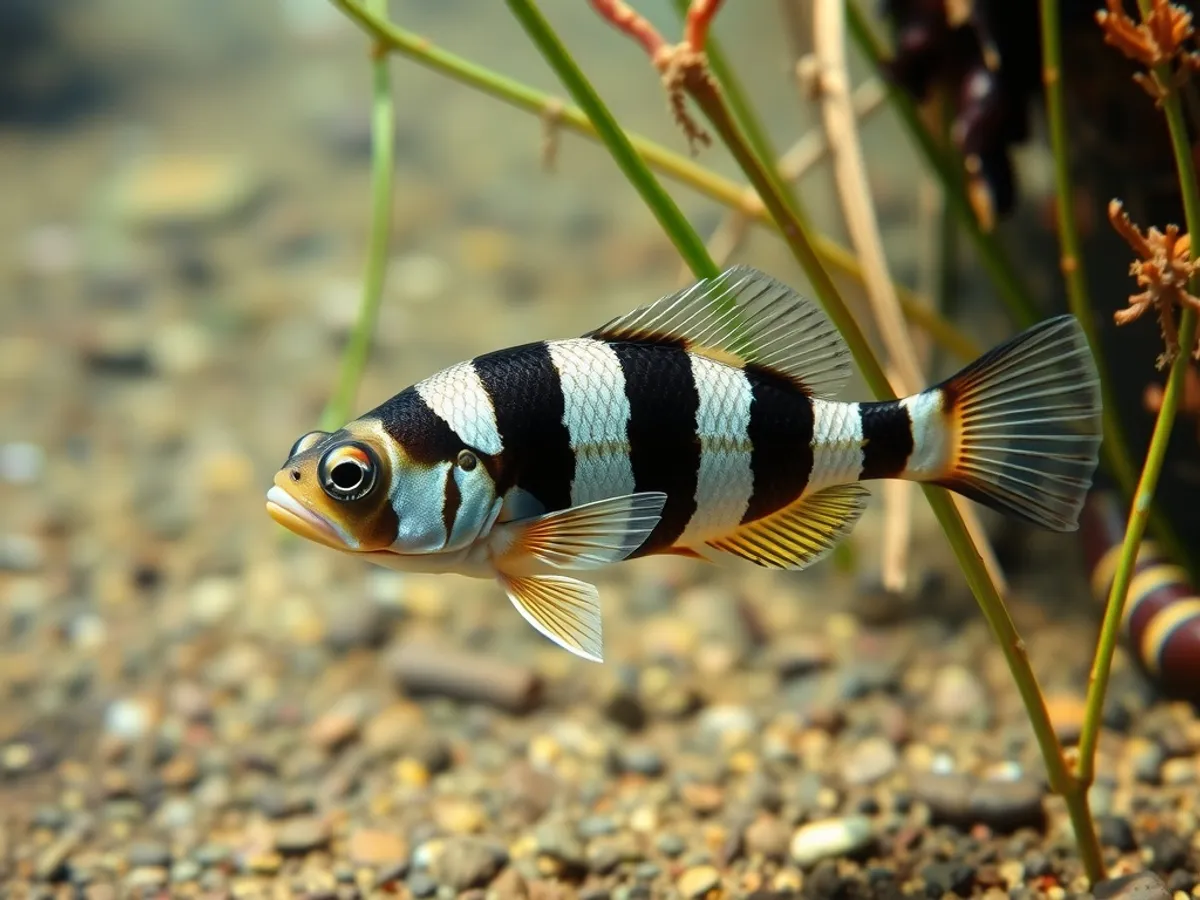
About the Banded Archerfish
The Banded Archerfish is a fascinating species of fish recognized for its remarkable ability to shoot jets of water to knock insects and prey off overhanging vegetation. Native to brackish and freshwater habitats throughout Southeast Asia and Northern Australia, this fish is easily identified by its silver body marked with four to six distinct vertical black bands. Banded Archerfish can adapt to various salinities and are often found in mangrove swamps, estuaries, and coastal rivers. Their unique hunting method and striking appearance make them a popular subject of study and aquarium keeping.
Fascinating facts
Expert Marksman
The Banded Archerfish can spit water with such accuracy that it rarely misses its insect prey perched above the water surface.
Brackish Water Specialist
This species thrives in waters where freshwater and seawater mix, such as mangrove swamps and estuaries.
Visual Genius
Banded Archerfish can compensate for light refraction, skillfully aiming their water jets to hit targets above the surface.
Detailed description
The Banded Archerfish (Toxotes jaculatrix) is a medium-sized perciform fish, typically reaching 15–20 cm in length, though some individuals can grow up to 30 cm. Its laterally compressed, deep-bodied form is adapted for maneuverability in dense mangrove roots and shallow waters. The dorsal surface is olive to silvery-green, while the flanks are bright silver, marked with four to six prominent, wedge-shaped black bands that provide camouflage among dappled sunlight and submerged roots. The mouth is obliquely upturned, and the lower jaw is pronounced, facilitating its unique water-shooting behavior. Archerfish possess large, well-developed eyes positioned for binocular vision, enabling precise targeting of aerial prey. Their fins are generally translucent, with the dorsal fin set far back on the body. Internally, the pharyngeal and buccal cavities are specialized for forming a powerful, focused jet of water. Banded Archerfish are euryhaline, tolerating a wide range of salinities from freshwater to marine environments. Socially, they are often observed in loose schools, which may confer advantages in hunting and predator avoidance. Their striking appearance and remarkable hunting strategy have made them a subject of fascination in both scientific research and the aquarium trade.
Did you know?
The Banded Archerfish can recognize individual human faces, an ability rare among fish.
Research & sources
Behaviour & social structure
Banded Archerfish are diurnal, with peak activity during daylight hours when insect prey is most abundant. They exhibit a unique hunting behavior: upon spotting an insect or small arthropod perched above the water, the fish aligns itself just below the surface, calculates the angle of refraction, and expels a precise jet of water from its mouth to dislodge the prey. This behavior is highly accurate, with mature individuals able to hit targets up to 2–3 meters away. Archerfish can adjust the force and volume of the water jet depending on the distance and size of the prey. Juveniles learn this skill through trial and error, often practicing on floating debris. Socially, they may hunt in small groups, with dominant individuals typically claiming the knocked-down prey, though cooperative hunting and food sharing have also been observed. Outside of hunting, they display schooling behavior, which provides protection from predators such as larger fish and birds. Resting periods are interspersed with active foraging, and they are known to be more secretive and less active during tidal changes or in turbid water.
Reproduction & life cycle
Reproductive behavior in Toxotes jaculatrix is not fully documented in the wild, but spawning is believed to occur seasonally, often triggered by changes in water salinity and temperature associated with monsoonal rains. In captivity, spawning has been induced by simulating these environmental changes. The species is oviparous, with females releasing thousands of small, pelagic eggs into the water column, which are then fertilized externally by males. There is no parental care; eggs drift with the current and hatch within 12–24 hours, depending on temperature. Larvae are planktonic and remain in the open water for several weeks, feeding on microscopic organisms before settling into mangrove and estuarine habitats as juveniles. Sexual maturity is typically reached at 1–2 years of age. Breeding aggregations have been observed in brackish estuaries, suggesting a preference for these transitional zones during the spawning season.
Adaptations & survival
The Banded Archerfish is renowned for its evolutionary adaptation of water-shooting, a complex behavior requiring precise coordination of mouth, gill covers, and tongue to form a narrow, high-velocity jet. This adaptation allows it to exploit aerial prey resources unavailable to most fish. Its large, forward-facing eyes provide excellent binocular vision and depth perception, essential for compensating for light refraction at the air-water interface. The upturned mouth and robust lower jaw are structurally adapted for both surface feeding and water jet formation. Euryhalinity allows the archerfish to thrive in fluctuating salinities, a key advantage in dynamic estuarine and mangrove environments. Camouflage provided by its banded coloration aids in predator avoidance and ambush predation. Behavioral plasticity, such as learning and refining shooting accuracy, demonstrates advanced cognitive abilities uncommon among fish.
Cultural significance
The Banded Archerfish has intrigued humans for centuries, featuring in local folklore and natural history accounts throughout Southeast Asia. Its remarkable hunting technique is often referenced in traditional stories and is used as a metaphor for precision and skill. In some cultures, the archerfish is considered a symbol of ingenuity and adaptability. The species is popular in public aquaria and educational programs, where its water-shooting behavior is demonstrated to highlight animal intelligence and adaptation. There are no significant traditional medicinal or dietary uses documented, but its presence in the aquarium trade has contributed to its cultural visibility.
Recent research
Recent research has focused on the cognitive and neural mechanisms underlying the archerfish's shooting behavior. Studies have shown that Toxotes jaculatrix can learn to recognize and distinguish between different shapes and colors, indicating advanced visual processing. Neurophysiological investigations have revealed specialized brain regions involved in motor control and sensory integration. Ongoing research is examining the ecological impacts of mangrove loss on archerfish populations and their role as bioindicators of estuarine health. Genetic studies are exploring population structure across its range, with evidence of local adaptation to varying salinity regimes. The archerfish's learning abilities and problem-solving skills continue to make it a model organism in comparative cognition research.
Sources
The remarkable shooting behavior of archerfish: neuroethology, biomechanics, and ecology
Schuster, S. (2012)
scientificArcherfish use three-dimensional vision to compensate for refraction at the air–water interface
Temple, S.E., et al. (2010)
scientificThe Biology of the Archer Fish (Toxotes jaculatrix): Adaptations and Behavior
Schuster, S. et al. (2006)
scientificVideos
Habitat
Brackish mangroves, estuaries, and lower reaches of rivers

Conservation
The Banded Archerfish is currently classified as Least Concern on the IUCN Red List.
Threats & challenges
Currently classified as Least Concern by the IUCN, the Banded Archerfish faces localized threats from habitat loss due to mangrove deforestation, coastal development, and water pollution. Overfishing for the aquarium trade poses additional pressure in some regions, though populations remain stable overall. Climate change and associated sea level rise may alter estuarine and mangrove ecosystems, potentially impacting breeding and juvenile recruitment. Invasive species and changes in prey availability could also affect population dynamics. Despite these challenges, the species' broad distribution and adaptability to varying salinities buffer it against more severe declines, but continued monitoring is recommended.
Taxonomy
Scientific name
Toxotes jaculatrix
- Kingdom
- Animalia
- Phylum
- Chordata
- Class
- Actinopterygii
- Order
- Perciformes
- Family
- Toxotidae
- Genus
- Toxotes
- Species
- jaculatrix
Community notes
Share your observations about the Banded Archerfish.
No community notes yet. Be the first!
Discover more wildlife
More fascinating animals from the encyclopedia.