
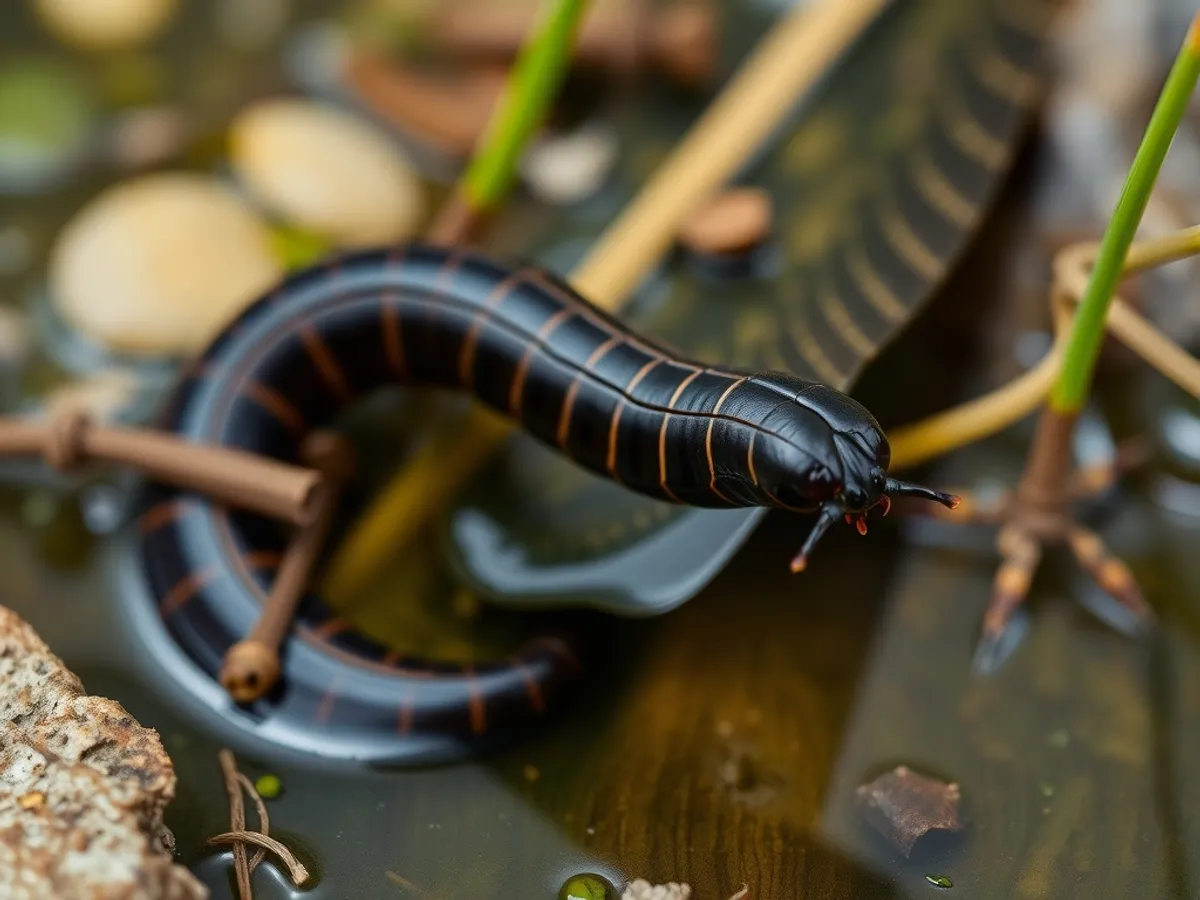
About the Californian blackworm
The Californian blackworm is a slender, segmented freshwater worm known for its dark coloration and graceful, undulating movement. Found commonly in ponds, marshes, and slow-moving streams, it thrives in environments rich in decaying organic matter. Its body can regenerate lost segments, making it a valuable model organism in scientific research. Blackworms play an essential role in aquatic ecosystems by breaking down organic debris and serving as a food source for various aquatic animals.
Fascinating facts
Regeneration Ability
Californian blackworms can regrow lost sections of their body, including both head and tail, making them important for regeneration research.
Oxygen Absorption
They absorb oxygen directly through their skin, aided by their high surface area and hemoglobin-rich blood.
Model Organism
Due to their regenerative powers and ease of care, blackworms are widely used in classroom and laboratory experiments.
Detailed description
Lumbriculus variegatus, commonly known as the Californian blackworm, is a slender annelid typically measuring between 4 and 10 centimeters in length, although individuals can reach up to 15 centimeters. Its body is composed of 150–250 segments, each equipped with tiny bristles (setae) that aid in locomotion and anchoring within substrate. The worm’s coloration ranges from dark brown to black, a result of its pigmented epidermis and underlying blood vessels, which are visible due to its semi-translucent skin. Blackworms lack eyes and a true head but possess a distinct anterior end with a prostomium used for sensory perception. They exhibit remarkable regenerative abilities, capable of regrowing both anterior and posterior segments after injury or fragmentation, a process that has made them a model organism in regeneration studies. Respiration occurs through their moist skin, and they are highly sensitive to changes in oxygen levels, often extending their posterior segments to the water surface for gas exchange. Blackworms are primarily benthic, living within the upper layers of soft, organic-rich sediments where they form dense aggregations. Their undulating swimming motion, facilitated by coordinated contraction of longitudinal muscles, allows them to escape predators or relocate within their habitat. The species plays a vital ecological role in nutrient cycling and sediment aeration.
Did you know?
Despite their simple appearance, blackworms have been extensively used in scientific studies of regeneration and behavior.
Research & sources
Behaviour & social structure
Californian blackworms are non-aggressive, solitary detritivores that spend most of their time burrowed in soft, muddy substrates. They feed by ingesting organic detritus and microorganisms, processing large volumes of sediment through their digestive tract. Blackworms exhibit a unique behavior known as 'pulsing,' where they rhythmically contract and extend their bodies to facilitate water flow and oxygen uptake. When oxygen levels are low, they display 'tail waving,' extending their posterior segments into the water column to maximize gas exchange. Although generally solitary, blackworms may aggregate in high densities in favorable microhabitats, particularly where organic matter is abundant. They are negatively phototactic, avoiding light by burrowing deeper into the substrate. Their daily activity is largely governed by environmental conditions rather than circadian rhythms, with increased surface activity during periods of low oxygen or disturbance.
Reproduction & life cycle
Lumbriculus variegatus reproduces primarily through asexual fragmentation (architomy), where the worm spontaneously divides into two or more fragments, each regenerating missing segments to form complete individuals. Sexual reproduction is rare in laboratory and natural populations, but when it occurs, the species is hermaphroditic, possessing both male and female reproductive organs. Mating involves mutual exchange of sperm, followed by cocoon deposition containing fertilized eggs. Cocoons are attached to submerged vegetation or debris, and embryonic development lasts approximately 2–3 weeks at optimal temperatures (18–22°C). There is no parental care post-cocoon deposition. Asexual reproduction allows for rapid population expansion, especially in stable, resource-rich environments.
Adaptations & survival
Key adaptations of the Californian blackworm include its exceptional regenerative capacity, enabling survival after predation or injury by regrowing lost segments. Its thin, permeable skin facilitates efficient cutaneous respiration, an advantage in low-oxygen environments. The ability to perform tail waving increases oxygen uptake in hypoxic conditions. Blackworms can tolerate a wide range of water temperatures (5–28°C) and varying levels of pollution, making them resilient to environmental fluctuations. Their negative phototaxis and burrowing behavior reduce predation risk. The presence of hemoglobin in their blood enhances oxygen transport, a rare trait among annelids and a significant evolutionary specialization for life in oxygen-poor sediments.
Cultural significance
While the Californian blackworm holds little traditional cultural or mythological significance, it is highly valued in scientific and educational contexts. It serves as a model organism in studies of regeneration, toxicology, and aquatic ecology, and is commonly used in classroom settings to demonstrate biological principles. Additionally, it is a popular live food for aquarium fish and amphibians, contributing to the pet trade. Its role in environmental monitoring and research underscores its importance to science and education rather than folklore or traditional use.
Recent research
Recent research has focused on the molecular and cellular mechanisms underlying blackworm regeneration, including the identification of stem cell populations and gene expression patterns during segment regrowth. Studies have also examined their use as bioindicators for sediment toxicity and water quality, given their sensitivity to pollutants such as heavy metals and pesticides. Advances in imaging and genetic tools have enabled detailed analysis of their nervous system and behavior. Ongoing research explores their potential in ecotoxicology, regenerative medicine, and as a model for understanding annelid evolution. Notably, blackworms have been used to study collective behavior and self-organization in simple organisms, providing insights into emergent biological phenomena.
Sources
Regeneration in Lumbriculus variegatus: A Model for Annelid Biology
Drewes, C.D. & Magruder, T. (2003)
scientificLumbriculus variegatus: A Model Organism for Studying Regeneration and Environmental Toxicology
Lesiuk, L.N. & Drewes, C.D. (1999)
scientificRegeneration in Lumbriculus variegatus: A Review of Recent Research
Leslie, J.F., et al. (2020)
scientificLumbriculus variegatus as a Model Organism for Toxicity Testing
OECD Guidelines for the Testing of Chemicals (2010)
scientificThe Regenerative Capacity of Lumbriculus variegatus: Cellular and Molecular Insights
Drewes, C.D. & Magruder, T. (2020)
scientificVideos
Habitat
Freshwater ponds, streams, and marshes

Conservation
The Californian blackworm is currently classified as Least Concern on the IUCN Red List.
Threats & challenges
Currently, Lumbriculus variegatus faces minimal direct threats and is classified as Least Concern. However, localized populations may be affected by habitat degradation, pollution from agricultural runoff or heavy metals, and alterations in water quality. Eutrophication can both benefit and harm populations by increasing organic matter but potentially causing anoxic conditions. The species is widely used as live food in aquaculture and as a model organism in laboratories, but collection for these purposes has not significantly impacted wild populations. Climate change and increased frequency of extreme weather events may pose future challenges by altering freshwater habitats.
Taxonomy
Scientific name
Lumbriculus variegatus
- Kingdom
- Animalia
- Phylum
- Annelida
- Class
- Clitellata
- Order
- Lumbriculida
- Family
- Lumbriculidae
- Genus
- Lumbriculus
- Species
- variegatus
Community notes
Share your observations about the Californian blackworm.
No community notes yet. Be the first!
Discover more wildlife
More fascinating animals from the encyclopedia.