
About the Rainbow Darter
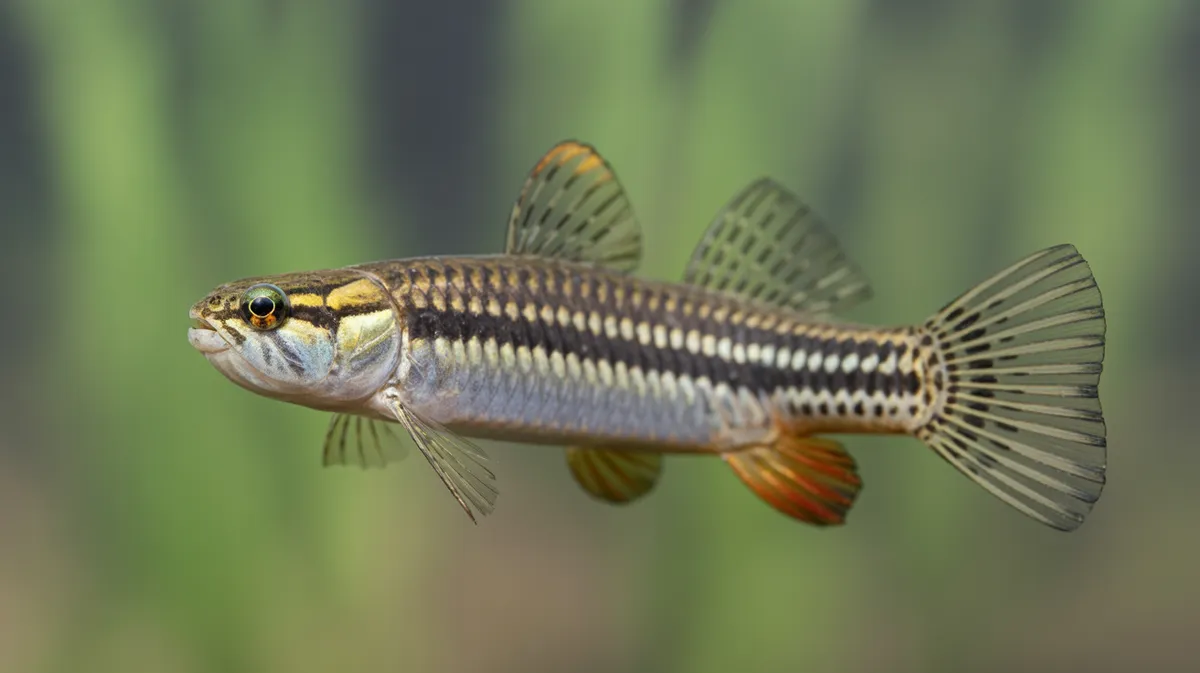
The Rainbow Darter is a small, vibrantly colored freshwater fish native to streams and rivers of eastern North America. Males display striking blue and orange markings, especially during breeding season, making them one of the most colorful darters. They prefer clear, fast-flowing water with gravel or rocky bottoms, where they can dart among the substrate. Rainbow Darters are active during the day and are often seen in groups, using their agility to avoid predators and search for food.
Fascinating facts
Dazzling Colors
Male Rainbow Darters display brilliant blue and orange hues, especially during the spring breeding season.
No Swim Bladder
Rainbow Darters lack a swim bladder, enabling them to remain on the bottom of fast-moving streams without drifting away.
Bottom Dwellers
These fish are benthic, spending most of their lives close to the streambed among rocks and gravel.
Detailed description
The Rainbow Darter (Etheostoma caeruleum) is a small, benthic freshwater fish distinguished by its vibrant coloration and streamlined body, typically measuring 5–7.5 cm (2–3 inches) in length. Males are especially striking during the breeding season, displaying iridescent blue and orange bands along their flanks, with blue and orange highlights on the dorsal, anal, and caudal fins; females are more subdued, with olive to brown tones and faint patterning. The body is laterally compressed, with three characteristic dark dorsal saddles and a blunt snout. Rainbow Darters possess two dorsal fins, the first spiny and the second soft-rayed, aiding in maneuverability in swift currents. Their ventral surface is flattened, an adaptation for clinging to rocky substrates. The species lacks a swim bladder, which allows them to remain close to the streambed without floating upward. They are diurnal and highly active, often seen darting among gravel and cobble in riffle habitats. Socially, Rainbow Darters are loosely gregarious outside of the breeding season, forming small aggregations. Their sensitivity to water quality makes them important bioindicators of stream health.
Did you know?
Despite their vivid colors, Rainbow Darters are rarely kept in home aquariums because they require fast-flowing, highly oxygenated water to thrive.
Research & sources
Wikipedia summary
The rainbow darter is a small species of freshwater ray-finned fish, a darter from the subfamily Etheostomatinae, part of the family Percidae, which also contains the perches, ruffes and pikeperches. It is native to North America where it is found in small, fast-moving streams and small to medium-sized rivers. It grows to 2 to 3 inches in length. The species is very sensitive to pollution and silt, staying in clean, pollution-free water. The rainbow darter is easily identified by three dark spots on the back, and blue and orange in the dorsal and anal fins.
Behaviour & social structure
Rainbow Darters exhibit a benthic lifestyle, spending most of their time on or near the streambed, where they use rapid, darting movements to navigate between rocks and avoid predators. They are opportunistic carnivores, feeding primarily on aquatic insect larvae (such as mayflies, caddisflies, and midges), small crustaceans, and occasionally small snails. Foraging occurs during daylight hours, with individuals using their keen vision to detect prey among the substrate. Aggressive interactions, especially among males, are common during the breeding season, involving displays of fin spreading and chasing to establish territories. Outside of breeding, social interactions are less pronounced, though individuals may aggregate in suitable microhabitats. Rainbow Darters are vigilant and quick to seek cover when threatened, relying on their cryptic coloration and agility.
Reproduction & life cycle
Breeding occurs in spring, typically from March to June, when water temperatures rise above 12°C (54°F). Males establish and defend small territories in shallow riffles with clean gravel or cobble. Courtship involves males displaying their vivid colors and performing a series of fin-fanning and body quivering behaviors to attract females. Females lay adhesive eggs (ranging from 200 to 800 per female per season) directly onto the substrate, often in gravel crevices. Fertilization is external, and there is no nest-building or parental care; eggs are left to develop unattended. Incubation lasts 7–10 days, depending on temperature, after which larvae emerge and quickly adopt a benthic lifestyle. Sexual maturity is typically reached within one year, and the species has a lifespan of about 3–4 years.
Adaptations & survival
Rainbow Darters exhibit several adaptations for life in fast-flowing, well-oxygenated streams. Their flattened bodies and reduced swim bladders allow them to maintain position on the substrate without being swept away by currents. Strong pectoral fins provide stability and maneuverability among rocks. Their cryptic coloration, with mottled patterns and dorsal saddles, offers camouflage against the gravel and cobble. The vibrant breeding colors of males serve as sexual signals to attract mates and deter rivals. Sensitivity to low oxygen and siltation reflects their reliance on clean, well-aerated habitats. Their acute vision enables precise prey detection in turbulent water.
Cultural significance
Rainbow Darters are not of significant commercial or subsistence value but are appreciated by naturalists and anglers for their beauty and as indicators of healthy stream ecosystems. They are sometimes kept in public aquaria and used in educational programs to illustrate stream biodiversity and the importance of water quality. Their presence is often celebrated in regional conservation efforts aimed at protecting freshwater habitats.
Recent research
Recent research on Rainbow Darters has focused on their use as bioindicators for stream health, with studies correlating their abundance and reproductive success to water quality metrics. Genetic studies have explored population structure and connectivity, revealing limited gene flow between isolated stream systems. Behavioral research has examined the role of male coloration in mate choice and territoriality. Ongoing studies are investigating the impacts of microplastics and emerging contaminants on their physiology and reproductive output. Conservation biologists are also using the species to monitor the effectiveness of stream restoration projects.
Videos
Habitat
Freshwater streams and rivers

Conservation
The Rainbow Darter is currently classified as Least Concern on the IUCN Red List.
Threats & challenges
While currently listed as Least Concern, Rainbow Darters face localized threats from habitat degradation, particularly sedimentation, pollution (including agricultural runoff and urban waste), and stream channelization. Their intolerance to silt and contaminants makes them vulnerable to declines in water quality. Fragmentation of stream habitats by dams and culverts can isolate populations, reducing genetic diversity. Climate change may alter stream flow regimes and temperature, impacting reproductive success. Despite these challenges, populations remain stable in many areas with intact, clean stream habitats.
Taxonomy
Scientific name
Etheostoma caeruleum
- Kingdom
- Animalia
- Phylum
- Chordata
- Class
- Actinopterygii
- Order
- Perciformes
- Family
- Percidae
- Genus
- Etheostoma
- Species
- caeruleum
Community notes
Share your observations about the Rainbow Darter.
No community notes yet. Be the first!
Discover more wildlife
More fascinating animals from the encyclopedia.