
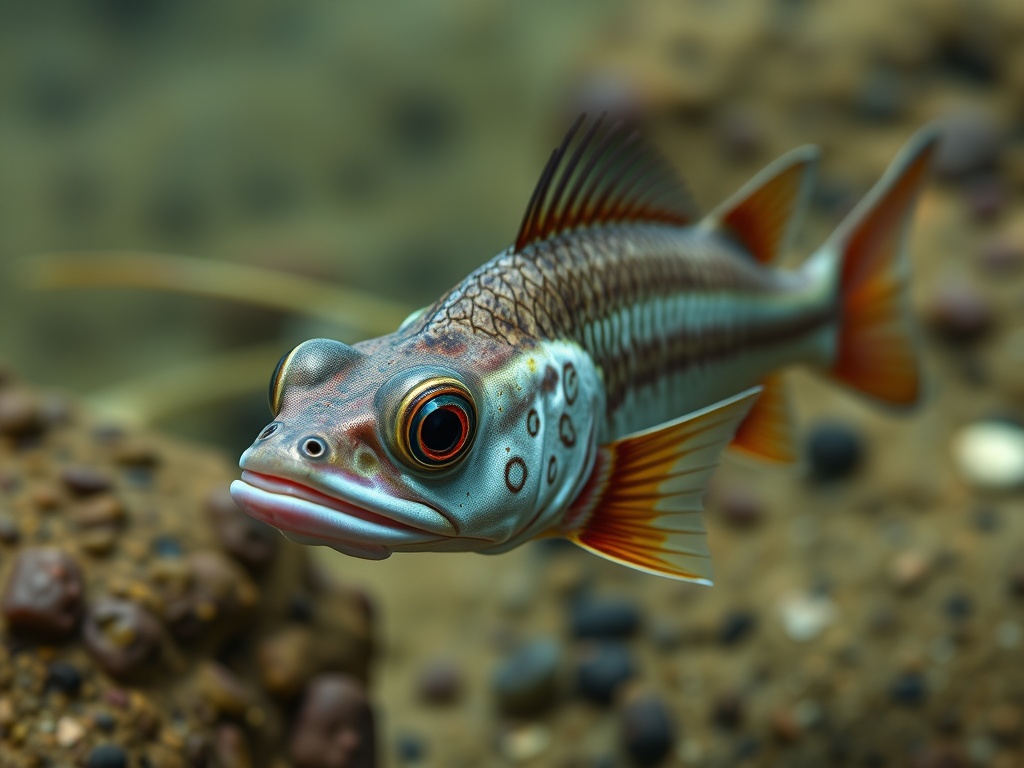
About the Four-eyed fish
The four-eyed fish is a fascinating surface-dwelling fish native to the coastal waters and estuaries of Central and South America. Its most striking feature is its unique eyes, which are divided into two lobes each, allowing it to see simultaneously above and below the waterline. Four-eyed fish are highly adapted to a life at the water’s surface, using their specialized vision to detect both aerial and aquatic predators and prey. They are livebearers and exhibit unusual reproductive adaptations, including asymmetrical genitalia to ensure successful mating.
Fascinating facts
Unique Split Eyes
Each eye of the four-eyed fish is divided into two parts, allowing it to see above and below water simultaneously.
Surface Skimmer
Four-eyed fish spend most of their lives at the surface, skimming for floating insects and other food.
Livebearer Adaptations
Unlike most fish, four-eyed fish give birth to live young and have evolved left- and right-sided reproductive organs for successful mating.
Detailed description
Anableps anableps, commonly known as the four-eyed fish, is a medium-sized, surface-dwelling fish reaching lengths of up to 32 cm (12.5 inches). Its most distinctive anatomical feature is its highly specialized eyes, which are positioned dorsally and divided horizontally by a band of tissue and a partial septum, effectively creating two pupils per eye. This adaptation enables simultaneous vision above and below the waterline, a crucial advantage for detecting both aerial and aquatic threats or prey. The body is elongated and laterally compressed, with a silvery-gray coloration and a flattened head that further facilitates surface swimming. Anableps anableps is an obligate surface feeder, rarely diving below the top few centimeters of water. It possesses a protrusible mouth angled upwards, optimized for capturing insects and other organisms at the water's surface. Socially, these fish are often observed in loose aggregations, particularly in tidal estuaries and brackish lagoons along the Atlantic coasts of northern South America. They are viviparous, giving birth to live young, and display pronounced sexual dimorphism, with males possessing asymmetrical gonopodia (intromittent organs) that correspond to the female's genital opening. This left-right asymmetry ensures successful copulation in a species where mating occurs side-by-side. The four-eyed fish is highly tolerant of fluctuating salinities, allowing it to exploit a range of coastal and estuarine environments.
Did you know?
Despite their name, four-eyed fish actually have only two eyes—each is uniquely adapted to see both above and below the water at the same time.
Research & sources
Wikipedia summary
The four-eyed fishes are a genus, Anableps, of fishes in the family Anablepidae. They have eyes raised above the top of the head and divided in two different parts, so that they can see below and above the water surface at the same time.
Behaviour & social structure
Anableps anableps exhibits a unique surface-skimming behavior, swimming with the dorsal part of its eyes exposed to air and the ventral part submerged. This dual vision allows it to efficiently scan for terrestrial insects, floating plant matter, and small aquatic invertebrates, which make up the bulk of its omnivorous diet. Feeding is typically crepuscular, with peaks at dawn and dusk when insect activity is highest. The species is known for its rapid escape responses, darting away at the slightest disturbance, a behavior likely evolved in response to avian and aquatic predators. Social interactions are generally non-aggressive, with individuals maintaining loose group cohesion, possibly as a strategy to reduce predation risk. During the breeding season, males actively pursue females, displaying courtship behaviors that include lateral displays and rapid swimming. Resting behavior is minimal, as the fish must remain near the surface to breathe and feed.
Reproduction & life cycle
Reproduction in Anableps anableps is characterized by internal fertilization and live birth (viviparity). Males possess a modified anal fin called a gonopodium, which is either left- or right-curved, matching the corresponding genital opening of the female. This asymmetric genitalia ensures mating only occurs between compatible pairs, reducing hybridization and increasing reproductive success. The gestation period lasts approximately 8 to 12 weeks, after which females give birth to 10–20 fully formed juveniles. There is no parental care post-birth; the young are independent immediately. Breeding typically coincides with the rainy season, when food resources are abundant and estuarine conditions are favorable. Females may store sperm from multiple matings, allowing for multiple broods from a single fertilization event.
Adaptations & survival
The most remarkable adaptation of Anableps anableps is its divided eye, which features two corneas and two pupils per eye, each focusing light onto separate regions of the retina. This allows for simultaneous aerial and aquatic vision, a rare trait among vertebrates. The retina itself is specialized, with the dorsal portion adapted for underwater vision and the ventral portion for aerial vision. The fish's flattened head and upturned mouth facilitate efficient surface feeding. Physiologically, Anableps anableps is euryhaline, tolerating a wide range of salinities due to specialized osmoregulatory mechanisms in its gills and kidneys. Its reproductive asymmetry is another key adaptation, reducing inbreeding and promoting genetic diversity. Behavioral adaptations include schooling and rapid escape responses to minimize predation.
Cultural significance
The four-eyed fish has intrigued naturalists and local communities for centuries, often cited in scientific literature as a classic example of evolutionary adaptation. In some South American cultures, its unusual appearance has inspired folklore and curiosity, though it does not play a major role in traditional diets or medicine. The species is occasionally kept in public aquaria as an educational exhibit, highlighting evolutionary innovation and adaptation to ecological niches.
Recent research
Recent research has focused on the neurobiology and optics of the divided eye, providing insights into vertebrate vision and sensory processing. Studies using the optomotor response (OMR) have demonstrated that Anableps can process visual information independently in the aerial and aquatic fields, with differential behavioral responses depending on which part of the eye is stimulated. Genetic studies have explored the development of ocular asymmetry and the molecular basis of euryhalinity. Ongoing research also examines the evolutionary origins of genital asymmetry and its implications for reproductive isolation and speciation within the genus.
Videos
Habitat
Brackish estuaries, coastal lagoons, and slow-moving freshwater rivers

Conservation
The Four-eyed fish is currently classified as Least Concern on the IUCN Red List.
Threats & challenges
Currently classified as Least Concern by the IUCN, Anableps anableps faces localized threats from habitat degradation, pollution, and the alteration of estuarine environments due to urbanization and agriculture. Overfishing is not a significant threat, but the species is sometimes collected for the aquarium trade. Climate change poses a potential long-term risk by altering rainfall patterns and estuarine salinity regimes. Despite these challenges, populations remain stable across much of their range, thanks to their broad ecological tolerance and reproductive resilience.
Taxonomy
Scientific name
Anableps anableps
- Kingdom
- Animalia
- Phylum
- Chordata
- Class
- Actinopterygii
- Order
- Cyprinodontiformes
- Family
- Anablepidae
- Genus
- Anableps
- Species
- anableps
Community notes
Share your observations about the Four-eyed fish.
No community notes yet. Be the first!
Discover more wildlife
More fascinating animals from the encyclopedia.