
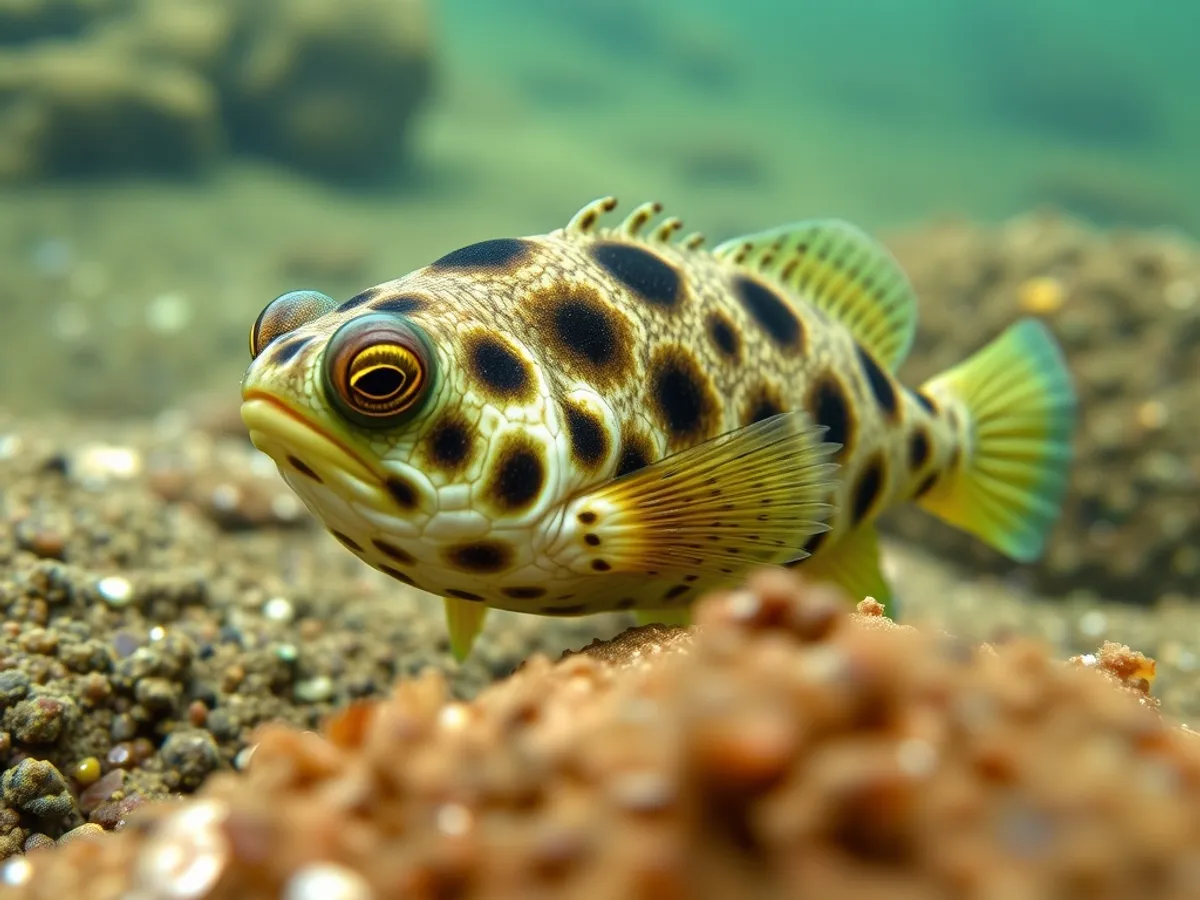
About the Green spotted puffer
The green spotted puffer is a striking species of pufferfish known for its vibrant green coloration adorned with dark spots across its body. Native to Southeast Asia, this fish is found in both brackish and freshwater habitats and is popular in the aquarium trade due to its unique appearance and engaging behaviors. Green spotted puffers are highly intelligent, displaying problem-solving skills and curious personalities. However, they possess a potent toxin in their tissues as a defense against predators, making them dangerous if consumed.
Fascinating facts
Toxin Defense
Green spotted puffers contain tetrodotoxin in their organs, a potent neurotoxin that makes them dangerous if eaten by predators or humans.
Habitat Flexibility
Juvenile green spotted puffers can tolerate freshwater, but adults need brackish or marine environments to stay healthy.
Constantly Growing Teeth
Their beak-like teeth never stop growing, so they must eat hard foods like snails and crustaceans to naturally file them down.
Detailed description
The Green Spotted Puffer (Dichotomyctere nigroviridis) is a medium-sized pufferfish, typically reaching 12–17 cm (4.7–6.7 in) in length, with a robust, rounded body and a slightly beak-shaped mouth formed by fused teeth. Its dorsal surface is a vivid green, adorned with irregular black or dark brown spots, while the ventral side is pale to white. The skin is scaleless and covered in tiny dermal spines, giving it a rough texture. This species has large, expressive eyes adapted for acute vision, aiding in both predator detection and prey location. Green Spotted Puffers are known for their intelligence and inquisitive nature, often interacting with their environment and displaying problem-solving behaviors. They are primarily solitary but may tolerate conspecifics in spacious environments. In the wild, they inhabit brackish and occasionally freshwater systems, such as mangrove estuaries, tidal rivers, and coastal lagoons across Southeast Asia, including Thailand, Malaysia, Indonesia, and Vietnam. Their diet is carnivorous, consisting mainly of mollusks, crustaceans, and occasionally smaller fish, which they crush with their powerful jaws. As a defense mechanism, their tissues contain tetrodotoxin, a potent neurotoxin deterring predation. The species is oviparous, with external fertilization and minimal parental care. Their adaptability to varying salinities and unique physiological traits make them a subject of scientific interest and a popular, though challenging, aquarium species.
Did you know?
Despite being sold as freshwater fish in pet stores, green spotted puffers actually require brackish or even marine conditions as adults to thrive and remain healthy.
Research & sources
Wikipedia summary
Green spotted puffer may refer to:Dichotomyctere fluviatilis, sometimes called the green, Ceylon, or topaz pufferfish Dichotomyctere nigroviridis Dichotomyctere sabahensis, sometimes called the Sabahensis puffer
Behaviour & social structure
Green Spotted Puffers are diurnal and highly active, spending much of the day exploring their environment and foraging. They exhibit pronounced curiosity, investigating novel objects and changes within their territory. In the wild, they are ambush predators, using stealth and quick bursts of speed to capture prey, often employing their strong jaws to crush hard-shelled invertebrates. They are solitary by nature and can be territorial, especially in confined spaces, displaying threat postures such as fin spreading and body arching. Social interactions are limited outside of breeding, and aggression may occur if individuals are housed together without ample space. Puffers are known for their ability to inflate their bodies by ingesting water or air when threatened, making them appear larger and more difficult for predators to swallow. They also exhibit substrate-sifting behavior, using their mouths to dig for hidden prey. In captivity, they may recognize their keepers and can be trained to accept food from forceps or even by hand.
Reproduction & life cycle
Dichotomyctere nigroviridis reproduces via external fertilization. Spawning typically occurs during the rainy season, when changes in water temperature and salinity trigger reproductive behaviors. Males court females through displays of fin spreading and circling. Females lay adhesive eggs—often numbering several hundred—on submerged vegetation or flat surfaces. After fertilization, there is little to no parental care; adults may even consume their own eggs if given the opportunity. The eggs hatch within 5–7 days, depending on temperature, and the larvae are planktonic, feeding on microscopic organisms. Juveniles gradually transition from freshwater to brackish environments as they mature, a process believed to enhance survival and growth rates.
Adaptations & survival
The Green Spotted Puffer exhibits several notable adaptations. Its beak-like teeth, which grow continuously, allow it to feed on hard-shelled prey such as snails and crustaceans. The skin is covered in dermal spines, providing physical protection. The species is euryhaline, capable of tolerating a wide range of salinities, which enables it to exploit diverse habitats from freshwater rivers to brackish estuaries. Tetrodotoxin production in its tissues serves as a chemical defense against predators. Its ability to inflate its body is a unique anti-predator adaptation. Additionally, the puffer’s acute vision and well-developed sense of smell aid in locating prey and avoiding threats. Behavioral plasticity, including problem-solving and learning, further enhances its survival in variable environments.
Cultural significance
While not a major figure in traditional folklore, the Green Spotted Puffer has gained popularity in the global aquarium trade for its striking appearance and engaging behavior. In some Southeast Asian cultures, pufferfish in general are associated with caution due to their toxicity, and their presence in local waterways is sometimes noted in children’s stories or as a symbol of hidden danger. Unlike some marine pufferfish species, D. nigroviridis is not commonly consumed due to its toxicity and small size.
Recent research
Recent research on D. nigroviridis has focused on its osmoregulatory mechanisms, revealing sophisticated physiological adaptations that allow it to transition between freshwater and brackish environments. Studies have also examined the genetic basis of tetrodotoxin resistance and production. Behavioral research highlights their cognitive abilities, including spatial learning and object recognition. The species is used as a model organism for studying vertebrate development and environmental adaptation. Ongoing research is investigating the ecological impacts of habitat changes and the potential effects of climate-induced salinity shifts on population dynamics.
Videos
Habitat
Brackish and freshwater rivers, estuaries, and coastal lagoons

Conservation
The Green spotted puffer is currently classified as Least Concern on the IUCN Red List.
Threats & challenges
Currently assessed as Least Concern by the IUCN, the Green Spotted Puffer faces localized threats including habitat degradation from pollution, mangrove deforestation, and waterway modification. Overcollection for the aquarium trade is a minor concern, though wild populations remain stable in most regions. Climate change and salinity shifts in estuarine habitats may pose future challenges. Invasive snail species and changes in prey availability can also impact local populations. Despite these pressures, the species’ broad distribution and adaptability to different salinities contribute to its resilience.
Taxonomy
Scientific name
Dichotomyctere nigroviridis
- Kingdom
- Animalia
- Phylum
- Chordata
- Class
- Actinopterygii
- Order
- Tetraodontiformes
- Family
- Tetraodontidae
- Genus
- Dichotomyctere
- Species
- nigroviridis
Community notes
Share your observations about the Green spotted puffer.
No community notes yet. Be the first!
Discover more wildlife
More fascinating animals from the encyclopedia.