
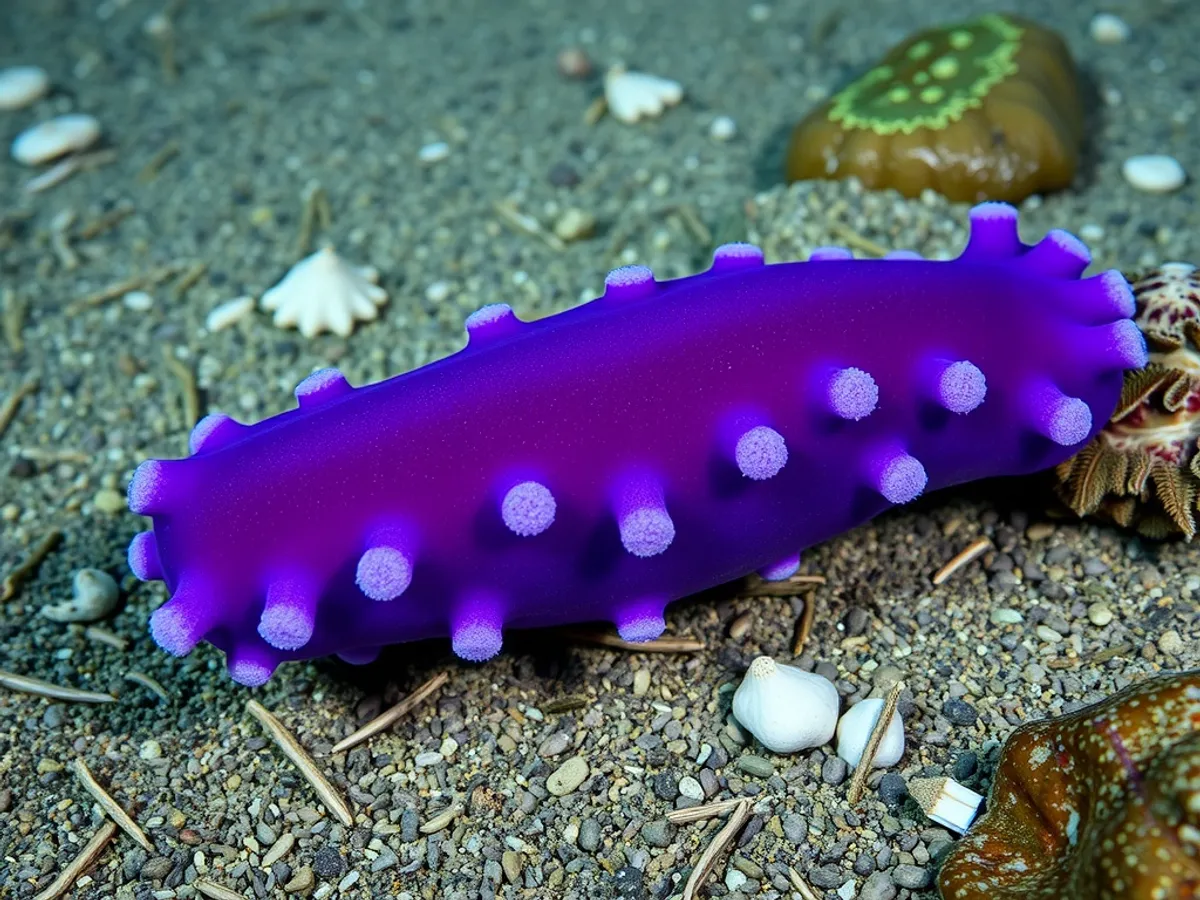
About the Violet Sea Cucumber
The Violet Sea Cucumber is a striking echinoderm known for its elongated, soft body and deep purple coloration. Found primarily along the Pacific coasts of North America, this species inhabits sandy or muddy substrates in shallow waters, often hidden among rocks or seaweed. It plays a vital ecological role by recycling nutrients on the ocean floor through its feeding activities. Violet Sea Cucumbers are slow-moving and rely on a unique form of locomotion by contracting their body muscles and tube feet.
Fascinating facts
Colorful Defense
The Violet Sea Cucumber’s vivid coloration may help deter predators and provides camouflage among seaweed and rocks.
Nutrient Recycler
By feeding on detritus and organic matter, they help clean the ocean floor and recycle nutrients back into the ecosystem.
Regeneration Ability
If threatened or injured, Violet Sea Cucumbers can regenerate lost body parts, including internal organs.
Detailed description
The Violet Sea Cucumber (Parastichopus purple) is a medium-to-large echinoderm, typically reaching lengths of 15–30 cm, with some individuals growing up to 40 cm. Its body is soft, elongated, and cylindrical, covered in leathery skin that ranges from deep violet to purplish-brown hues, often with lighter ventral surfaces. The skin is embedded with microscopic ossicles, providing both flexibility and subtle protection. Along its body, five longitudinal rows of tube feet are visible, which aid in locomotion and substrate attachment. The mouth, located at the anterior end, is surrounded by 10–20 branched, retractable tentacles used for feeding. Internally, the Violet Sea Cucumber possesses a water vascular system for movement and respiration, and a unique respiratory tree for gas exchange. This species is primarily nocturnal, remaining concealed during the day under rocks or within crevices. As a detritivore, it plays a crucial role in benthic ecosystems by ingesting sediment and organic matter, thereby recycling nutrients. Its ability to eviscerate—expelling internal organs as a defense mechanism—demonstrates a remarkable regenerative capacity, allowing lost tissues to regrow within weeks.
Did you know?
Despite their soft appearance, Violet Sea Cucumbers possess microscopic calcium plates in their skin for added protection.
Research & sources
Behaviour & social structure
Violet Sea Cucumbers are solitary and slow-moving, relying on peristaltic contractions of their body wall and coordinated movement of tube feet to traverse the substrate. They exhibit thigmotactic behavior, preferring to remain in contact with solid surfaces or partially buried in sediment. Feeding occurs primarily at night; the animal extends its tentacles to collect detritus, plankton, and organic particles, which are then retracted into the mouth for ingestion. They are non-aggressive and display minimal social interaction, although aggregations may form in areas of high food availability. When threatened, they can expel sticky Cuvierian tubules or even eviscerate internal organs to deter predators, a process followed by rapid regeneration. Their daily routine is characterized by alternating periods of feeding and rest, with increased activity during low-light conditions.
Reproduction & life cycle
Parastichopus purple exhibits separate sexes (gonochorism), though external sexual dimorphism is minimal. Spawning typically occurs in late spring to early summer, triggered by rising water temperatures and lunar cycles. During spawning events, individuals elevate their anterior body and release gametes into the water column for external fertilization. Fertilized eggs develop into planktonic auricularia larvae, which drift with currents for several weeks before settling and metamorphosing into juvenile sea cucumbers. There is no parental care post-spawning. Sexual maturity is generally reached within 2–3 years, and reproductive output can be influenced by environmental conditions and food availability.
Adaptations & survival
The Violet Sea Cucumber is well-adapted to benthic life through its flexible, muscular body and adhesive tube feet, which allow it to navigate complex substrates and anchor itself against currents. Its feeding tentacles are highly sensitive and branched, maximizing surface area for efficient collection of detritus. The species' ability to eviscerate internal organs and regenerate them is a significant evolutionary adaptation for predator avoidance. The respiratory tree, connected to the cloaca, enables efficient gas exchange even in low-oxygen environments. Additionally, the skin contains saponins (holothurins), toxic compounds that deter many potential predators.
Cultural significance
Unlike some other sea cucumber species, Parastichopus purple has limited direct cultural or economic significance. It is not widely harvested for food or traditional medicine, likely due to its chemical defenses and relatively low abundance compared to commercial species. However, it contributes to the health of coastal ecosystems, which are valued by indigenous and local communities for fisheries and biodiversity. In some coastal cultures, sea cucumbers in general are symbols of regeneration and resilience.
Recent research
Recent research has focused on the regenerative biology of Parastichopus purple, with studies examining the molecular pathways involved in organ regrowth and wound healing. Ongoing ecological surveys are assessing the species' role in sediment bioturbation and nutrient cycling, highlighting its importance in maintaining benthic ecosystem health. Genetic studies are underway to clarify population structure and connectivity along the Pacific coast, which may inform future conservation strategies. Additionally, the species is being studied for its potential bioactive compounds, which could have pharmaceutical applications.
Videos
Habitat
Ocean floor, coastal waters

Conservation
The Violet Sea Cucumber is currently classified as Least Concern on the IUCN Red List.
Threats & challenges
Currently classified as Least Concern, the Violet Sea Cucumber faces localized threats from habitat degradation, coastal pollution, and incidental bycatch in fisheries. In some regions, overharvesting for the aquarium trade or for use as bait may impact populations. Climate change, particularly ocean acidification and warming, poses potential long-term risks to reproductive success and larval development. Despite these challenges, populations remain stable across most of their range, though continued monitoring is recommended.
Taxonomy
Scientific name
Parastichopus purple
- Kingdom
- Animalia
- Phylum
- Echinodermata
- Class
- Holothuroidea
- Order
- Aspidochirotida
- Family
- Stichopodidae
- Genus
- Parastichopus
- Species
- purple
Community notes
Share your observations about the Violet Sea Cucumber.
No community notes yet. Be the first!
Discover more wildlife
More fascinating animals from the encyclopedia.