
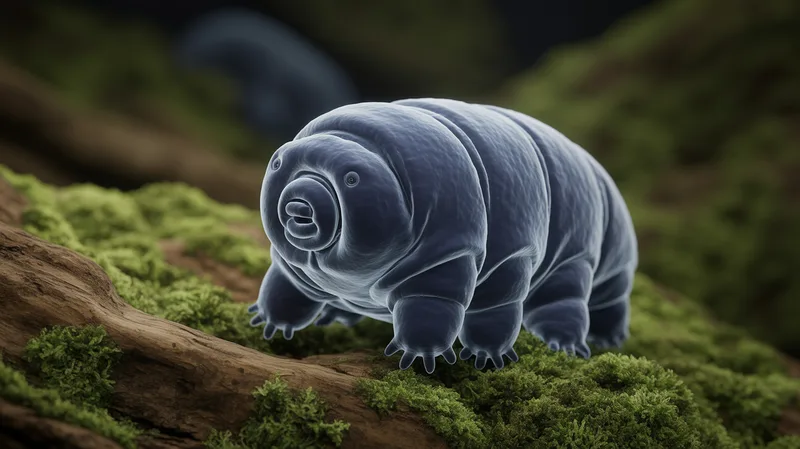
They are barely visible to the naked eye, they live in the moss on your roof, and they may be the most indestructible animals ever discovered. Meet the tardigrade — affectionately known as the "water bear" or "moss piglet" — a microscopic creature that has survived conditions that would obliterate almost anything else alive, including a trip into open space.
Meet the Water Bear
Tardigrades are tiny eight-legged animals, typically under a millimetre long, that lumber through droplets of water on mosses, lichens, soil, and seabeds worldwide. Under a microscope they really do resemble plump, clawed bears ambling in slow motion. Ordinary in appearance — extraordinary in resilience.
The Secret: Becoming Glass
Their superpower is a survival trick called cryptobiosis. When their world dries out or turns deadly, a tardigrade pulls in its legs, expels almost all the water from its body, and curls into a barrel-shaped husk called a tun. Inside its cells the contents thicken and set like glass, and its metabolism falls to something very close to zero — effectively pausing life itself (The Scientist). In this state it can wait, sometimes for years, until water returns and revives it.
Tested to the Extreme — and Into Space
In the tun state, tardigrades have endured almost unbelievable punishment: temperatures from around −237 °C to over 150 °C, pressures several times greater than the deepest ocean, and intense radiation. Most famously, on the 2007 FOTON-M3 mission they became the first animals known to survive direct exposure to the vacuum of space, along with its cosmic and ultraviolet radiation (Wikipedia — Tardigrades in space).
The Molecular Toolkit
Scientists are now uncovering how they do it. Tardigrades produce a protein nicknamed Dsup ("damage suppressor") that physically shields their DNA from radiation, and special CAHS proteins that form a protective gel as the animal dries, cushioning its cellular machinery. Researchers hope these molecules could one day help protect human cells, stabilise medicines without refrigeration, or safeguard astronauts.
How to Find One Yourself
The most delightful thing about tardigrades is that one is almost certainly within a few metres of you right now. They live in the moss on walls, roofs, and pavements, and in lichen and leaf litter.
Finding them is genuinely easy. Soak a clump of moss in water for a few hours, squeeze the water out into a dish, and examine the sediment under even an inexpensive microscope.
With a little patience you will see them lumbering into view — plump, clawed, and unmistakable. Few of nature's great wonders are so accessible to anyone with a jar and a lens.
Not Actually Indestructible
The tardigrade's reputation deserves an important asterisk. All those headline-grabbing feats — the vacuum of space, extremes of heat and cold, crushing pressure — apply to the animal in its dried-out tun state.
An active, hydrated tardigrade going about its business is a fairly fragile creature, easily killed by heat or a careless squash. It also needs time and the right conditions to form a tun in the first place.
Research has found they are surprisingly vulnerable to sustained warmth, which raises an uncomfortable irony: the toughest animal on Earth may still be undone by a warming climate.
What They Tell Us About Life Beyond Earth
Tardigrades have become central to astrobiology, because they push out the boundary of what we thought life could endure. If an animal can survive the vacuum and radiation of space, the odds of life persisting in harsh places elsewhere look a little better.
They have already reached the Moon — though not intentionally. The Israeli Beresheet lander crashed in 2019 carrying dehydrated tardigrades, scattering them across the lunar surface.
Almost certainly they cannot revive there, since they need liquid water to come back to life. But the episode raised serious questions about contaminating other worlds, and turned a microscopic moss-dweller into a genuine problem in space ethics.
What Does a Tardigrade Actually Eat?
For all the talk of surviving space, tardigrades still have to make a living. Most feed by piercing plant cells, algae, or moss with a pair of needle-like mouthparts called stylets, then sucking out the contents.
Others are predators. Some species hunt rotifers and nematodes — and a few will happily eat other tardigrades, seizing them and draining them dry.
That flexible diet is part of why they are everywhere. Wherever there is a film of water and something living to pierce, a tardigrade can make a home.
A Bigger Family Than You'd Think
There is no single "the tardigrade". Scientists have described well over a thousand species, and new ones turn up regularly — often in samples of moss scraped from an ordinary wall.
They live in the deep sea, in freshwater sediment, in the soil of every continent including Antarctica, and on mountaintops and in hot springs.
Different species have very different tolerances, too: the toughest are the ones that live in habitats which regularly dry out, because it is that repeated drying that drove the evolution of the tun in the first place.
Key Takeaways
- Tardigrades are microscopic eight-legged animals found in moss, soil, and water worldwide.
- Via cryptobiosis they dry into a "tun," nearly halting their metabolism.
- They have survived extreme heat, cold, pressure, radiation, and the vacuum of space.
- Proteins like Dsup and CAHS underpin their resilience and inspire medical research.
Frequently Asked Questions
Can tardigrades really survive in space? Yes — in 2007 they became the first animals shown to survive exposure to space vacuum and radiation.
Are tardigrades immortal? No. They can pause life in the tun state for long periods, but they die under sustained lethal conditions.
Where can I find them? In damp moss and lichen almost anywhere — though you need a microscope to see them.
The toughest animal on Earth is one you have almost certainly walked past without noticing. Discover more astonishing creatures in the Creature Atlas encyclopedia.