
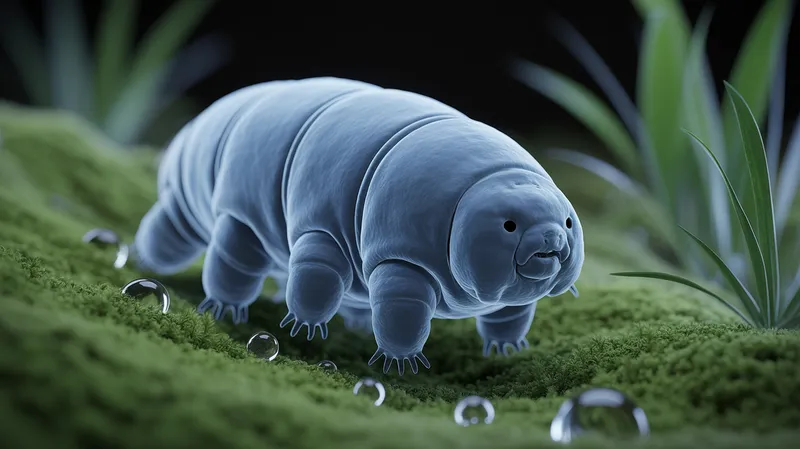
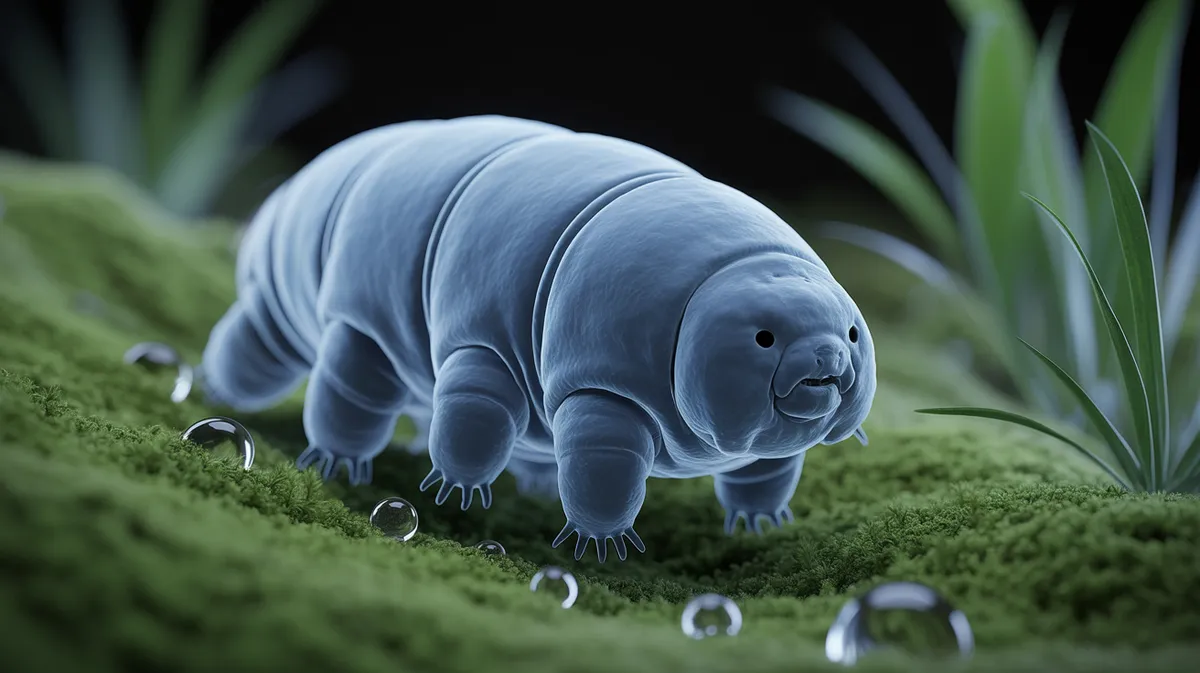
About the Moss Piglet
Tardigrades — water bears, moss piglets — are half-millimetre invertebrates with eight legs tipped in claws, and their reputation for indestructibility is badly overstated. An active, hydrated tardigrade is a soft, vulnerable animal that a nematode can eat. What is extraordinary is the state it can enter when its habitat dries out: the animal expels most of its body water, retracts its legs, curls into a barrel shape called a tun, and replaces water in its cells with trehalose sugar and a set of intrinsically disordered proteins that vitrify into a glass, physically holding cell membranes and proteins in place. In the tun state, metabolism drops to undetectable levels and the animal has survived boiling water, temperatures near absolute zero, 6,000 atmospheres of pressure, and ten days of open vacuum and unfiltered solar radiation in low Earth orbit during the 2007 FOTON-M3 mission. Most tardigrades are not extremophiles at all — they live in the water film on moss, lichen and leaf litter, and they are found on every continent. They feed by piercing plant cells, algae or other invertebrates with a pair of sharp stylets and sucking out the contents.
Fascinating facts
Extreme Survivors
Moss piglets have survived temperatures from just above absolute zero to over 150°C, and can withstand high doses of radiation and the vacuum of space.
Cryptobiosis Experts
When faced with harsh conditions, moss piglets curl into a desiccated ball called a 'tun' and can remain in this suspended state for years.
Microscopic Marvels
Adult moss piglets measure just 0.3–0.5 mm long, making them invisible to the naked eye and observable only under a microscope.
Detailed description
Hypsibius dujardini, commonly known as the moss piglet, is a microscopic tardigrade species measuring approximately 250–500 micrometers in length, with a translucent, segmented body divided into five distinct regions: a head and four trunk segments, each bearing a pair of stubby, clawed legs. The cuticle is flexible and periodically molted as the animal grows. Its mouthparts include a buccal tube and stylets, which pierce plant or algal cells to extract nutrients. Internally, H. dujardini possesses a simple digestive tract and a rudimentary nervous system with a brain and ventral nerve cord. The species is primarily limnoterrestrial, thriving in moist microhabitats such as moss cushions, lichens, and leaf litter, where water films are present. It is solitary and exhibits limited social interaction, relying on environmental cues for movement and feeding. Reproduction is primarily oviparous, with females laying eggs that are often deposited within the shed cuticle. H. dujardini is renowned for its cryptobiotic abilities, entering a tun state to survive extreme desiccation, freezing, and high radiation. This adaptation involves the synthesis of protective proteins and sugars, notably trehalose, and the vitrification of cellular contents. The species is a model organism in tardigrade research due to its relatively large genome and ease of laboratory culture, contributing to studies on extremotolerance and developmental biology.
Did you know?
Moss piglets can lose almost all the water in their bodies and remain dormant for decades, reviving once rehydrated.
Research & sources
Behaviour & social structure
Hypsibius dujardini is primarily a solitary organism, exhibiting limited social behaviors beyond occasional aggregation in favorable microhabitats. Its locomotion is characterized by slow, deliberate crawling using its eight lobopodous legs, each ending in four to six claws that provide grip on substrate surfaces. Feeding occurs via stylet penetration of plant or algal cells, followed by pharyngeal pumping to ingest cytoplasmic contents. The species is an opportunistic omnivore, consuming algae, detritus, and occasionally small nematodes or rotifers. Activity levels are closely tied to ambient moisture; individuals become quiescent or enter cryptobiosis when desiccation threatens. Daily routines are largely dictated by environmental conditions rather than circadian rhythms, with periods of feeding, molting, and cryptobiosis alternating as needed. There is no evidence of cooperative behavior or territoriality, and interactions are generally limited to competition for resources in dense populations.
Reproduction & life cycle
Hypsibius dujardini reproduces primarily through sexual reproduction, although parthenogenesis has been observed in some populations. Mating involves indirect sperm transfer: males deposit spermatophores in the environment, which are then taken up by females during molting or egg-laying. Females lay clutches of 5–15 eggs, typically within the shed exuviae (molted cuticle), providing a degree of protection from desiccation and predation. Embryonic development is direct, with no larval stage, and hatching occurs after 5–14 days, depending on temperature and humidity. There is no parental care post-oviposition. Breeding can occur year-round in stable, moist environments, with multiple generations produced annually under optimal conditions. The species exhibits determinate growth, reaching reproductive maturity after three to four molts.
Adaptations & survival
Hypsibius dujardini exhibits a suite of remarkable adaptations for survival in fluctuating terrestrial microhabitats. Its most notable adaptation is cryptobiosis, a reversible ametabolic state induced by desiccation, freezing, or other extreme stresses. During cryptobiosis, the animal contracts into a tun, dramatically reducing metabolic activity and synthesizing protective molecules such as trehalose and tardigrade-specific intrinsically disordered proteins (TDPs) that stabilize cellular structures. The cuticle provides moderate protection against mechanical damage and osmotic stress. The claws and flexible legs facilitate movement across uneven substrates and enable anchorage during feeding. The ability to withstand high doses of ionizing radiation is attributed to efficient DNA repair mechanisms and the presence of antioxidants. H. dujardini also demonstrates anhydrobiosis, surviving complete desiccation for months to years, and can endure temperatures ranging from -200°C to +150°C in the tun state.
Cultural significance
While Hypsibius dujardini does not feature in traditional folklore or mythology, it has gained significant cultural prominence in modern science and popular media as a symbol of resilience and extremotolerance. The tardigrade's ability to survive space exposure and extreme environments has made it an icon in discussions of astrobiology, life’s limits, and the search for extraterrestrial life. It has appeared in educational materials, documentaries, and even as a mascot for scientific outreach. The species is also referenced in art and literature as a metaphor for endurance and adaptability.
Recent research
Hypsibius dujardini is a model organism in tardigrade research, particularly due to its sequenced genome and ease of laboratory culture. Recent studies have elucidated the molecular basis of its cryptobiotic abilities, identifying unique proteins (such as Dsup) that protect DNA from radiation-induced damage. Research has also focused on the mechanisms of anhydrobiosis, revealing the role of vitrification and trehalose in cellular preservation. Comparative genomics has provided insights into tardigrade evolution and their placement within the Ecdysozoa. Ongoing studies are investigating the potential applications of tardigrade proteins in biotechnology, including cryopreservation and radioprotection. H. dujardini has also been used in space experiments to assess the effects of cosmic radiation and vacuum on multicellular life.
Videos
Habitat
Moist terrestrial environments such as mosses, lichens, and leaf litter
 Polar and Subpolar Regions
Tundra
Cold, treeless regions with permafrost supporting specialized cold-adapted wildlife.
 Various Continental Regions
Grassland
Open areas dominated by grasses rather than trees, supporting numerous herbivores and their predators.
 Elevated Terrain
Mountain
High-altitude environments with varying climates and specialized wildlife adapted to rugged terrain and thin air.
 Global
Forest
Wooded areas with significant tree cover and diverse plant and animal communities.
 Global
Freshwater
Lakes, rivers, and wetlands with diverse aquatic ecosystems.
Conservation
The Moss Piglet is currently classified as Least Concern on the IUCN Red List.
Threats & challenges
Currently, Hypsibius dujardini faces minimal direct threats due to its microscopic size, cryptobiotic abilities, and widespread distribution in microhabitats that are generally resilient to moderate environmental changes. However, habitat degradation from pollution, urbanization, and climate change may impact local populations by altering moisture regimes and reducing suitable habitat. The species is not targeted by human activities and is considered of Least Concern by conservation assessments. Long-term challenges include the potential loss of microhabitats due to deforestation, acid rain, and changes in land use. Population trends are stable, but localized declines could occur if environmental conditions become inhospitable or if pollutants disrupt cryptobiosis or reproduction.
Taxonomy
Scientific name
Hypsibius dujardini
- Kingdom
- Animalia
- Phylum
- Tardigrada
- Class
- Eutardigrada
- Order
- Parachela
- Family
- Hypsibiidae
- Genus
- Hypsibius
- Species
- dujardini
Community notes
Share your observations about the Moss Piglet.
No community notes yet. Be the first!
Discover more wildlife
More fascinating animals from the encyclopedia.