
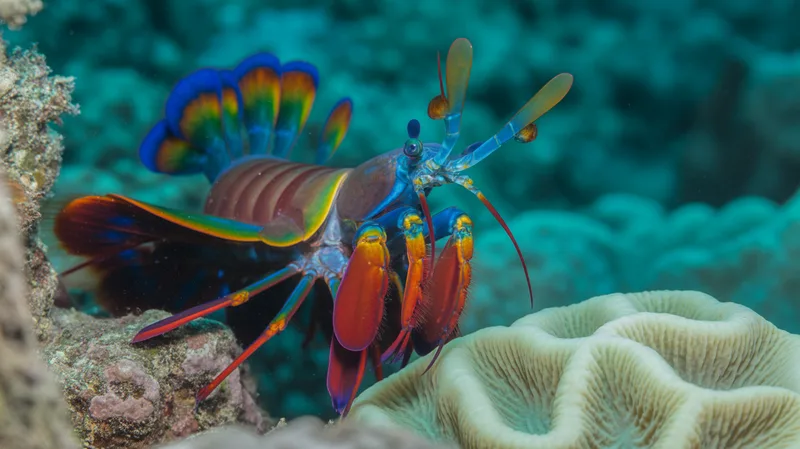
It is rarely longer than your hand, it lives in a burrow on the reef, and it throws the fastest, most violent punch in the entire animal kingdom. The mantis shrimp is a pint-sized marvel that breaks the rules of physics and biology at once — smashing prey with a strike so fast it boils the water, and seeing the world through eyes unlike anything else on Earth.
A Punch That Defies Physics
Many mantis shrimp are "smashers," armed with club-like appendages called dactyls that they cock back like a loaded spring. When released, the club rockets forward at around 23 metres per second — roughly 80 km/h from a standing start — with an acceleration compared to that of a .22-calibre bullet, and it does this underwater, where drag is some 800 times greater than in air (Natural History Museum). The force can shatter snail shells, crab armour, and even aquarium glass.
It Boils the Water — and Makes Light
The strike is so fast that it triggers cavitation: the water cannot move out of the way quickly enough, so a near-vacuum bubble forms and then violently collapses microseconds later. That collapse delivers a second shockwave to the target — meaning the mantis shrimp effectively lands two blows per punch (Science News Today). The collapsing bubble even produces a faint flash of light, a phenomenon known as sonoluminescence, as the gas inside is compressed to extreme temperatures for a few billionths of a second.
Eyes From Another World
If the punch were not enough, the mantis shrimp also has the most extraordinary eyes in nature. Where humans see colour through just three types of photoreceptor, many mantis shrimp have 12 to 16 different types, and can also detect ultraviolet and polarised light that is completely invisible to us. Their eyes move independently and perceive depth with a single eye. Curiously, research suggests they may not blend these signals into a rich colour picture the way we do — instead their brains seem to recognise colours rapidly and directly, a fundamentally different way of seeing.
How a Small Animal Hits So Hard
The secret to the punch is a biological spring-and-latch system. The shrimp slowly loads energy into a saddle-shaped spring in its arm, holds it with a latch, and then releases it all at once — the same principle as a crossbow or a mousetrap. This lets a tiny muscle deliver a blow far more powerful and faster than muscle alone could ever produce. Engineers now study this mechanism to design tough, impact-resistant materials and fast micro-robots.
Key Takeaways
- Smasher mantis shrimp strike at ~23 m/s with the acceleration of a bullet.
- The strike causes cavitation bubbles that collapse into a second shockwave — two hits per punch.
- Many species have 12–16 photoreceptor types (humans have 3) and see UV and polarised light.
- A spring-and-latch system lets a tiny animal deliver enormous force.
Smashers and Spearers: Two Weapons, Two Lives
Not every mantis shrimp punches. The group splits into two camps, and the split runs right down the middle of their anatomy and their behaviour.
The smashers are the famous ones. Their raptorial appendage ends in a hardened, club-like heel, and they use it to shatter the shells of snails, crabs, and clams — a hammer built for armoured prey.
The spearers carry a very different weapon: a barbed, spring-loaded lance. They lurk in burrows in soft sediment and stab outward at soft-bodied prey like fish and shrimp, impaling them before they can react. Same mechanism, entirely different target.
The smasher's club is what draws the engineers. Its layered, spiralling structure stops cracks from spreading, letting it survive tens of thousands of blows that should have destroyed it. Materials scientists have copied that architecture into composites for aircraft panels and body armour — one of the clearest cases of a creature's weapon becoming our shield.
Frequently Asked Questions
How fast is a mantis shrimp punch? Around 23 metres per second from a standstill, with bullet-like acceleration.
What is cavitation? A vapour bubble formed by the ultra-fast strike that collapses to deliver a second blow and a flash of light.
How many colours can a mantis shrimp see? They have 12–16 photoreceptor types and detect UV and polarised light, though they may process colour very differently from us.
Can a mantis shrimp break glass? Yes — captive ones have cracked aquarium walls.
The mantis shrimp proves that some of the ocean's biggest superpowers come in the smallest, most colourful packages. Discover more astonishing marine life in the Creature Atlas encyclopedia.
How fast is the mantis shrimp's strike? It accelerates at a rate comparable to a bullet leaving a gun, in a fraction of a blink.
Can a mantis shrimp break aquarium glass? A large smasher genuinely can, which is why keepers house them carefully.
Do mantis shrimp really see 16 colours? They have 16 photoreceptor types, but tests show they are actually poor at telling similar colours apart.
What is cavitation? The strike is so fast it vaporises water into a bubble that collapses with a second, damaging shockwave.
Are mantis shrimp dangerous to people? They can inflict a nasty cut or bruise — hence the nickname "thumb splitter" — but they are not deadly.
How does such a small animal store so much energy? It works like a crossbow. The muscle slowly loads a saddle-shaped spring in the limb, a latch holds it, and releasing the latch dumps all that stored energy at once — far faster than muscle alone could ever contract.
Do mantis shrimp lose their club? The club takes real damage over time, but the animal moults, replacing the worn weapon with a fresh one.
Are mantis shrimp actually shrimp? No. Despite the name they are stomatopods, an ancient group only distantly related to true shrimp.
Do they live alone? Mostly, and aggressively so — though some species form long-term monogamous pairs that share a burrow for years.