
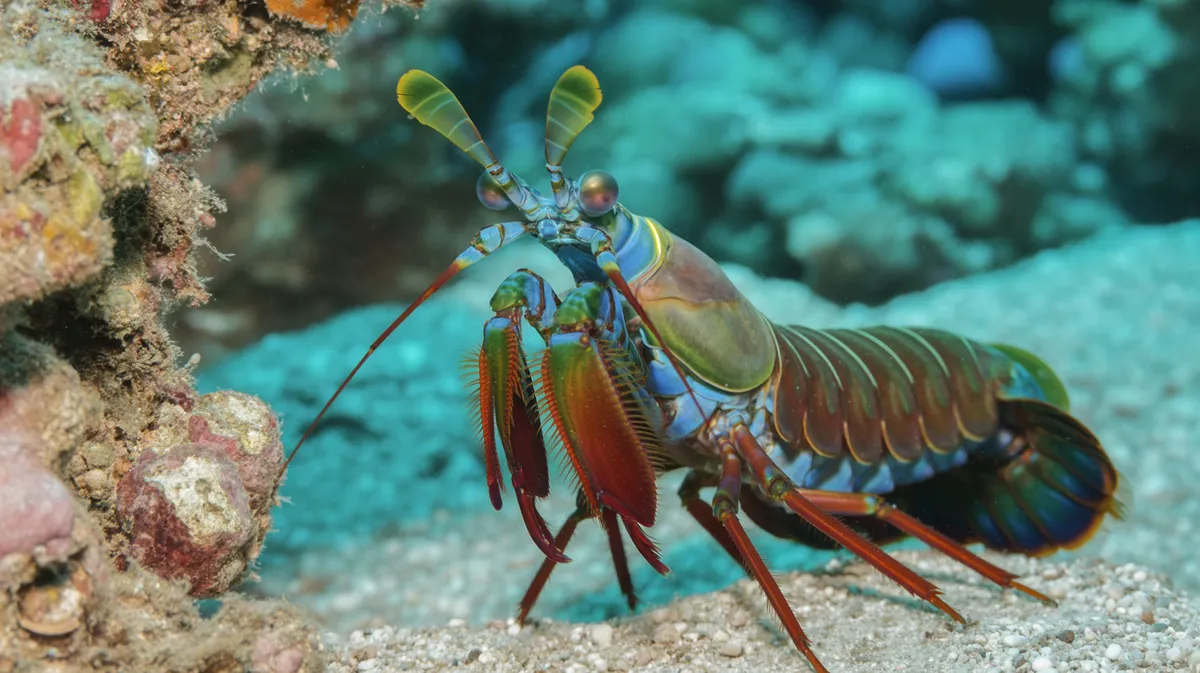
About the Peacock Mantis Shrimp
The peacock mantis shrimp is the most famous of the smashers, and its club is a piece of biological engineering. It cocks the limb against a spring-loaded latch, storing energy in a saddle-shaped structure, then releases it so fast that the club accelerates like a bullet. The water in front of it cannot get out of the way, the pressure collapses, and a cavitation bubble forms and implodes — producing a second shockwave, a flash of light and a burst of heat. The prey is therefore struck twice for a single punch, and even a miss can be lethal. The club has to survive its own violence, and it does so through a layered composite structure that engineers are now copying for body armour. Its eyes sit on independently swivelling stalks and carry twelve to sixteen types of photoreceptor to our three, and it can see circularly polarised light, which almost nothing else on Earth can perceive — a private channel it appears to use for signalling to other mantis shrimp.
Fascinating facts
Superpowered Strike
The peacock mantis shrimp can strike with its club-like appendages at speeds up to 80 km/h (50 mph), creating forces strong enough to crack aquarium glass.
Exceptional Vision
Its eyes can move independently and perceive up to 12 color channels (compared to humans' three), allowing it to see an unparalleled spectrum of colors.
Burrow Builder
This shrimp constructs and defends intricate burrows in coral and sand, which serve as both a home and a base for hunting.
Detailed description
The peacock mantis shrimp (Odontodactylus scyllarus) is a large and visually striking stomatopod crustacean, typically reaching lengths of 10–18 cm, with some individuals growing up to 20 cm. Its robust, segmented body is adorned with vivid coloration, including iridescent greens, blues, reds, and orange, making it one of the most colorful marine invertebrates. The species is characterized by a hard, calcified carapace covering the head and thorax, and a muscular abdomen ending in a fan-like tail. Most notable are its raptorial appendages, or 'clubs,' which can accelerate underwater at speeds exceeding 23 m/s (over 50 mph), delivering blows with forces comparable to a bullet and capable of breaking glass aquarium walls or the shells of hard-shelled prey. The peacock mantis shrimp possesses some of the most complex eyes in the animal kingdom, featuring trinocular vision in each eye and the ability to detect 12–16 color channels, including ultraviolet and polarized light. This advanced visual system aids in hunting, communication, and mate selection. The species is primarily solitary and territorial, excavating and defending burrows in coral rubble or sandy substrates. Its behavior is highly specialized, with individuals spending much of their time within their burrows, emerging to hunt or interact with conspecifics. Reproduction involves elaborate courtship displays, and both sexes may participate in brood care. The peacock mantis shrimp is a formidable predator, preying on mollusks, crustaceans, and occasionally fish, using its powerful appendages to crack or spear prey. Its ecological role as both predator and prey contributes significantly to the biodiversity and trophic dynamics of Indo-Pacific reef ecosystems.
Did you know?
A peacock mantis shrimp's punch is so fast it momentarily boils the water around it, creating a flash of light called sonoluminescence.
Research & sources
Wikipedia summary
Odontodactylus scyllarus, commonly known as the peacock mantis shrimp, harlequin mantis shrimp, painted mantis shrimp, clown mantis shrimp, rainbow mantis shrimp, or simply mantis shrimp, is a large Stomatopod native to the epipelagic seabed across the Indo-Pacific, ranging from the Marianas to East Africa, and as far South as Northern KwaZulu Natal in South Africa. There are roughly 480 species of Stomatopod. These crustaceans are well known for their raptorial claws, exceptional vision, and their unique way of interacting with other marine species.
Behaviour & social structure
Peacock mantis shrimps are diurnal, with peak activity during daylight hours. They are highly territorial, aggressively defending their burrows from intruders of the same or different species. Hunting is primarily ambush-based: the shrimp waits at the entrance of its burrow, rapidly striking passing prey with its raptorial appendages. These strikes are so fast they generate cavitation bubbles, which produce secondary shockwaves that can stun or kill prey even if the initial strike misses. Feeding is opportunistic, focusing on hard-shelled animals such as snails, crabs, and bivalves, but they may also consume softer-bodied prey. Social interactions are generally antagonistic, though ritualized displays—such as body posturing and color flashing—are used to avoid physical conflict. Mantis shrimps communicate using visual signals, tapping, and substrate vibrations. Outside of breeding, individuals are solitary, only coming together for brief, sometimes aggressive, encounters.
Reproduction & life cycle
Odontodactylus scyllarus exhibits complex reproductive behaviors, including courtship rituals that involve visual displays and tactile interactions. Breeding can occur year-round in tropical regions, but peaks may coincide with warmer seasons. After mating, females lay clusters of several hundred to a few thousand eggs, which are either brooded by the female in her burrow or carried in her pleopods (swimmerets) beneath the abdomen. The incubation period typically lasts 9–14 days, depending on water temperature. During this time, the female aerates and cleans the eggs, rarely leaving the burrow. Upon hatching, planktonic larvae (nauplii) are released into the water column, where they undergo several molts before settling to the benthos and developing into juveniles. Parental care is primarily maternal, with males sometimes assisting in burrow defense during the brooding period.
Adaptations & survival
The peacock mantis shrimp's most remarkable adaptation is its raptorial appendages, which have evolved into highly specialized 'smashers' capable of delivering rapid, high-force blows. The dactyl club is reinforced with a unique, helicoidal arrangement of chitin and mineralized layers, providing exceptional impact resistance and energy absorption. Its eyes are divided into three parts, allowing for trinocular vision and depth perception with each eye independently. The ability to detect polarized and multispectral light enhances prey detection, predator avoidance, and intraspecific communication. The species' burrowing behavior provides protection from predators and environmental stressors. Its bright coloration may serve as a warning signal (aposematism) or play a role in mate selection and territorial displays.
Cultural significance
The peacock mantis shrimp has gained notoriety in popular culture for its extraordinary strength and vibrant appearance, often featured in documentaries, art, and internet memes. In some Indo-Pacific cultures, mantis shrimps are occasionally harvested for food, though not as a primary resource. Their unique visual system and biomechanics have inspired research in materials science, robotics, and imaging technology. The species is also a popular exhibit in public aquaria, where it serves as an educational ambassador for marine biodiversity and adaptation.
Recent research
Recent research has focused on the biomechanics of the mantis shrimp's strike, revealing the role of elastic energy storage and rapid release in the dactyl club, which has influenced the design of advanced impact-resistant materials. Studies of their visual system have uncovered novel photoreceptor proteins and polarization-detection mechanisms, with potential applications in optical engineering and medical imaging. Ongoing ecological research examines their role as keystone predators in reef ecosystems and their responses to environmental stressors such as ocean warming and acidification. Genomic studies are beginning to elucidate the genetic basis of their unique adaptations, including vision and exoskeletal structure.
Sources
Videos
Habitat
Coral reefs and sandy or rubble areas of shallow tropical marine waters

Conservation
The Peacock Mantis Shrimp is currently classified as Least Concern on the IUCN Red List.
Threats & challenges
Currently listed as Least Concern by the IUCN, the peacock mantis shrimp faces localized threats from habitat degradation, particularly coral reef destruction due to climate change, ocean acidification, and human activities such as coastal development and destructive fishing practices. Collection for the aquarium trade poses additional pressure in some regions, as their striking appearance makes them popular among marine hobbyists. Despite these threats, the species remains widespread and abundant throughout its range, with no evidence of significant population decline. However, ongoing reef loss and environmental change could pose future risks to their habitats and populations.
Taxonomy
Scientific name
Odontodactylus scyllarus
- Kingdom
- Animalia
- Phylum
- Arthropoda
- Class
- Malacostraca
- Order
- Stomatopoda
- Family
- Odontodactylidae
- Genus
- Odontodactylus
- Species
- scyllarus
Community notes
Share your observations about the Peacock Mantis Shrimp.
No community notes yet. Be the first!
Discover more wildlife
More fascinating animals from the encyclopedia.