
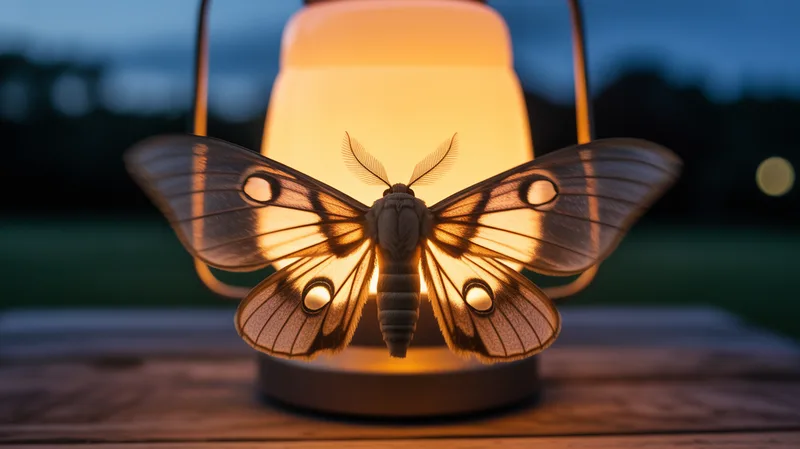
"Like a moth to a flame" — we use the phrase to mean an irresistible, doomed attraction. For centuries people assumed that is literally what happens: that moths are drawn to light and fly straight into it. But in 2024, scientists finally watched closely enough to discover that the old story is wrong. Moths are not attracted to light at all. Something far stranger is going on.
The Old Explanations Didn't Add Up
For decades, biologists floated theories. Maybe insects navigate by the moon and mistake a lamp for it. Maybe light blinds them, or they fly toward it to escape. Each idea had problems — none quite matched the bizarre way insects actually behave around a bulb, spiralling, stalling, and circling rather than simply flying in. To really know, researchers needed to see exactly how the insects were orienting their bodies in flight.
The 2024 Study That Cracked It
A team led by Samuel Fabian at Imperial College London used high-speed motion capture, in the lab and in the field, to track the precise body angles of flying insects around lights. Their finding, published in Nature Communications, overturned the myth: insects are not steering toward the light — they are tilting their backs toward it (Imperial College London).
The Dorsal Light Response
This behaviour is called the dorsal light response. For hundreds of millions of years, the brightest thing in a flying insect's world was the sky above. Keeping its back pointed toward that brightness is a brilliantly simple way to know which way is up and stay level — essential when your tiny sensors and split-second aerial manoeuvres make it hard to tell up from down (Mongabay). The trouble is that an artificial light hijacks this ancient reflex.
Trapped, Not Attracted
When a moth passes a bright lamp, it keeps tilting its back toward that light source. If the light is off to the side or below, this throws the insect into a constant bank, sending it into tight orbits, steep climbs, or sudden dives around the bulb (Scientific American). It is not flying to the light out of desire — it is trapped in a loop by a navigation system that evolved for a world where the only bright light was the sky. The moth is not in love with the flame; it is disoriented by it.
What This Means for Light Pollution
If moths are not attracted to our lights but trapped by them, the implications are considerably darker than a piece of insect trivia.
Artificial light at night now covers a large and growing share of the planet's land surface, and it is spreading faster than the human population. Every streetlamp, floodlight, and illuminated sign is, in effect, a small trap that captures night-flying insects and holds them there — circling, exhausted, and hugely exposed to predators — until they drop.
Set that against the broader picture of insect decline and it becomes hard to dismiss. Moths are major nocturnal pollinators and they are the foundation of the food chain for bats, birds, and countless other animals. Draining them out of the night sky does not stay a moth problem for long.
The unusually good news is that this is one of the cheapest environmental problems to fix. Shield lights so they point down instead of sideways and up. Use warmer colour temperatures — insects are drawn far more strongly to blue-white light than to amber. Fit motion sensors and timers so lights are only on when they are needed. None of this requires anyone to sit in the dark, and unlike almost every other conservation measure, switching a light off works instantly.
Why It Matters
Beyond settling a famous question, the discovery matters for conservation. Insect populations are falling worldwide, and light pollution is a suspected culprit. Understanding why artificial light traps insects points to practical fixes: lights that point downward, warmer colours, shielding, and switching off unnecessary lighting can all reduce the deadly orbiting effect — a rare problem with a genuinely actionable solution.
Key Takeaways
- Moths are not actually attracted to light — a 2024 study overturned the myth.
- They tilt their backs toward the brightest light (the "dorsal light response") to stay oriented.
- Artificial lights hijack this reflex, trapping insects in orbits, climbs, and dives.
- Better-designed, shielded, downward lighting can reduce the harm to insects.
Frequently Asked Questions
Are moths attracted to light? No — research shows they tilt their backs toward light to orient, which traps them near artificial sources.
What is the dorsal light response? An instinct to keep the back pointed at the brightest light (normally the sky) to know which way is up.
Why do they circle the bulb? Constantly banking to keep their back to the light sends them into tight orbits around it.
Can we help? Yes — shielded, downward-facing, warmer lights reduce the trapping effect.
The next time a moth circles your porch light, remember: it is not chasing the flame — it is lost in the glare of a sky that no longer makes sense. Explore more surprising animal science in the Creature Atlas encyclopedia.
So why do moths circle lights? They tilt their backs toward the brightest light to stay level — near a lamp, that tilt curves them into orbit.
Is it true they navigate by the moon? That was the old explanation, but the evidence never really supported it.
Do all insects do this? Many flying insects show the same trapped, circling behaviour around artificial light.
Which lights are worst? Cool blue-white lights, especially unshielded ones that spill light sideways and upward.
Does turning lights off actually help? Immediately. Unlike most environmental harms, light pollution stops the moment the light does.
What is the dorsal light response? A reflex that keeps a flying insect the right way up by tilting its back toward the brightest part of the sky.
Why are moths important? They are major night-time pollinators and a foundational food source for bats and birds.