
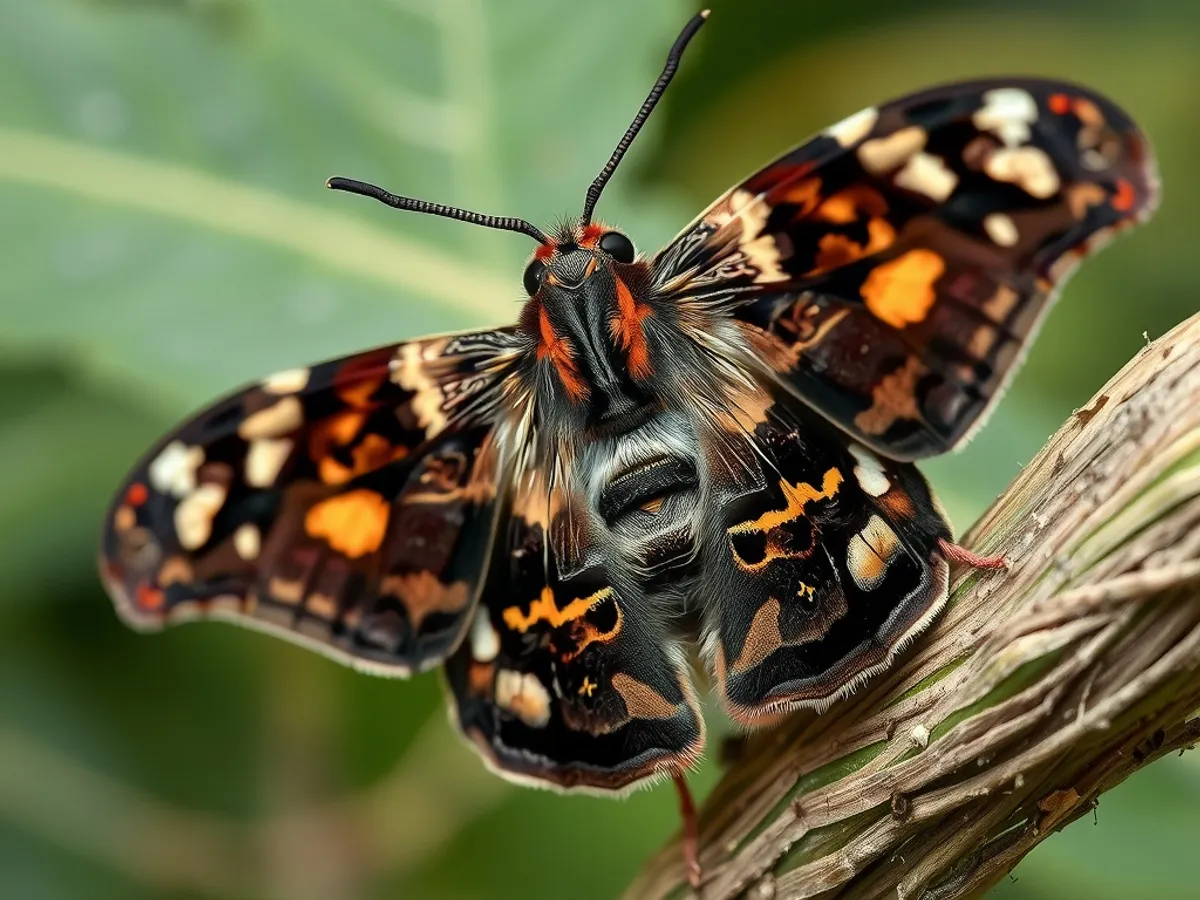
About the Death's-head hawkmoth
Acherontia atropos wears a pattern on its thorax that a human brain immediately reads as a skull, and it is one of very few insects that can produce a loud audible squeak. The sound is not made by rubbing body parts together like a cricket; the moth draws air in through its short, stout proboscis, and the rush of air vibrates a flap in the pharynx, so it is closer to a whistle than to stridulation. It squeaks when handled, and it squeaks inside beehives — which is the moth's real speciality. Death's-head hawkmoths raid honeybee colonies to drink honey directly from the comb, and they get away with it because their cuticle is coated in fatty acids that chemically resemble the bees' own colony scent, and because their skin is thick and rubbery enough to shrug off the stings they do collect. The stout proboscis, unusually short for a hawkmoth, is built for piercing capped honeycomb rather than for hovering at flowers. Adults are strong migrants, crossing from Africa into Europe each summer and breeding as far north as Britain in good years, though they cannot survive northern winters. The caterpillar is a huge green or yellow creature with a curled tail horn that feeds mainly on potato and other nightshades.
Fascinating facts
Unique Skull Marking
The Death's-head hawkmoth is instantly recognizable by the skull-shaped pattern on its thorax, which has inspired myths and superstitions.
Honey Thief
This moth is infamous for entering beehives to feed on honey, and it chemically mimics the scent of bees to avoid detection.
Squeaking Defense
When threatened, it emits a loud squeak by expelling air through its proboscis, startling potential predators.
Detailed description
The Death's-head hawkmoth (Acherontia atropos) is a robust, large-bodied moth, with a wingspan ranging from 90 to 130 mm, making it one of the largest moths in Europe and Africa. Its forewings are mottled brown and black, while the hindwings are banded with yellow and brown, aiding in camouflage among foliage and bark. The most distinctive feature is the pale, skull-shaped pattern on the thorax, which has contributed to its notoriety in folklore. The body is stout and covered in fine scales, and the abdomen often displays a series of yellow and black stripes. The larvae are equally striking, reaching up to 120 mm in length, and are typically green, yellow, or brown with oblique lateral stripes and a thorn-like horn on the posterior. Adults are primarily nocturnal, with powerful, rapid flight, and are known for their ability to emit a high-pitched squeak when disturbed—a rare trait among Lepidoptera. Their compound eyes provide acute night vision, and their strong proboscis is uniquely adapted for piercing wax cells in beehives to feed on honey. The species is solitary, with individuals only coming together to mate. Death's-head hawkmoths are migratory, capable of long-distance flights, and are often observed in late summer and autumn, coinciding with their breeding season.
Did you know?
The Death's-head hawkmoth has been featured in popular culture, most notably in the film 'The Silence of the Lambs,' where it became an iconic symbol.
Research & sources
Wikipedia summary
The name death's-head hawkmoth refers to any of three moth species of the genus Acherontia. The former species is found throughout Africa and in Europe, the latter two are Asian; most uses of the common name refer to the African species. These moths are easily distinguishable by the vaguely human skull-shaped pattern of markings on the thorax. They are large nocturnal moths with brown and yellow or orange coloring, and all three species are fairly similar in size, coloration and life cycle.
Behaviour & social structure
Death's-head hawkmoths are primarily solitary and nocturnal, becoming active shortly after dusk. Adults exhibit strong, direct flight and are attracted to light sources at night. Their feeding behavior is unusual among moths: while they can feed on nectar, they are best known for raiding honeybee (Apis mellifera) hives to consume honey. They achieve this by mimicking the scent of bees, which helps them avoid detection, and using their stout proboscis to pierce wax cells. When threatened, adults can produce a loud, squeaking sound by expelling air from their pharynx, accompanied by defensive posturing such as raising the abdomen and spreading the wings. Larvae are voracious herbivores, feeding mainly on Solanaceae (nightshade family) plants such as potato, tomato, and deadly nightshade, but will also consume other plant families if necessary. Pupation occurs underground, where larvae burrow to create a chamber for metamorphosis. There is no evidence of social structure beyond mating interactions.
Reproduction & life cycle
Reproduction in Acherontia atropos typically occurs in late summer and autumn, though timing can vary with climate and geography. Males locate females via pheromones, and mating takes place at night. Females lay between 150 and 200 eggs singly on the underside of host plant leaves. The eggs hatch within 7–10 days, and the larvae undergo five instars over approximately 3–5 weeks, depending on temperature and food availability. Fully grown larvae burrow into the soil to pupate, forming an earthen cell where metamorphosis lasts 3–4 weeks. There is no parental care post-oviposition. In warmer regions, multiple generations may occur per year, while in cooler climates, the species is univoltine (one generation per year).
Adaptations & survival
The Death's-head hawkmoth exhibits several remarkable adaptations. Its ability to produce a squeaking sound is a unique anti-predator defense among moths. The moth's cuticle and coloration provide effective camouflage against tree bark and foliage. The adult's proboscis is short but robust, adapted for piercing wax cells in beehives—a rare dietary adaptation in Lepidoptera. Chemical mimicry allows the moth to infiltrate beehives by imitating the bees' scent, reducing aggression from worker bees. Larvae possess cryptic coloration and a prominent, curved horn, which may deter predators. The species' migratory behavior enables it to exploit transient resources and avoid unfavorable conditions.
Cultural significance
The Death's-head hawkmoth has a long-standing reputation in European and African folklore, often associated with death and the supernatural due to the skull-like marking on its thorax. It has appeared in art, literature, and film, most famously in 'The Silence of the Lambs,' where it symbolizes transformation and mortality. In some cultures, its appearance is considered an omen, while in others, it is used in traditional medicine or as a curiosity. Its striking appearance has made it a subject of fascination for naturalists and collectors since the 18th century.
Recent research
Recent research has focused on the moth's chemical mimicry of honeybee pheromones, revealing complex olfactory adaptations that facilitate hive infiltration. Studies using gas chromatography-mass spectrometry (GC-MS) have identified cuticular hydrocarbons that closely match those of honeybees. Genetic studies are investigating population structure and migratory routes, using mitochondrial DNA markers. There is ongoing interest in the neurobiology of the moth's sound production and its implications for predator deterrence. Climate change impacts on distribution and voltinism are also being monitored, with citizen science initiatives contributing valuable data on range shifts.
Videos
Habitat
Open woodland, gardens, and farmlands


Conservation
The Death's-head hawkmoth is currently classified as Least Concern on the IUCN Red List.
Threats & challenges
Currently, Acherontia atropos is listed as Least Concern, with stable populations across much of its range. However, localized threats include habitat loss due to agricultural intensification, pesticide use (especially on nightshade crops), and climate change, which may alter migratory patterns and host plant availability. The species is sometimes persecuted due to superstition or mistaken beliefs about its impact on beehives, though it rarely causes significant damage. Light pollution may also disrupt nocturnal behaviors. Despite these challenges, the species' broad distribution and adaptability have helped maintain healthy populations.
Taxonomy
Scientific name
Acherontia atropos
- Kingdom
- Animalia
- Phylum
- Arthropoda
- Class
- Insecta
- Order
- Lepidoptera
- Family
- Sphingidae
- Genus
- Acherontia
- Species
- atropos
Community notes
Share your observations about the Death's-head hawkmoth.
No community notes yet. Be the first!
Discover more wildlife
More fascinating animals from the encyclopedia.