
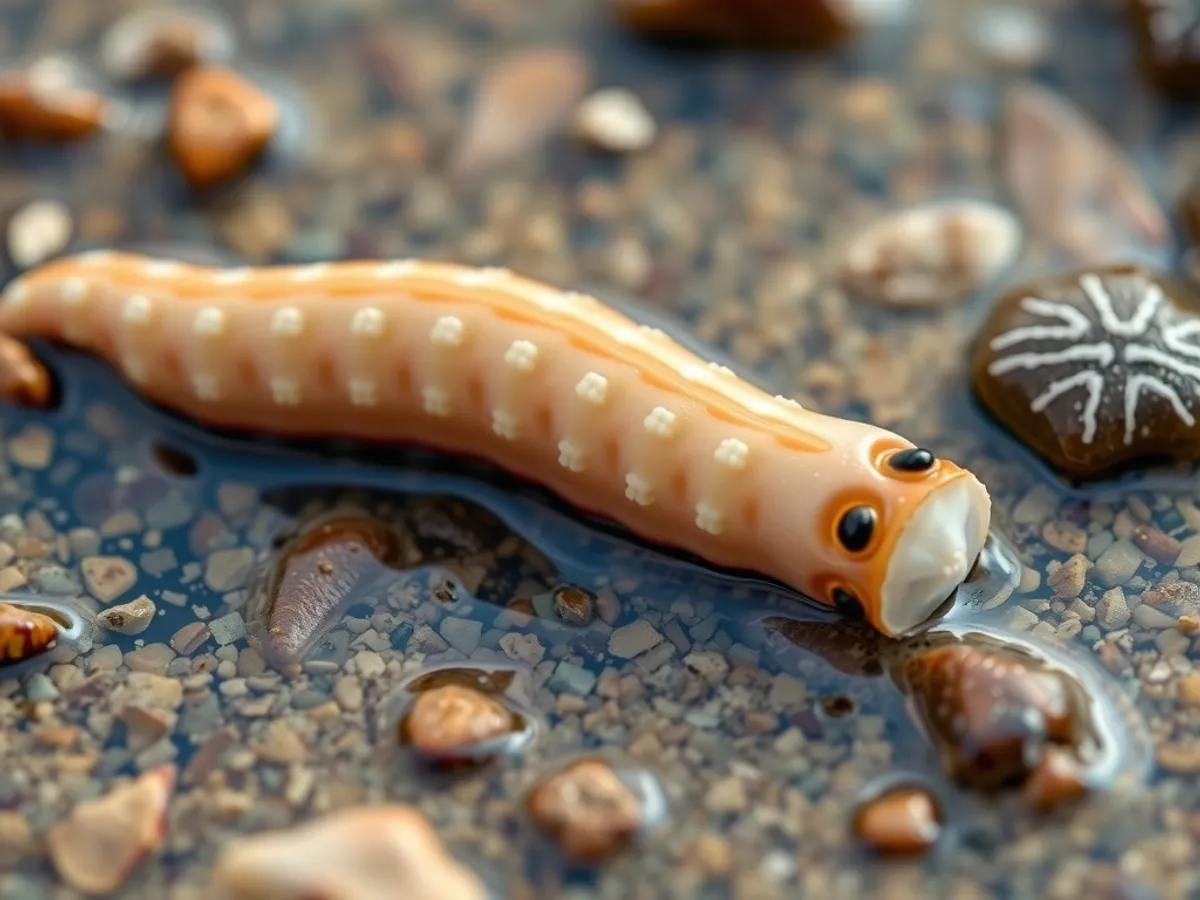
About the Acorn Worm
Acorn worms are soft-bodied, burrowing marine invertebrates belonging to the class Enteropneusta. They are named for the acorn-like appearance of their proboscis, which is used for digging and feeding. Acorn worms play an important role in marine ecosystems by aerating sediments and recycling nutrients. These animals are considered evolutionary significant as they share characteristics with both vertebrates and invertebrates, offering insight into early deuterostome evolution.
Fascinating facts
Ancient Lineage
Acorn worms are considered living fossils and provide clues to the evolutionary history of vertebrates.
Sediment Dwellers
They burrow into marine sediments, where they help aerate the sea floor and recycle organic material.
Unique Nerve Cord
Acorn worms possess a dorsal nerve cord similar to vertebrates, an unusual feature among invertebrates.
Detailed description
Saccoglossus kowalevskii, commonly known as the acorn worm, is a soft-bodied marine invertebrate reaching lengths of 10–40 cm, though some individuals may grow larger. Its body is divided into three distinct regions: a muscular, acorn-shaped proboscis, a short collar, and a long, tapering trunk. The proboscis is used for burrowing and collecting organic particles from sediment. The trunk houses the digestive tract, gonads, and a series of gill slits used for respiration and filter feeding. Acorn worms possess a dorsal nerve cord and a stomochord, a structure homologous to the notochord of chordates, making them important for evolutionary studies. Their skin is ciliated and secretes mucus, aiding in locomotion and feeding. S. kowalevskii is primarily a solitary animal, spending most of its life in U-shaped burrows in shallow coastal sediments. It plays a crucial ecological role by bioturbating sediments, which enhances nutrient cycling and oxygenation of the substrate. The species is sensitive to environmental changes, making it a valuable indicator organism for marine ecosystem health.
Did you know?
Despite their simple appearance, acorn worms are closely related to chordates, the group that includes all vertebrates.
Research & sources
Wikipedia summary
The acorn worms or Enteropneusta are a hemichordate class of invertebrates consisting of one order of the same name. The closest non-hemichordate relatives of the Enteropneusta are the echinoderms. There are 111 known species of acorn worm in the world, the main species for research being Saccoglossus kowalevskii. Two families—Harrimaniidae and Ptychoderidae—separated at least 370 million years ago.
Behaviour & social structure
Acorn worms are non-aggressive, solitary detritivores that spend the majority of their time within self-constructed burrows. They exhibit deposit-feeding behavior, extending their proboscis onto the sediment surface to collect organic matter and microorganisms, which are then transported to the mouth via ciliary action and mucus. The trunk periodically contracts to expel waste, maintaining the integrity of the burrow. Saccoglossus kowalevskii shows limited movement, typically only emerging from its burrow to relocate or when disturbed. There is no evidence of social structure or cooperative behavior; individuals maintain separate territories. Daily activity patterns are influenced by tidal cycles, with increased feeding during periods of submersion. They are sensitive to vibrations and chemical cues, retracting quickly into their burrows when threatened.
Reproduction & life cycle
Saccoglossus kowalevskii reproduces sexually, with separate male and female individuals (dioecious). Spawning typically occurs in late spring to early summer, triggered by rising water temperatures and photoperiod changes. Gametes are released into the water column, where external fertilization takes place. The fertilized eggs develop into planktonic tornaria larvae, which are free-swimming and feed on phytoplankton for several weeks. The tornaria larva undergoes metamorphosis, settling onto the substrate and transforming into a juvenile worm. There is no parental care; all development occurs independently in the plankton and then in the sediment. Generation time is typically one year, but may vary with environmental conditions.
Adaptations & survival
Acorn worms possess several adaptations for a burrowing, detritivorous lifestyle. The muscular proboscis is specialized for digging and manipulating sediment, while the collar and trunk are streamlined for movement within narrow burrows. Mucus secretion not only aids in locomotion and feeding but also protects the body from desiccation and pathogens. The presence of multiple gill slits allows for efficient gas exchange in low-oxygen environments. Their ciliated epidermis facilitates both movement and the transport of food particles. Evolutionarily, the stomochord and dorsal nerve cord represent key transitional features between invertebrates and chordates, highlighting their significance in deuterostome evolution.
Cultural significance
Acorn worms have minimal direct significance in human culture, lacking roles in mythology, symbolism, or traditional use. Their primary importance lies in scientific research, where they serve as a model organism for studies on deuterostome development, evolutionary biology, and marine ecology. Their unique anatomical features have contributed to our understanding of the evolutionary origins of chordates and vertebrates.
Recent research
Recent research has focused on the genomic sequencing of Saccoglossus kowalevskii, revealing insights into the evolution of deuterostomes and the genetic basis of body plan development. Studies on their larval forms have illuminated the origins of hemichordate and echinoderm larvae, supporting hypotheses about early Cambrian animal evolution. Ongoing work investigates their role in sediment bioturbation and ecosystem engineering. The 2024 discovery of early Cambrian pelago-benthic acorn worms has provided new perspectives on the ancestral life history strategies of hemichordates.
Videos
Habitat
Shallow marine sediments, coastal mudflats, and sandy shores

Conservation
The Acorn Worm is currently classified as Least Concern on the IUCN Red List.
Threats & challenges
Currently, Saccoglossus kowalevskii faces few direct threats and is classified as Least Concern. However, its populations are vulnerable to habitat degradation from coastal development, pollution, eutrophication, and sediment disturbance from dredging or trawling. Climate change, particularly ocean acidification and temperature shifts, may impact larval development and adult survival. As a sediment-dweller, it is sensitive to heavy metal contamination and organic pollutants. While not targeted by fisheries, its ecological role means that declines could affect sediment health and nutrient cycling.
Taxonomy
Scientific name
Saccoglossus kowalevskii
- Kingdom
- Animalia
- Phylum
- Hemichordata
- Class
- Enteropneusta
- Order
- Enteropneusta
- Family
- Harrimaniidae
- Genus
- Saccoglossus
- Species
- kowalevskii
Community notes
Share your observations about the Acorn Worm.
No community notes yet. Be the first!
Discover more wildlife
More fascinating animals from the encyclopedia.