
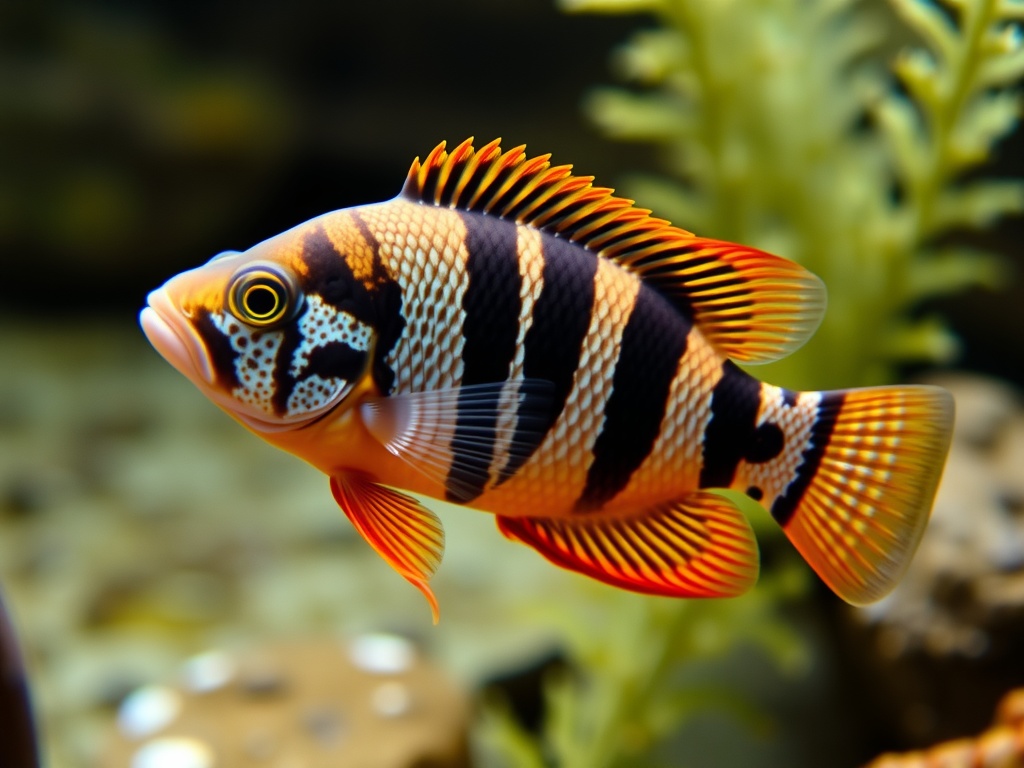
African cichlid
Varies (e.g., Pseudotropheus zebra, Haplochromis burtoni)
About the African cichlid
African cichlids are a diverse group of freshwater fish native primarily to the Great Rift Valley lakes of East Africa, especially Lakes Malawi, Tanganyika, and Victoria. They are renowned for their vivid coloration, complex social behaviors, and remarkable adaptability, with hundreds of species exhibiting a wide range of shapes and sizes. African cichlids are popular in the aquarium trade due to their striking appearance and active personalities, but they require specialized care. Their rapid speciation and ecological diversity make them a key subject in evolutionary biology studies. These fish play important roles in their native ecosystems, contributing to the unique biodiversity of African freshwater habitats.
Fascinating facts
Spectacular Colors
Many African cichlids display brilliant blues, yellows, reds, and intricate patterns, making them highly sought after for aquariums.
Mouthbrooding Masters
Some African cichlids protect their offspring by carrying eggs and fry in their mouths until they are ready to swim freely.
Evolution in Action
African cichlids have rapidly diversified into hundreds of species, providing scientists with valuable insights into the processes of adaptive radiation and speciation.
Detailed description
African cichlids comprise a vast and morphologically diverse assemblage of freshwater fish, with body lengths ranging from less than 5 cm in some dwarf species to over 90 cm in the giant cichlid (Boulengerochromis microlepis). They display a remarkable variety of body shapes, from deep-bodied and laterally compressed forms to elongated, torpedo-like profiles, often correlated with their ecological niches. Their dentition is highly specialized, with some species exhibiting robust pharyngeal jaws adapted for crushing mollusks, while others possess slender, protrusible mouths for picking plankton or scraping algae. Coloration is famously vibrant, with males often displaying iridescent blues, yellows, and reds, especially during breeding periods. African cichlids are renowned for their complex social structures, including territoriality, dominance hierarchies, and intricate courtship displays. Many species are mouthbrooders, with females (and in some cases males) incubating eggs and fry in their buccal cavities, providing protection during early development. Their sensory systems are highly developed, with acute vision adapted to the specific light conditions of their native lakes, and some species exhibit remarkable abilities to detect polarized light. The group’s evolutionary radiation, particularly in Lakes Malawi, Tanganyika, and Victoria, is one of the fastest and most extensive known among vertebrates, resulting in extraordinary ecological and morphological diversity. This adaptive radiation has produced specialized feeders, such as scale-eaters, snail crushers, and algae scrapers, each filling unique ecological roles. African cichlids are keystone species in their habitats, influencing community structure and nutrient cycling.
Did you know?
African cichlids are one of the fastest-evolving vertebrate groups on Earth, with hundreds of new species appearing in just a few thousand years.
Research & sources
Wikipedia summary
Cichlids are a large, diverse, and widespread family of percomorph fish in the family Cichlidae, order Cichliformes. At least 1,760 species have been scientifically described, making it one of the largest vertebrate families, with only the Cyprinidae being more speciose. New species are discovered annually, and many species remain undescribed. The actual number of species is therefore unknown, with estimates varying between 2,000 and 3,000. They are native to the Neotropics, Africa, the Middle East, and the Indian subcontinent, although some species have been introduced worldwide.
Behaviour & social structure
African cichlids exhibit a wide range of behavioral patterns, often dictated by their ecological niche and social structure. Many species are highly territorial, with males aggressively defending breeding sites or rocky crevices from rivals. Social hierarchies are common, with dominant individuals displaying brighter coloration and increased breeding opportunities. Feeding behavior is equally diverse: some cichlids are opportunistic omnivores, while others are specialized piscivores, insectivores, or herbivores. For example, Pseudotropheus zebra (a Lake Malawi mbuna) grazes on algae and invertebrates from rocks, while Haplochromis burtoni is known for its flexible diet, shifting between zooplankton and benthic prey. Daily routines often involve foraging during daylight hours, with periods of rest or sheltering at night. Courtship and mating behaviors are elaborate, including color changes, fin displays, and construction of spawning sites or bowers. Parental care is advanced, with mouthbrooding species exhibiting coordinated behaviors to protect and nurture offspring. Communication is facilitated through visual signals, body postures, and, in some cases, substrate vibrations.
Reproduction & life cycle
Reproductive strategies among African cichlids are highly varied but often involve complex courtship rituals and advanced parental care. Many species are maternal or biparental mouthbrooders: after external fertilization, the female (or both parents) collects the eggs in her mouth, where they incubate for 2–3 weeks, depending on species and water temperature. During this period, the parent refrains from feeding and may exhibit reduced activity. Upon hatching, fry are released but may be re-collected in the mouth at signs of danger. Substrate-spawning species lay eggs on rocks or in pits, with both parents guarding the nest and fanning the eggs to ensure oxygenation. Breeding seasons are often synchronized with environmental cues such as rainfall or temperature changes, although in stable lake environments, reproduction can occur year-round. Fecundity varies widely, from a few dozen to several hundred eggs per clutch. Sexual dimorphism is pronounced in many species, with males displaying brighter colors and larger fins during the breeding season.
Adaptations & survival
African cichlids possess a suite of adaptations that have enabled their explosive diversification. Morphologically, their pharyngeal jaws allow for specialized feeding strategies, enabling exploitation of diverse food resources. Many species have evolved cryptic coloration or disruptive patterns for camouflage among rocks and vegetation, while others use bright colors for mate attraction and species recognition. Behavioral adaptations include advanced parental care (mouthbrooding and nest guarding), complex social signaling, and the ability to rapidly adjust feeding strategies in response to environmental changes. Sensory adaptations include spectral tuning of visual pigments to match the unique light environments of their native lakes, facilitating species recognition and mate choice. Some species have evolved specialized teeth for scraping algae, prying snails, or even nipping scales from other fish. Rapid speciation is facilitated by sexual selection, ecological specialization, and geographic isolation within the lakes’ diverse microhabitats.
Cultural significance
African cichlids hold significant value in both local and global contexts. In East African communities, cichlids are an important source of protein and income, supporting artisanal fisheries. Their remarkable diversity and striking appearance have made them highly sought after in the global aquarium trade, where they are prized for their colors and behaviors. Cichlids also feature in local folklore and symbolism, often representing abundance or adaptability. In the scientific community, African cichlids are model organisms for the study of adaptive radiation, speciation, and evolutionary biology, with their rapid diversification providing key insights into mechanisms of evolution. Educational and ecotourism initiatives in the African Great Lakes region increasingly highlight the ecological and economic importance of cichlids, fostering conservation awareness.
Recent research
Recent research on African cichlids has focused on the genomic basis of their rapid speciation, revealing that hybridization and gene flow between lineages have played significant roles in generating diversity. Studies using whole-genome sequencing have identified genes associated with jaw morphology, coloration, and sensory adaptation, shedding light on the mechanisms underlying ecological specialization. Behavioral studies have explored the evolution of complex social systems, parental care, and communication, including the use of visual and acoustic signals. Conservation research has documented the impacts of environmental change and invasive species, leading to the development of captive breeding and reintroduction programs for threatened species. Ongoing work continues to unravel the evolutionary history of cichlids, with new species described annually and phylogenetic relationships continually revised.
Videos
Habitat
Freshwater lakes and rivers

Conservation
The African cichlid is currently classified as Varies by species (from Least Concern to Critically Endangered) on the IUCN Red List.
Threats & challenges
African cichlids face a range of conservation challenges, many linked to human activities. Habitat degradation from deforestation, agricultural runoff, and urbanization leads to increased sedimentation and eutrophication in lakes. Introduction of invasive species, notably the Nile perch in Lake Victoria, has caused dramatic declines and extinctions of native cichlid species. Overfishing, both for local consumption and the aquarium trade, poses additional pressures, particularly for species with restricted ranges. Climate change threatens to alter water levels, temperature regimes, and oxygen availability, further impacting sensitive species. Hybridization, often exacerbated by habitat disturbance, can erode genetic diversity. Conservation status varies widely: while some widespread species remain abundant, others are classified as Vulnerable, Endangered, or Critically Endangered by the IUCN. Ongoing monitoring, habitat protection, and sustainable management are critical for the preservation of this unique evolutionary lineage.
Taxonomy
Scientific name
Varies (e.g., Pseudotropheus zebra, Haplochromis burtoni)
- Kingdom
- Animalia
- Phylum
- Chordata
- Class
- Actinopterygii
- Order
- Cichliformes
- Family
- Cichlidae
- Genus
- Varies (notably Pseudotropheus, Haplochromis, Aulonocara, etc.)
- Species
- Varies
Community notes
Share your observations about the African cichlid.
No community notes yet. Be the first!
Discover more wildlife
More fascinating animals from the encyclopedia.