
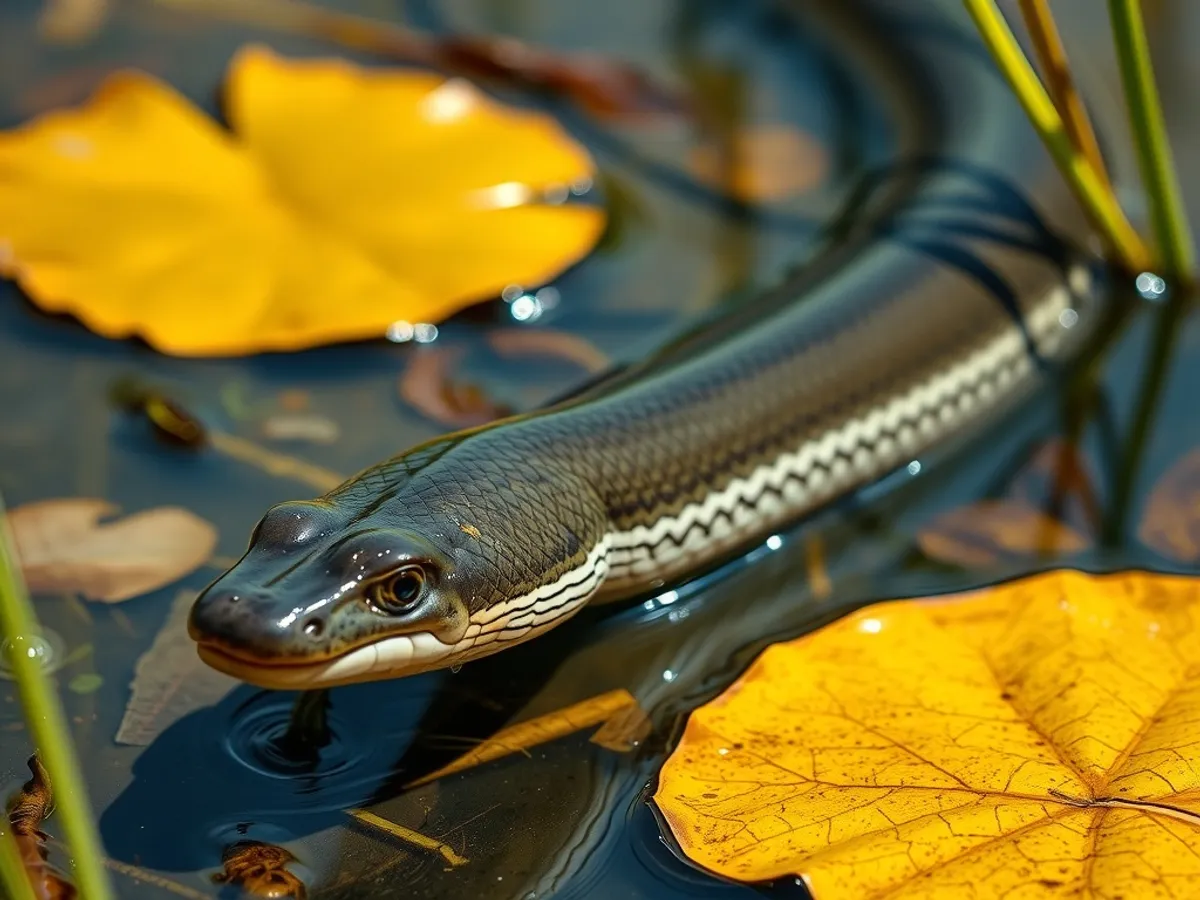
About the Asian swamp eel
The Asian swamp eel is a slender, elongated fish native to East and Southeast Asia, recognized for its snake-like appearance and adaptability to various freshwater habitats. Unlike true eels, it lacks scales and pectoral fins, and has a pointed snout with a small mouth. This species is highly tolerant of low-oxygen environments, often surfacing to breathe air. Asian swamp eels are nocturnal and can survive out of water for extended periods by burrowing into moist soil. Their ability to rapidly colonize new habitats has made them an invasive species in some regions outside their native range.
Fascinating facts
Air Breather
Asian swamp eels can breathe atmospheric air using a vascularized lining in their mouth and throat, allowing survival in stagnant or low-oxygen waters.
Sex Changer
They exhibit protogynous hermaphroditism, meaning individuals start life as females and later transform into males.
Invasive Potential
Asian swamp eels have established invasive populations in places like Florida, USA, where they threaten native aquatic species.
Detailed description
The Asian swamp eel (Monopterus albus) is a highly adaptable, elongated fish reaching lengths of 40–100 cm, with some individuals exceeding 1 meter. Its body is cylindrical, scaleless, and covered in a mucous layer, which reduces water loss and facilitates movement through mud and dense vegetation. The dorsal, anal, and caudal fins are fused into a single continuous fringe, while pectoral and pelvic fins are entirely absent, giving the eel a snake-like appearance. The coloration ranges from olive-brown to grayish, often with a paler ventral surface. The head is small and pointed, with a terminal mouth and numerous small, conical teeth suited for grasping prey. The gill openings are reduced to small slits, and the species possesses a highly vascularized buccopharyngeal cavity, allowing efficient aerial respiration. Asian swamp eels are primarily nocturnal, emerging at dusk to hunt. They are solitary and secretive, often burrowing into soft substrates or hiding among aquatic vegetation during the day. Notably, the species exhibits protogynous hermaphroditism, with individuals starting life as females and later transitioning to males. This reproductive strategy, along with their tolerance for hypoxic conditions and ability to survive periods of drought by aestivating in mud, underpins their ecological success in both native and introduced habitats.
Did you know?
Despite being called an 'eel,' the Asian swamp eel is not a true eel but belongs to a different order of fish.
Research & sources
Wikipedia summary
The Asian swamp eel, also known as rice eel, ricefield eel, rice paddy eel or white rice-field eel, is a commercially important air-breathing species of fish in the family Synbranchidae. It occurs in East and Southeast Asia, where it is commonly sold and eaten throughout the region. It has been introduced to two areas near the Everglades in Florida and near Atlanta in Georgia.
Behaviour & social structure
Asian swamp eels are predominantly nocturnal ambush predators, relying on stealth and their acute sense of smell to locate prey in turbid waters. Their diet consists mainly of aquatic invertebrates, small fish, amphibians, and occasionally detritus. They use rapid sideways strikes to capture prey, often swallowing it whole. During the day, they remain hidden in burrows, under debris, or within dense aquatic vegetation. Social interactions are minimal outside of the breeding season, as individuals are territorial and may exhibit aggressive behavior toward conspecifics. The species is capable of overland movement during wet conditions, allowing it to colonize new habitats. Daily routines are strongly influenced by water temperature, oxygen levels, and seasonal changes, with increased activity during the rainy season when prey is abundant.
Reproduction & life cycle
Monopterus albus exhibits protogynous hermaphroditism, with most individuals maturing first as females and later transforming into males, typically at lengths above 30–40 cm. Spawning occurs during the wet season (typically May–September in much of its range), triggered by rising water levels and temperature. Males construct bubble nests or excavate shallow depressions in submerged substrates, where females deposit adhesive eggs. A single female can lay several hundred to over a thousand eggs per spawning event. Males guard the nest and aerate the eggs by fanning them with body movements until hatching, which occurs after 8–10 days depending on temperature. There is no further parental care post-hatching. The species can breed multiple times per season, contributing to its rapid population growth in suitable environments.
Adaptations & survival
Key adaptations include a highly vascularized buccopharyngeal cavity for air-breathing, enabling survival in hypoxic or stagnant waters. The absence of scales and fins reduces resistance when burrowing or moving through dense vegetation. Their ability to aestivate in mud during droughts allows them to survive prolonged dry periods. Protogynous hermaphroditism ensures reproductive flexibility and maximizes breeding potential. The capacity for overland migration during wet conditions facilitates dispersal to new habitats. Their generalist diet and tolerance for a wide range of water qualities further enhance their ecological resilience.
Cultural significance
Monopterus albus is an important food fish throughout East and Southeast Asia, commonly found in wet markets and featured in traditional dishes. It is farmed in some regions and valued for its high protein content. In Chinese medicine, it is believed to have restorative properties. The eel also appears in folklore and local proverbs, often symbolizing adaptability and resilience. In rural areas, it is sometimes used as bait for larger fish or as a biological control agent in rice paddies to reduce pest populations.
Recent research
Recent studies have focused on the species' invasive potential, genetic diversity, and physiological adaptations to hypoxia. Research in the United States has examined their impact on native ecosystems and the effectiveness of various control methods. Molecular studies have clarified taxonomic relationships within Synbranchidae and revealed cryptic diversity in Asian populations. Investigations into their reproductive biology have provided insights into the mechanisms and triggers of sex reversal. Ongoing research aims to understand their role in nutrient cycling and ecosystem engineering in both native and introduced habitats.
Videos
Habitat
Freshwater wetlands

Conservation
The Asian swamp eel is currently classified as Least Concern on the IUCN Red List.
Threats & challenges
In their native range, Asian swamp eels face localized threats from habitat loss due to wetland drainage, pollution, and overfishing for food markets. However, their adaptability and high reproductive output have kept populations stable, and the IUCN lists them as Least Concern. In introduced regions such as Florida and Georgia, they are considered invasive, posing threats to native aquatic fauna through predation and competition. Control and eradication efforts are ongoing but complicated by the eel's burrowing and air-breathing abilities. Climate change and increasing habitat modification may alter their distribution in the future.
Taxonomy
Scientific name
Monopterus albus
- Kingdom
- Animalia
- Phylum
- Chordata
- Class
- Actinopterygii
- Order
- Synbranchiformes
- Family
- Synbranchidae
- Genus
- Monopterus
- Species
- albus
Community notes
Share your observations about the Asian swamp eel.
No community notes yet. Be the first!
Discover more wildlife
More fascinating animals from the encyclopedia.