
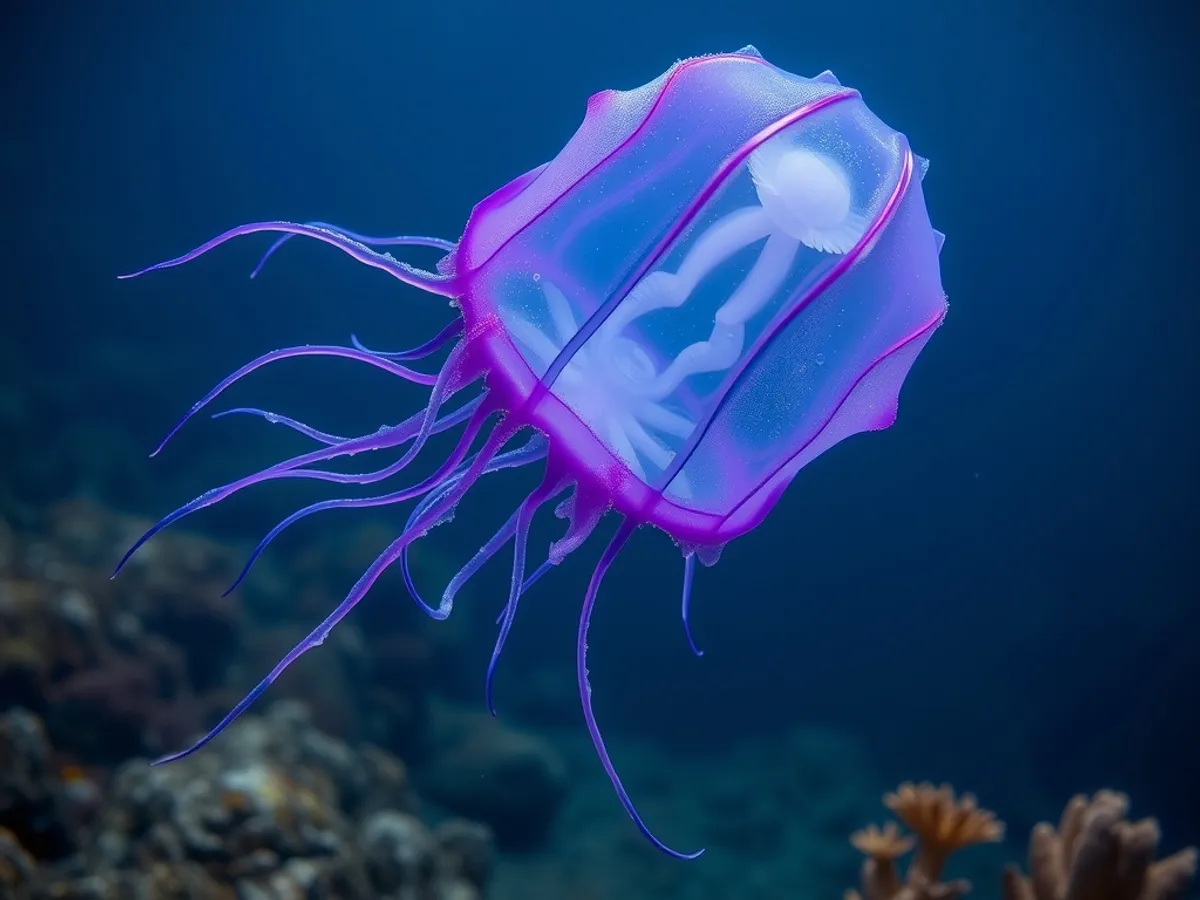
About the Atlantic Portuguese Man o' War
The Atlantic Portuguese Man o' War is a striking marine invertebrate known for its vibrant blue, purple, or pink gas-filled float that sits atop the ocean surface. Despite its jellyfish-like appearance, it is actually a siphonophore, a colonial organism made up of specialized zooids that function together as one. Its long, venomous tentacles can extend over 30 feet and are used to paralyze and capture small fish and plankton. The sting of the Portuguese Man o' War can be extremely painful to humans and sometimes dangerous, but it primarily serves as a defense mechanism and a way to subdue prey.
Fascinating facts
Wind-Powered Traveler
The Portuguese Man o' War relies on the wind and ocean currents for movement, using its gas-filled float as a sail to drift vast distances across the sea.
Colonial Creature
Unlike jellyfish, it is a siphonophore—a colony of specialized polyps (zooids) that perform different functions such as feeding, defense, and reproduction.
Venomous Tentacles
Its tentacles can deliver a potent sting that paralyzes prey and can cause severe pain, welts, and occasionally dangerous reactions in humans.
Detailed description
The Atlantic Portuguese Man o’ War (Physalia physalis) is a colonial hydrozoan, not a single animal but a siphonophore composed of genetically identical zooids, each specialized for specific functions such as floating, feeding, defense, and reproduction. Its most distinctive feature is the pneumatophore, a translucent, gas-filled float that can reach up to 30 cm (12 in) in length and rises up to 15 cm (6 in) above the water, acting as a sail to catch the wind and propel the colony across the ocean surface. Below the float dangle a cluster of long, venomous tentacles, some extending over 30 m (98 ft), which are lined with specialized stinging cells called nematocysts capable of delivering potent neurotoxic venom. The tentacles are used to ensnare and immobilize small fish, crustaceans, and zooplankton, which are then transported to the gastrozooids for digestion. The colony lacks centralized control; instead, the zooids operate in a coordinated but decentralized manner. Physalia physalis is pelagic, drifting with ocean currents and winds, and is incapable of active swimming. It is often found in large aggregations, sometimes numbering in the thousands, particularly after storms. The vivid coloration of the float, ranging from deep blue to purple and pink, serves as a warning to potential predators. Despite its delicate appearance, the Man o’ War is a formidable predator in its ecosystem and has few natural enemies, with some species of fish and sea slugs able to tolerate or even utilize its venomous tentacles.
Did you know?
Despite looking like a jellyfish, the Portuguese Man o' War belongs to a different group of organisms called siphonophores.
Research & sources
Behaviour & social structure
The Portuguese Man o’ War is primarily a passive drifter, relying on wind and surface currents for movement, though it can partially deflate its float and submerge briefly to avoid threats. It exhibits diel vertical migration, with tentacles extending deeper during the day and retracting at night. Hunting is opportunistic; the tentacles trail in the water, capturing prey that comes into contact with them. Once stung, prey is paralyzed and reeled up to the gastrozooids for digestion. Social interactions are limited, but large aggregations can form, especially after strong winds or storms. There is no evidence of cooperative behavior between colonies. The Man o’ War is subject to predation by the loggerhead turtle (Caretta caretta), the ocean sunfish (Mola mola), and the blue dragon sea slug (Glaucus atlanticus), which can consume its nematocysts and incorporate them into their own tissues for defense.
Reproduction & life cycle
Physalia physalis reproduces sexually, with separate male and female colonies releasing gametes into the water column in a process known as broadcast spawning. Fertilization is external, and the resulting planula larvae develop into new colonies through asexual budding, forming the various specialized zooids. The precise timing and environmental triggers for spawning are not fully understood, but it is believed to occur seasonally in response to temperature and photoperiod cues. There is no parental care; after spawning, the larvae are left to develop independently. Growth is rapid in favorable conditions, and colonies can reach full size within several months. The reproductive cycle and early development stages remain a subject of ongoing research due to the difficulty of observing these processes in the open ocean.
Adaptations & survival
The Man o’ War’s most notable adaptation is its division of labor among specialized zooids, allowing efficient feeding, defense, and reproduction. The pneumatophore is filled with a mixture of gases, including up to 14% carbon monoxide, giving it buoyancy and enabling wind-driven locomotion. The tentacles are equipped with thousands of nematocysts capable of delivering venom potent enough to kill small fish and deter most predators. The vivid coloration of the float acts as aposematic (warning) coloration. Some colonies exhibit left- or right-handed orientation of the float, which may help populations avoid being stranded en masse on beaches by varying their sailing direction relative to prevailing winds. The ability to retract tentacles and partially deflate the float provides limited protection from surface threats and desiccation.
Cultural significance
The Portuguese Man o’ War has a prominent place in maritime folklore, often feared by sailors and swimmers due to its painful sting. Its name derives from its resemblance to 18th-century Portuguese warships under full sail. In some cultures, it is seen as a symbol of danger and beauty in the ocean. There are no known traditional uses, given its toxicity, but it has inspired art, literature, and cautionary tales. The animal is sometimes mistakenly referred to as a jellyfish, contributing to confusion in popular media.
Recent research
Recent research has focused on the genetic and developmental mechanisms underlying zooid specialization and colony integration. Studies using molecular phylogenetics have clarified the evolutionary relationships between siphonophores and other hydrozoans. Investigations into the composition and function of the venom have identified novel toxins with potential biomedical applications. Ongoing research is examining the ecological role of Physalia physalis in pelagic food webs and its responses to oceanographic changes. There is also interest in the mechanisms of wind-driven dispersal and the factors influencing mass stranding events. Citizen science projects have contributed valuable data on distribution and seasonal occurrence.
Videos
Habitat
Open ocean (pelagic zone) in warm tropical and subtropical waters

Conservation
The Atlantic Portuguese Man o' War is currently classified as Least Concern on the IUCN Red List.
Threats & challenges
Currently, Physalia physalis is not considered threatened and is classified as Least Concern by the IUCN. However, it faces challenges from habitat changes due to climate change, such as shifting ocean currents and increasing sea surface temperatures, which may affect distribution and aggregation patterns. Mass strandings on beaches can result from strong winds and storms, leading to high mortality. Human impacts include accidental bycatch in fisheries and negative interactions with beachgoers, sometimes resulting in culling or removal. Pollution, particularly plastics, may indirectly affect populations by altering prey availability or causing entanglement. Despite these challenges, the species remains widespread and abundant in suitable habitats.
Taxonomy
Scientific name
Physalia physalis
- Kingdom
- Animalia
- Phylum
- Cnidaria
- Class
- Hydrozoa
- Order
- Siphonophorae
- Family
- Physaliidae
- Genus
- Physalia
- Species
- physalis
Community notes
Share your observations about the Atlantic Portuguese Man o' War.
No community notes yet. Be the first!
Discover more wildlife
More fascinating animals from the encyclopedia.