
About the Azure Vase Sponge
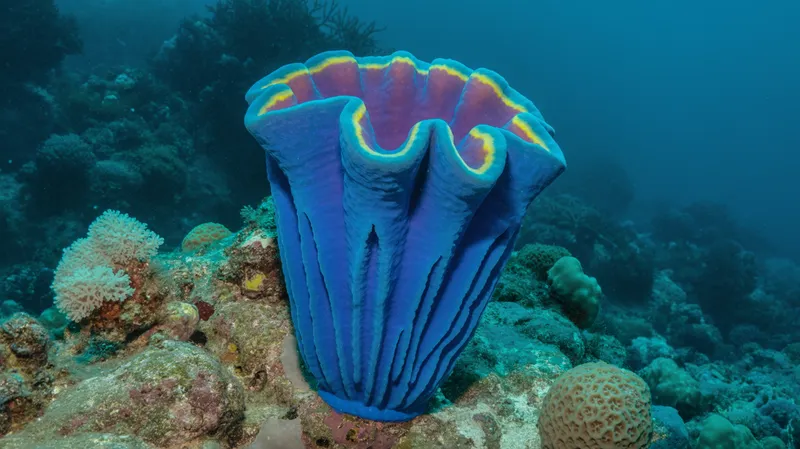
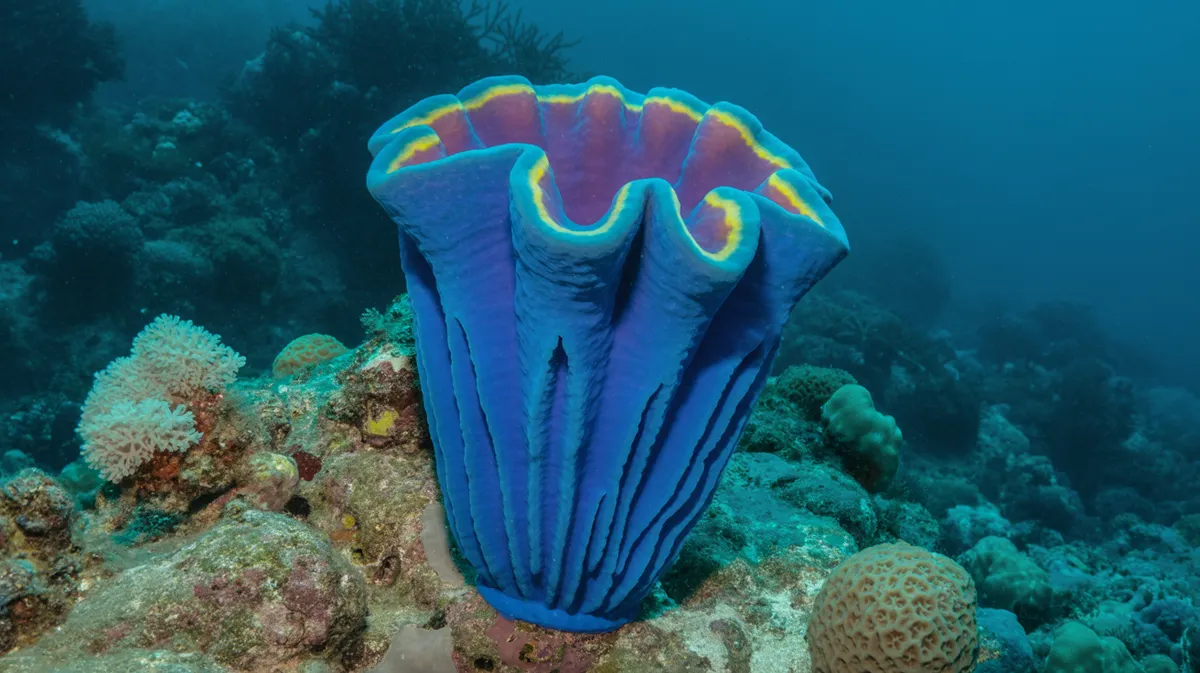
The Azure Vase Sponge is a strikingly beautiful marine invertebrate recognized for its vibrant purple to blue coloration and elegant vase-like shape. Native to the coral reefs of the Caribbean Sea and western Atlantic Ocean, this sponge can grow up to 27 centimeters tall and 13 centimeters wide. It provides habitat and shelter for a variety of small marine organisms, contributing to the overall biodiversity of reef ecosystems. The porous body allows efficient water filtration, playing a crucial ecological role by cleaning the surrounding water.
Fascinating facts
Natural Water Filter
An individual Azure Vase Sponge can filter up to 20,000 times its own volume in water each day, removing bacteria and organic particles from the ocean.
Brilliant Colors
Their iconic blue and purple hues help protect them from harmful sunlight and are produced by pigments and symbiotic cyanobacteria.
Miniature Ecosystem
The sponge’s structure provides refuge for shrimp, small fish, and other marine creatures, supporting complex reef communities.
Detailed description
The Azure Vase Sponge (Callyspongia plicifera) is a visually striking demospongian, easily recognized by its vibrant azure to purple coloration and its characteristic vase- or tube-shaped morphology. Typically reaching heights of 15–27 centimeters and diameters up to 13 centimeters, its walls are thin (2–5 mm) and perforated with numerous ostia (inhalant pores) that facilitate water flow. The surface is often smooth but may display subtle ridges or folds, enhancing its surface area for filtration. Internally, a complex network of canals and chambers maximizes contact with water, allowing the sponge to efficiently extract microscopic food particles and oxygen. The central cavity, or atrium, opens at the top via a large osculum, which is often rimmed and slightly flared. Callyspongia plicifera is sessile, attaching firmly to hard substrates such as coral rubble or rocky outcrops in clear, oligotrophic waters, typically at depths of 10–45 meters. Its tissues are reinforced by a skeleton of spongin fibers and siliceous spicules, providing both flexibility and structural integrity. The sponge’s vivid coloration is due to a combination of pigment granules and symbiotic cyanobacteria, which may also contribute to its nutritional intake via photosynthesis. This species is a vital component of Caribbean reef ecosystems, providing habitat for commensal invertebrates and serving as a microhabitat for juvenile fishes and crustaceans.
Did you know?
Despite their plant-like appearance, Azure Vase Sponges are actually simple animals composed of loosely organized cells without true tissues or organs.
Research & sources
Wikipedia summary
Callyspongia plicifera, the azure vase sponge, is a species of sea sponge belonging to the family Callyspongiidae. It is native to the Bahamas where it is found at a depth of 31.5-44.2 m. It was first described in 1814 by Jean-Baptiste Lamarck.
Behaviour & social structure
Callyspongia plicifera is a non-motile, sessile organism that relies on passive filter feeding as its primary behavioral strategy. Water is drawn in through the numerous ostia by the coordinated beating of flagella within specialized choanocyte cells, creating a unidirectional flow that brings in plankton, bacteria, and dissolved organic matter. The sponge can regulate the diameter of its osculum to control water flow, closing it in response to sedimentation or irritants. While lacking a nervous system, it exhibits coordinated cellular responses to environmental stimuli, such as contraction of the osculum or temporary cessation of pumping when disturbed. Social interactions are limited, but dense aggregations can occur, especially in optimal reef habitats, potentially facilitating reproductive synchrony. The sponge is often colonized by small shrimp (e.g., Synalpheus spp.) and polychaete worms, which use its internal canals for shelter, forming commensal or mutualistic relationships.
Reproduction & life cycle
Azure Vase Sponges are hermaphroditic, producing both eggs and sperm, though typically not simultaneously to avoid self-fertilization. Reproduction is primarily sexual, with sperm released into the water column and drawn into neighboring sponges, where internal fertilization occurs. Embryos develop within the parent’s mesohyl and are released as free-swimming parenchymella larvae, which disperse for several hours to days before settling and metamorphosing into juvenile sponges. Asexual reproduction via budding or fragmentation is also possible, especially following physical damage. Spawning events are often synchronized with lunar cycles and elevated water temperatures, typically peaking in late spring to early summer. Parental care is limited to the brooding of embryos within the sponge body until larval release.
Adaptations & survival
Callyspongia plicifera exhibits several key adaptations for survival in coral reef environments. Its vase shape and thin walls maximize water flow and filtration efficiency, while the ability to regulate osculum size helps prevent clogging by sediments. The presence of siliceous spicules and spongin fibers provides both flexibility and resistance to predation and wave action. Pigmentation and symbiotic cyanobacteria offer protection against harmful UV radiation and may supplement nutrition via photosynthesis. The sponge can rapidly repair damaged tissue, an adaptation to the high-energy reef environment. Its chemical defenses, including secondary metabolites, deter many potential predators such as fish and invertebrates.
Cultural significance
The Azure Vase Sponge is admired for its beauty by divers and underwater photographers, often featured in marine tourism promotions for the Caribbean. While not traditionally harvested for commercial use due to its delicate structure, it has inspired decorative motifs in Caribbean art and jewelry. There is no significant role in folklore or mythology, but its ecological importance is increasingly recognized in conservation education and outreach programs.
Recent research
Recent studies have focused on the sponge’s microbiome, revealing a diverse community of symbiotic bacteria and cyanobacteria that contribute to nutrient cycling and chemical defense. Research into its secondary metabolites has identified compounds with potential pharmaceutical applications, including antimicrobial and anticancer properties. Genetic studies are shedding light on population connectivity across the Caribbean, informing conservation strategies. Ongoing monitoring is assessing the impacts of climate change and disease outbreaks on sponge health and reef ecosystem services.
Videos
Habitat
Coral reefs
Conservation
The Azure Vase Sponge is currently classified as Least Concern on the IUCN Red List.
Threats & challenges
Although currently listed as Least Concern, Callyspongia plicifera faces several threats, including habitat degradation from coral reef decline, sedimentation, pollution, and climate change. Ocean acidification and rising sea temperatures may impact its symbiotic relationships and reproductive success. Overgrowth by macroalgae, invasive species, and increased frequency of sponge diseases (e.g., cyanobacterial infections) are additional concerns. While not targeted by fisheries, sponges are sometimes collected for the aquarium trade. Population trends are generally stable, but localized declines have been observed in areas with significant reef disturbance.
Taxonomy
Scientific name
Callyspongia plicifera
- Kingdom
- Animalia
- Phylum
- Porifera
- Class
- Demospongiae
- Order
- Haplosclerida
- Family
- Callyspongiidae
- Genus
- Callyspongia
- Species
- plicifera
Community notes
Share your observations about the Azure Vase Sponge.
No community notes yet. Be the first!
Discover more wildlife
More fascinating animals from the encyclopedia.