
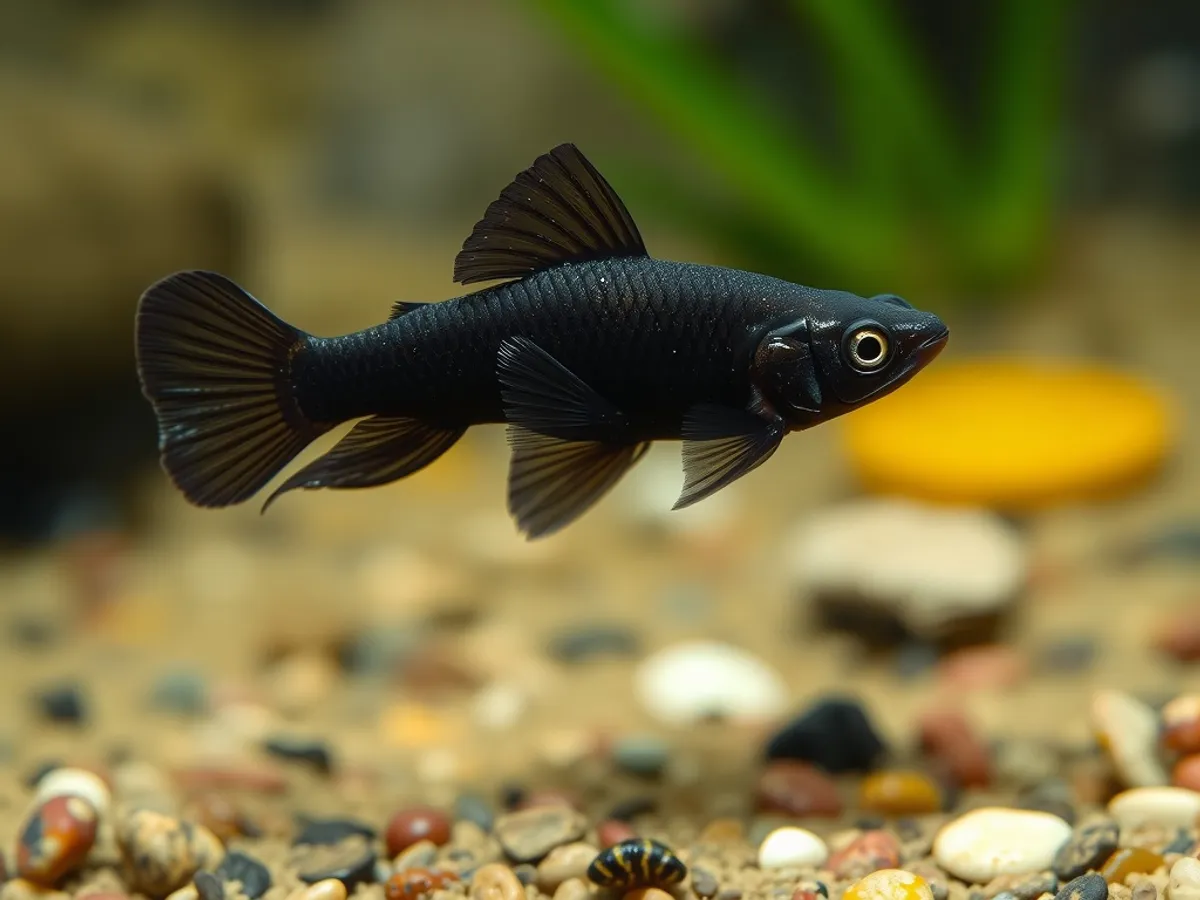
About the Black Molly
The Black Molly is a popular freshwater fish known for its striking all-black coloration and peaceful temperament. Native to Central and South America, this livebearing species thrives in both freshwater and brackish environments. Black Mollies are small, active fish that are often kept in home aquariums due to their hardiness and adaptability. They are social animals that do best in groups and are known for their prolific breeding habits.
Fascinating facts
Livebearer
Unlike many fish, Black Mollies give birth to live, free-swimming young instead of laying eggs.
Habitat Flexibility
Black Mollies can adapt to a range of water types, including freshwater and slightly salty (brackish) environments.
Algae Eaters
They help keep aquariums clean by grazing on algae and organic debris.
Detailed description
The Black Molly (Poecilia sphenops) is a small, laterally compressed fish, typically reaching 6–10 cm in length, with females generally larger than males. Its most distinctive feature is its uniform, velvety black coloration, a result of selective breeding from naturally occurring wild morphs. The body is streamlined, with a slightly upturned mouth adapted for surface feeding, and males possess a modified anal fin called a gonopodium used in reproduction. Black Mollies exhibit sexual dimorphism, with males being slimmer and having more pointed dorsal and anal fins. In the wild, they inhabit slow-moving freshwater streams, coastal lagoons, and brackish estuaries, displaying remarkable tolerance to varying salinities. Social by nature, they form loose shoals, which provides safety from predators and facilitates complex social interactions. Their omnivorous diet includes algae, detritus, small invertebrates, and plant matter, contributing to their ecological role as both grazers and prey. Black Mollies are livebearers, giving birth to fully formed fry after internal fertilization, and are known for their high reproductive rates. Their adaptability, hardiness, and peaceful temperament have made them a staple in the aquarium trade, where they are valued for their striking appearance and ease of care.
Did you know?
Black Mollies can help control algae growth in aquariums due to their grazing behavior.
Research & sources
Behaviour & social structure
Black Mollies are diurnal, being most active during daylight hours. They spend much of their time grazing on algae and biofilm on submerged surfaces, often in small groups that provide social stimulation and reduce individual stress. In the wild, they exhibit shoaling behavior, which helps deter predators and enhances foraging efficiency. Feeding is opportunistic; they consume filamentous algae, small crustaceans, insect larvae, and organic detritus. Hierarchies may form within groups, especially among males competing for mates, but aggression is generally low. Courtship involves males displaying their fins and performing rapid swimming movements to attract females. Black Mollies are known for their adaptability, adjusting their activity levels and feeding habits in response to environmental changes, such as fluctuations in salinity, temperature, and food availability.
Reproduction & life cycle
Poecilia sphenops is a livebearing species with internal fertilization. Males use their gonopodium to transfer sperm to females, who can store sperm for several months, allowing multiple broods from a single mating. Gestation lasts 4–6 weeks, depending on water temperature and environmental conditions. Females give birth to 20–100 fry per brood, with larger females producing more offspring. There is no parental care; fry are independent from birth and often seek shelter among aquatic vegetation to avoid predation, including from adult mollies. Breeding occurs year-round in tropical climates, but in captivity, optimal breeding is achieved at temperatures of 24–28°C. Selective breeding in aquaria has enhanced reproductive traits, such as increased brood size and frequency.
Adaptations & survival
Black Mollies possess several adaptations for survival in variable environments. Their euryhaline physiology allows them to tolerate a wide range of salinities, from freshwater to brackish and even marine conditions, by regulating ion exchange through specialized gill and kidney functions. Their upturned mouth is adapted for surface feeding, enabling them to exploit floating food sources and algae. The species' prolific reproductive strategy ensures rapid population recovery and colonization of new habitats. Social shoaling behavior reduces predation risk and enhances foraging success. Additionally, their dark coloration provides camouflage in shaded, vegetated waters, and may play a role in thermoregulation by absorbing more heat in cooler environments.
Cultural significance
The Black Molly holds a prominent place in the global aquarium hobby, symbolizing adaptability and resilience. It is one of the earliest livebearers to be domesticated and selectively bred, with its striking coloration making it a favorite among aquarists since the early 20th century. In some cultures, mollies are believed to bring good luck or prosperity, and their ease of breeding has made them a model organism for genetic and developmental studies. While not featured in traditional folklore, their popularity has influenced aquarium culture and contributed to public interest in aquatic biodiversity.
Recent research
Recent research on Poecilia sphenops has focused on its remarkable salinity tolerance, with studies elucidating the molecular and physiological mechanisms underlying osmoregulation. Genetic studies have explored the effects of selective breeding on coloration, reproductive traits, and hybridization with related species. Black Mollies have also been used as model organisms in ecotoxicology, helping to assess the impacts of pollutants and endocrine disruptors in aquatic environments. Ongoing research investigates their social behavior, mate choice, and the evolutionary significance of livebearing reproduction. Advances in genomics are providing new insights into the genetic basis of their adaptability and phenotypic diversity.
Sources
Poecilia sphenops (Black Molly): Taxonomy, Biology, and Ecology
Rosen, D.E. & Bailey, R.M. (1963)
scientificPoecilia sphenops (Black Molly): Taxonomy, Ecology, and Reproductive Biology
R. Wischnath, Livebearing Fishes: A Guide to Their Biology and Classification (1993)
scientificVideos
Habitat
Freshwater rivers, streams, and coastal brackish waters

Conservation
The Black Molly is currently classified as Least Concern on the IUCN Red List.
Threats & challenges
Currently listed as Least Concern by the IUCN, Black Mollies face few significant threats in the wild due to their adaptability and broad distribution. However, localized populations may be affected by habitat degradation, pollution, and competition with invasive species. In some areas, hybridization with other Poecilia species introduced through the aquarium trade poses a risk to genetic integrity. Over-collection for the pet trade is not considered a major threat, as most aquarium specimens are captive-bred. Climate change and water quality deterioration could pose future challenges, particularly in sensitive estuarine habitats.
Taxonomy
Scientific name
Poecilia sphenops
- Kingdom
- Animalia
- Phylum
- Chordata
- Class
- Actinopterygii
- Order
- Cyprinodontiformes
- Family
- Poeciliidae
- Genus
- Poecilia
- Species
- sphenops
Community notes
Share your observations about the Black Molly.
No community notes yet. Be the first!
Discover more wildlife
More fascinating animals from the encyclopedia.