
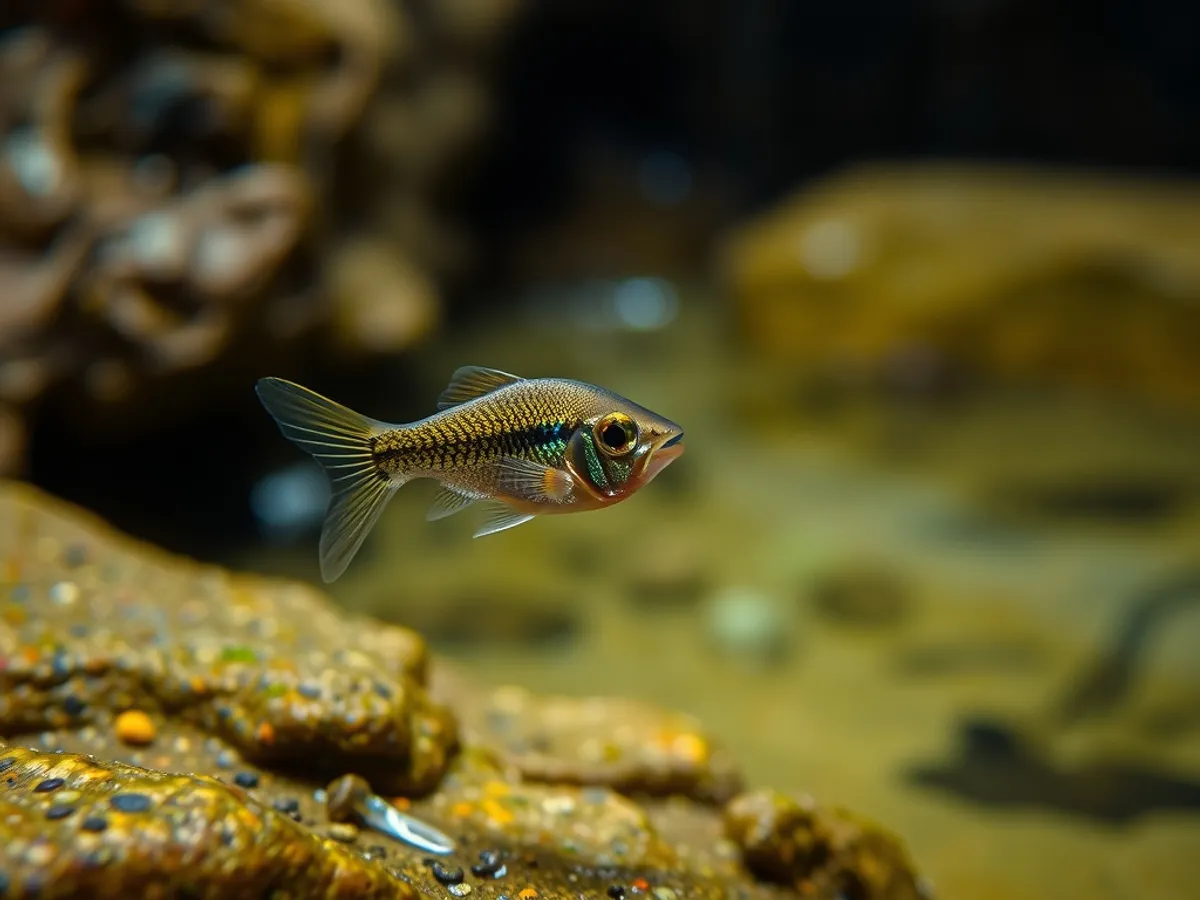
About the Blind cave tetra
The blind cave tetra is the same species as an ordinary, fully eyed silver river fish, Astyanax mexicanus, and that is what makes it so valuable. Surface fish washed into caves in northeastern Mexico have independently lost their eyes and pigment on at least thirty separate occasions, giving biologists a repeated natural experiment. The eye loss is active, not passive: the embryo starts building a perfectly normal eye, and then the lens triggers its own destruction and the whole structure degenerates. Transplant a lens from a surface fish into a cave fish embryo and the eye develops. What it gains in exchange is a redistributed budget: far more taste buds on the head, denser lateral-line neuromasts that let it read the pressure waves bouncing off cave walls so it never collides with anything, extra fat, and radically reduced sleep — around two hours a day where surface fish sleep for hours. It also carries a mutation that in humans causes insulin resistance, yet remains healthy, which has made it a serious model in diabetes research.
Fascinating facts
Born with Eyes
Blind cave tetras develop eyes as embryos, but their eyes degenerate and are covered with skin as they grow, leaving them completely blind as adults.
Life in Darkness
This species is specially adapted to live in pitch-black cave systems, relying on other senses to survive.
Model Organism
Scientists use blind cave tetras to study genetic changes related to vision loss and adaptation, as well as regressive evolution.
Detailed description
The blind cave tetra (Astyanax mexicanus) is a small, laterally compressed freshwater fish, typically reaching 7–12 cm in length. Its most distinctive features are the complete absence of functional eyes and pigmentation, resulting in a pale, almost translucent body. The species exhibits a robust, streamlined form with well-developed fins, aiding navigation in subterranean waters. Sensory adaptations include an enhanced lateral line system and increased numbers of taste buds and mechanoreceptors, allowing the fish to detect minute water movements and chemical cues. Unlike its surface-dwelling relatives, the cave form lacks scales and exhibits a reduced metabolic rate, an adaptation to the nutrient-poor cave environment. Behaviorally, blind cave tetras are active foragers, relying on chemosensory and mechanosensory input to locate food. Socially, they are generally non-territorial and may form loose aggregations, although interactions are limited compared to surface forms. Reproduction occurs year-round in stable cave conditions, with external fertilization and no parental care. The species is a model organism for studies of regressive evolution, as both surface (eyed, pigmented) and cave (eyeless, depigmented) morphs exist and can interbreed, providing insight into genetic and developmental mechanisms underlying evolutionary change.
Did you know?
Some populations of blind cave tetras have evolved independently in different cave systems, making them a classic example of convergent evolution.
Research & sources
Wikipedia summary
The Mexican tetra, also known as the blind cave fish, blind cave characin or the blind cave tetra, is a freshwater fish in the Characidae family of the order Characiformes. The type species of its genus, it is native to the Nearctic realm, originating in the lower Rio Grande, and the Neueces and Pecos Rivers in Texas, into the Central Plateau and eastern states of Mexico.
Behaviour & social structure
Blind cave tetras are primarily nocturnal foragers, though the perpetual darkness of their habitat renders traditional diurnal cycles irrelevant. They use their highly sensitive lateral line system to detect vibrations and water currents, enabling them to locate prey such as small invertebrates, detritus, and plant matter. Feeding is opportunistic, and they exhibit a 'bump and taste' strategy—frequently bumping into objects and tasting them to determine edibility. Socially, cave tetras are less aggressive and less hierarchical than their surface counterparts, displaying reduced territoriality and aggression, likely an adaptation to the limited resources and space in caves. They may form loose shoals, but individual spacing is maintained through mechanosensory cues. In laboratory settings, they show reduced schooling behavior and increased exploratory activity compared to surface forms.
Reproduction & life cycle
Astyanax mexicanus is oviparous, with external fertilization. Spawning can occur year-round due to the stable temperature and environmental conditions of caves (typically 22–25°C). Females release hundreds of adhesive eggs, which attach to submerged surfaces. There is no parental care; eggs hatch after 2–4 days, and larvae are free-swimming shortly thereafter. Sexual maturity is reached at about 6–8 months. In both wild and laboratory conditions, breeding is triggered by increased food availability and slight temperature changes. Hybridization between cave and surface forms is possible, and offspring display a range of intermediate traits, making the species valuable for genetic studies of development and evolution.
Adaptations & survival
Key adaptations include complete loss of functional eyes (ocular regression), loss of pigmentation (albinism), and enhancement of non-visual sensory systems. The lateral line system is highly developed, allowing detection of subtle water movements and vibrations. Taste buds are more numerous and distributed over the head and body, facilitating chemosensory exploration. Metabolic rate is lower than surface forms, reducing energy requirements in the nutrient-scarce cave environment. Behavioral adaptations include reduced aggression, increased foraging efficiency, and altered circadian rhythms. Genetic studies have identified mutations in genes related to eye development (e.g., pax6, shh) and pigmentation (e.g., oca2), illustrating convergent evolution across multiple cave populations.
Cultural significance
The blind cave tetra holds a unique place in scientific culture as a model organism for evolutionary biology, particularly studies of regressive evolution, sensory adaptation, and developmental genetics. It is frequently featured in educational materials, documentaries, and public aquaria. In local Mexican folklore, cave fish are sometimes regarded as mysterious or symbolic of the hidden world beneath the earth, though there is limited evidence of traditional uses or mythology specifically associated with this species.
Recent research
Recent research has focused on the genetic basis of eye and pigment loss, with studies revealing that multiple, independently evolved cave populations exhibit similar regressive traits through both shared and unique genetic pathways. The species is also used to investigate sleep regulation, metabolic adaptation, and neural development in the absence of light. Notably, studies have shown that cave tetras sleep less than surface forms, possibly as an adaptation to maximize foraging in a resource-poor environment. Ongoing research includes genome sequencing, CRISPR-based gene editing, and comparative developmental studies to elucidate the mechanisms of evolutionary change.
Videos
Habitat
Cave streams and underground freshwater pools

Conservation
The Blind cave tetra is currently classified as Least Concern on the IUCN Red List.
Threats & challenges
While the surface-dwelling form of Astyanax mexicanus is listed as Least Concern, some isolated cave populations are considered vulnerable due to their restricted ranges and sensitivity to habitat disturbance. Threats include groundwater pollution, habitat modification, over-extraction of water, and human disturbance of cave systems. Climate change and drought may also impact aquifer levels and water quality. Population trends are generally stable for surface forms, but some cave populations are declining or fragmented, warranting local conservation attention.
Taxonomy
Scientific name
Astyanax mexicanus
- Kingdom
- Animalia
- Phylum
- Chordata
- Class
- Actinopterygii
- Order
- Characiformes
- Family
- Characidae
- Genus
- Astyanax
- Species
- mexicanus
Where to see a blind cave tetra
2 zoos and aquariums in 1 country are recorded as keeping this species.

Community notes
Share your observations about the Blind cave tetra.
No community notes yet. Be the first!
Discover more wildlife
More fascinating animals from the encyclopedia.