
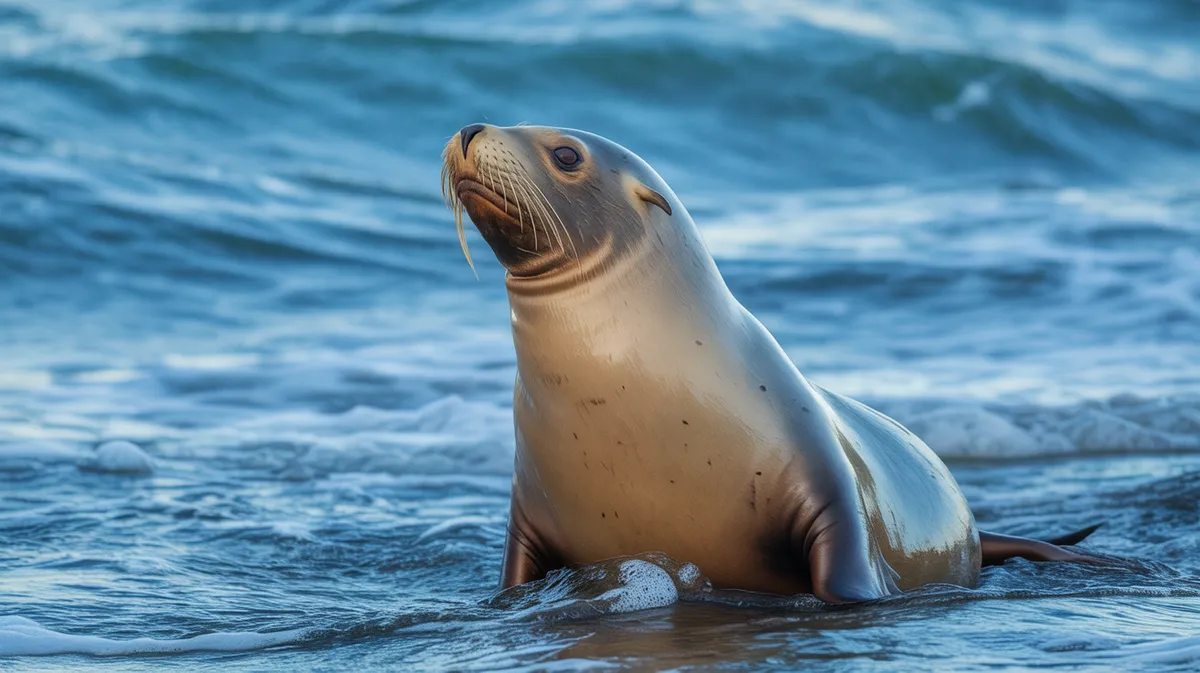
About the Californian Sea Lion
The Californian Sea Lion is a sleek, intelligent marine mammal renowned for its playful nature and adaptability. Found along the western coast of North America, these sea lions are highly social, often seen in large, noisy colonies on beaches and rocky shores. They have streamlined bodies, external ear flaps, and powerful fore-flippers, making them agile swimmers capable of reaching speeds up to 40 km/h. Their intelligence and trainability have made them popular performers in marine parks and valuable participants in scientific research.
Fascinating facts
Superb Swimmers
Californian Sea Lions can reach speeds up to 40 km/h (25 mph) in the water, making them one of the fastest marine mammals.
Vocal Communicators
They use a wide range of vocalizations, such as barks and growls, to communicate within large colonies and establish territory.
Highly Trainable
Their intelligence and social nature make them excellent for marine mammal training, search and rescue, and even military applications.
Detailed description
The California sea lion (Zalophus californianus) is a robust, sexually dimorphic pinniped distinguished by its streamlined, torpedo-shaped body, external ear flaps (pinnae), and long, powerful foreflippers. Adult males can reach lengths of 2.4 meters (8 ft) and weigh up to 390 kg (860 lbs), while females are smaller, averaging 1.8 meters (6 ft) and 110 kg (240 lbs). Males develop a prominent sagittal crest on their heads as they mature, which is associated with dominance and breeding status. Their pelage is short and sleek, varying from chocolate brown in males to lighter golden brown in females and juveniles. California sea lions are highly social, forming large, noisy colonies on beaches, rocky outcrops, and increasingly in urbanized harbors. They are known for their agility both in water and on land, capable of 'porpoising' at speeds up to 40 km/h (25 mph) and climbing onto docks or jetties with ease. Their vocalizations are complex, including barks, growls, and mother-pup contact calls. As opportunistic predators, they consume a wide variety of fish and cephalopods, adapting their foraging strategies to local prey availability. Their intelligence, problem-solving abilities, and trainability have made them subjects of cognitive research and marine mammal programs. California sea lions exhibit seasonal migrations, with some populations traveling hundreds of kilometers between breeding and feeding grounds.
Did you know?
Californian Sea Lions can recognize and remember individual human voices, which is rare among non-human animals.
Research & sources
Wikipedia summary
The California sea lion is a coastal eared seal native to western North America. It is one of six species of sea lions. Its natural habitat ranges from southeast Alaska to central Mexico, including the Gulf of California. California sea lions are sexually dimorphic; males are larger than females, and have a thicker neck, and a protruding sagittal crest. They mainly haul out on sandy or rocky beaches, but they also frequent manmade environments such as marinas and wharves. California sea lions feed on a number of species of fish and squid, and are preyed on by orcas and great white sharks.
Behaviour & social structure
California sea lions are diurnal and highly gregarious, often observed resting in dense groups on haul-out sites during the day and foraging at night. Social hierarchies are established, especially among males during the breeding season, with dominant males defending territories and harems. They display a range of social behaviors, including synchronized swimming, playful interactions, and cooperative hunting. Foraging dives typically last 1.5–3 minutes and can reach depths of 80–274 meters (260–900 ft), though most feeding occurs in the upper 100 meters. Their diet is diverse, including anchovies, sardines, mackerel, squid, and occasionally salmonids. California sea lions use their sensitive vibrissae (whiskers) to detect prey in murky waters and are known to exploit fishing operations, sometimes leading to conflict with humans. Vocal communication is essential for mother-pup recognition and social cohesion within colonies.
Reproduction & life cycle
Breeding occurs from May to August, primarily on offshore islands and remote coastal sites. Males arrive first to establish and defend territories, often engaging in vocal and physical contests. Females give birth to a single pup after a gestation period of about 11–12 months, which includes a delayed implantation of the fertilized egg. Pups are born on land and weigh 6–9 kg (13–20 lbs) at birth. Mothers nurse their pups for 6–12 months, alternating between foraging trips at sea and nursing periods on land. Females are capable of mating again within a few weeks after giving birth, leading to the overlapping of lactation and gestation. Parental care is exclusively maternal, with strong mother-pup bonds maintained through vocal and olfactory cues.
Adaptations & survival
California sea lions possess several adaptations for their marine lifestyle, including a thick layer of blubber for insulation, streamlined bodies for efficient swimming, and large, muscular foreflippers for propulsion. Their flexible spine and strong hind flippers allow for agile movement both in water and on land. They have excellent underwater vision, aided by a reflective tapetum lucidum, and can close their nostrils and ears to prevent water entry. Their vibrissae are highly sensitive, enabling detection of hydrodynamic trails left by prey. Physiologically, they can slow their heart rate (bradycardia) during deep dives to conserve oxygen and tolerate high levels of carbon dioxide.
Cultural significance
California sea lions have long been a symbol of the Pacific coast, featured in indigenous folklore and modern popular culture. They are prominent attractions at marine parks and aquariums, where their intelligence and trainability are showcased in performances. In some coastal communities, sea lions are considered both a tourist draw and a nuisance due to their presence in harbors and marinas. They have been used in military marine mammal programs for tasks such as object recovery and harbor security. Their playful nature and charismatic behavior have made them ambassadors for marine conservation efforts.
Recent research
Recent research on California sea lions has focused on the effects of environmental stressors, such as domoic acid toxicosis, which can cause neurological damage and reproductive failure. Studies on their foraging ecology have utilized satellite telemetry and biologging devices to track movements and dive behavior, revealing complex migratory patterns and habitat use. Cognitive research has demonstrated advanced problem-solving abilities and vocal learning. Ongoing genetic studies are investigating population structure and connectivity across their range. California sea lions are also sentinel species for monitoring ocean health, as their health reflects changes in marine ecosystems.
Videos
Habitat
Coastal waters and rocky or sandy beaches

Conservation
The Californian Sea Lion is currently classified as Least Concern on the IUCN Red List.
Threats & challenges
While currently listed as Least Concern by the IUCN, California sea lions face several threats, including entanglement in fishing gear, ingestion of marine debris, and exposure to biotoxins such as domoic acid from harmful algal blooms. They are also susceptible to infectious diseases, including leptospirosis and phocine distemper virus. Human activities, such as habitat disturbance, illegal shootings, and competition with fisheries, pose additional risks. Climate change and ocean warming may impact prey availability and distribution, leading to nutritional stress and increased strandings. Despite these challenges, the population is considered stable and has rebounded significantly since the implementation of protective legislation in the 1970s.
Taxonomy
Scientific name
Zalophus californianus
- Kingdom
- Animalia
- Phylum
- Chordata
- Class
- Mammalia
- Order
- Carnivora
- Family
- Otariidae
- Genus
- Zalophus
- Species
- californianus
Community notes
Share your observations about the Californian Sea Lion.
No community notes yet. Be the first!
Discover more wildlife
More fascinating animals from the encyclopedia.