
About the Christmas Tree Worm
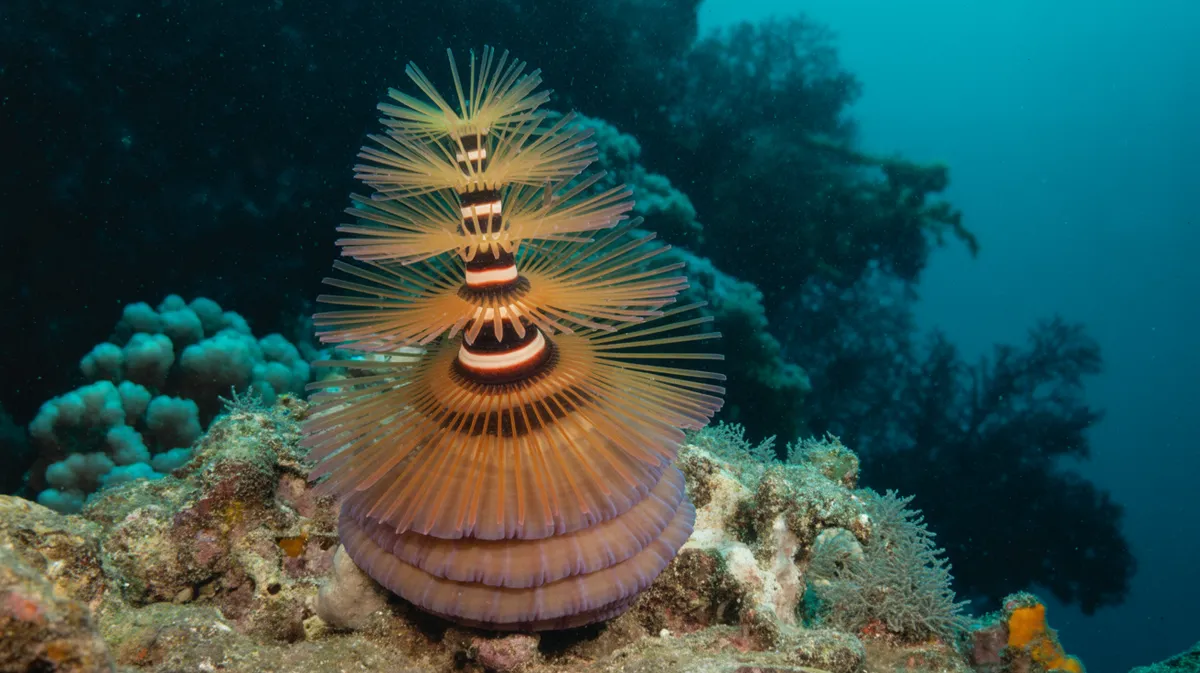
The two spiralling "trees" are all you ever see, and they are not the animal: they are the radioles, feathery crowns that do double duty as gills and as a food-collecting fan, sweeping plankton and particles down a groove to the mouth. The worm itself is a soft tube-dweller hidden inside a calcareous tube bored into living coral, and it got there in an unexpected way — the larva settles on a live coral head, and the coral simply grows around it, so the worm ends up permanently embedded in a colony that keeps building itself up around the tube. Withdrawal is instantaneous: a passing shadow or a pressure wave triggers a retraction so fast the eye can barely follow, and the worm then plugs the entrance behind it with an operculum. Colour is astonishingly variable within a single species — orange, blue, white, yellow, maroon — with no obvious pattern to it. Individuals can live for 20 to 40 years, embedded in the same coral head for their entire lives.
Fascinating facts
Colorful Spirals
The worm's iconic spirals can be found in a wide variety of vivid colors, enhancing the diversity and beauty of coral reefs.
Hidden Tube Dweller
The soft body of the Christmas Tree Worm stays safely tucked away in a hard, calcareous tube built inside coral, only exposing its plumes.
Efficient Filter Feeder
Using its radioles, the worm filters tiny food particles, such as plankton, from the surrounding seawater.
Detailed description
Spirobranchus giganteus, commonly known as the Christmas Tree Worm, is a sedentary marine polychaete worm characterized by its vividly colored, spiral-shaped radioles that protrude from its calcareous tube. These radioles, which can reach up to 4 cm in length, serve dual functions as both respiratory organs and as specialized feeding appendages, capturing plankton and suspended organic particles from the water column. The worm’s body, typically 2.5–4 cm in length, remains concealed within a tube it secretes from calcium carbonate, which is often embedded directly into the living tissue of massive stony corals, particularly Porites species. The Christmas Tree Worm exhibits remarkable color polymorphism, with individuals displaying hues of blue, orange, yellow, white, and combinations thereof, a feature thought to be genetically determined and possibly linked to camouflage or mate recognition. The worm’s operculum, a modified structure at the tube’s opening, acts as a protective door, sealing the worm inside when threatened by predators or environmental disturbances. S. giganteus is a sessile organism, meaning it remains fixed in place after settling as a larva, and it can live for up to 10–20 years under optimal conditions. Its presence is often used as an indicator of coral reef health due to its sensitivity to environmental changes. The species is distributed throughout tropical and subtropical coral reefs worldwide, from the Indo-Pacific to the Caribbean. Its intricate relationship with coral hosts is mutualistic, as the worm’s tube may help reinforce coral skeletons, while the coral provides protection and a stable substrate.
Did you know?
If threatened, the Christmas Tree Worm can retract its plumes into its tube in less than a second to avoid predators.
Research & sources
Wikipedia summary
Spirobranchus giganteus, commonly known as the Christmas tree worm, is a tube-building polychaete worm belonging to the family Serpulidae. The S. giganteus lives in coral reefs in the Indo-Pacific region to the Caribbean.
Behaviour & social structure
Christmas Tree Worms are primarily solitary, with each individual occupying its own tube, though multiple worms may be found on a single coral head. They are highly sensitive to vibrations and changes in light, rapidly retracting their radioles into their tubes at the slightest disturbance—a defense mechanism against predation by fish and invertebrates. As obligate filter feeders, they extend their radioles during daylight hours to maximize feeding efficiency, relying on ciliary currents to direct food particles toward their mouths. They do not actively hunt but passively collect plankton, microalgae, and detritus. Social interactions are minimal, limited to spatial competition for prime settlement sites on coral surfaces. The worms exhibit a circadian rhythm, with radioles more frequently extended during daylight and retracted at night or during strong water movement. They are non-migratory and remain in the same location for life after larval settlement.
Reproduction & life cycle
Spirobranchus giganteus is dioecious, with separate male and female individuals. Reproduction occurs via external fertilization, typically synchronized with seasonal cues such as water temperature, lunar cycles, and plankton blooms. During spawning events, males and females release gametes into the water column, where fertilization takes place. The resulting planktonic trochophore larvae remain in the water for several days to weeks, depending on environmental conditions, before settling onto suitable coral substrates and metamorphosing into juveniles. There is no parental care post-spawning. Breeding seasons vary geographically but often coincide with late spring to early summer in many regions, aligning with optimal conditions for larval survival.
Adaptations & survival
The Christmas Tree Worm exhibits several key adaptations for survival in coral reef environments. Its calcareous tube provides robust protection from predators and environmental stressors, while the operculum acts as a secure barrier when the worm retracts. The highly branched, ciliated radioles maximize surface area for both gas exchange and efficient suspension feeding. Their rapid withdrawal reflex is a critical anti-predator adaptation. The worm’s ability to secrete and repair its tube allows it to withstand partial coral mortality or physical damage. Color polymorphism may confer advantages in camouflage or mate selection. Additionally, S. giganteus can tolerate moderate sedimentation and fluctuating water quality, though it is sensitive to prolonged stress.
Cultural significance
The Christmas Tree Worm is a favorite subject for underwater photographers and divers due to its striking appearance and vibrant coloration. While it does not have a significant role in traditional folklore or mythology, it serves as an educational ambassador for coral reef conservation and biodiversity. Its image is frequently used in marine conservation campaigns and ecotourism marketing. There are no known traditional uses or direct exploitation by humans.
Recent research
Recent research has focused on the genetic basis of color polymorphism in S. giganteus, with studies suggesting that color variation may be linked to both genetic and environmental factors. Ongoing work is examining the worm’s role in coral reef resilience, particularly its potential to reinforce coral skeletons and influence microhabitat structure. Molecular studies have clarified phylogenetic relationships within the Serpulidae family, revealing cryptic species diversity. Additionally, the species is being used as a model organism for studying larval settlement cues and the impacts of ocean acidification on calcifying invertebrates. Long-term monitoring programs are assessing population trends in relation to coral health and climate change.
Videos
Habitat
Coral reefs

Conservation
The Christmas Tree Worm is currently classified as Least Concern on the IUCN Red List.
Threats & challenges
While currently listed as Least Concern, Christmas Tree Worms face indirect threats primarily through the degradation of coral reef habitats. Major challenges include coral bleaching, ocean acidification, destructive fishing practices, pollution, and physical damage from tourism (e.g., anchor drops, diver contact). As obligate associates of living corals, their populations are vulnerable to declines in coral cover. Localized population declines have been observed in areas with severe coral loss. However, their widespread distribution and adaptability to a range of coral hosts provide some resilience. Climate change remains the most significant long-term threat, potentially altering reproductive timing and larval dispersal.
Taxonomy
Scientific name
Spirobranchus giganteus
- Kingdom
- Animalia
- Phylum
- Annelida
- Class
- Polychaeta
- Order
- Sabellida
- Family
- Serpulidae
- Genus
- Spirobranchus
- Species
- giganteus
Community notes
Share your observations about the Christmas Tree Worm.
No community notes yet. Be the first!
Discover more wildlife
More fascinating animals from the encyclopedia.