
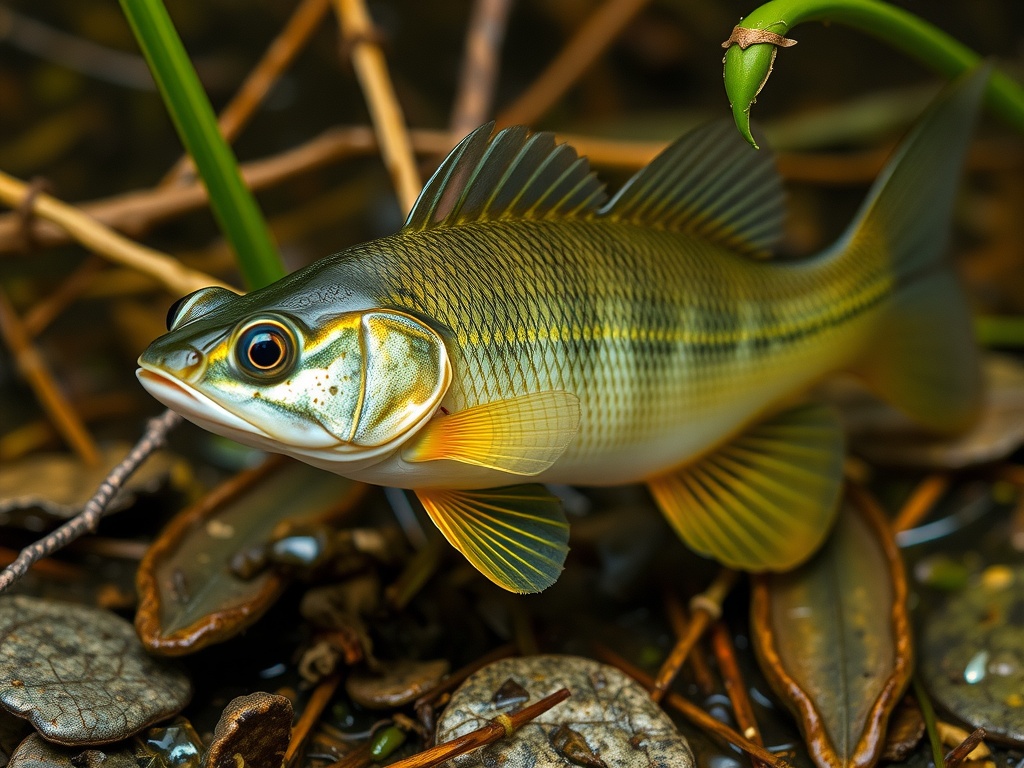
About the Climbing Perch
The Climbing Perch is a remarkable freshwater fish known for its ability to survive out of water for extended periods. Native to South and Southeast Asia, it inhabits ponds, swamps, and slow-moving streams, often in oxygen-poor environments. This species can breathe air using a specialized labyrinth organ, allowing it to traverse short distances over land in search of new habitats. Its adaptability has enabled it to thrive in a wide range of aquatic and semi-aquatic environments, making it a resilient and sometimes invasive species.
Fascinating facts
Air Breather
The Climbing Perch uses a labyrinth organ to extract oxygen from the air, allowing it to survive in low-oxygen waters and even out of water for several hours.
Land Traveler
This fish can 'walk' over land by flexing its body and using its pectoral fins, enabling it to migrate between water bodies during dry spells.
Rice Paddy Resident
Climbing Perch are commonly found in rice paddies, where their resilience to fluctuating water levels and oxygen content helps them thrive.
Detailed description
The Climbing Perch (Anabas testudineus) is a medium-sized freshwater fish, typically reaching 15–25 cm in length and weighing up to 250 grams, though most individuals are smaller. Its body is oblong and laterally compressed, covered with tough, ctenoid scales that provide protection in abrasive environments. The coloration is generally olive to brownish-green dorsally, fading to lighter shades on the belly, with faint vertical bars along the flanks. Notably, the species possesses a robust, spiny dorsal fin and a rounded caudal fin. The most distinctive anatomical feature is the labyrinth organ, a highly vascularized structure above the gills that enables efficient aerial respiration. This adaptation allows the fish to survive in hypoxic waters and even endure terrestrial excursions for several hours, provided the skin and gills remain moist. Climbing Perch are capable of moving overland by using their gill covers (opercula) and pectoral fins in a coordinated, crawling motion. Behaviorally, they are generally solitary or found in small groups, displaying territoriality during breeding. Their omnivorous diet includes aquatic invertebrates, detritus, algae, and occasionally small fish. Reproduction is oviparous, with external fertilization, and spawning is often triggered by monsoonal rains. Eggs are adhesive and deposited among submerged vegetation. The species is renowned for its resilience, tolerating wide fluctuations in temperature, salinity, and dissolved oxygen, which underpins its success in disturbed and artificial habitats.
Did you know?
Climbing Perch have been observed traveling distances of over 180 meters on land, especially during wet conditions, in search of better habitats.
Research & sources
Wikipedia summary
The Anabantidae are a family of ray-finned fish within the order Anabantiformes commonly called the climbing gouramies or climbing perches. The family includes about 34 species. As labyrinth fishes, they possess a labyrinth organ, a structure in the fish's head which allows it to breathe atmospheric oxygen. Fish of this family are commonly seen gulping at air at the surface of the water. The air is held in a structure called the suprabranchial chamber, where oxygen diffuses into the bloodstream via the respiratory epithelium covering the labyrinth organ. This therefore allows the fish to move small distances across land.
Behaviour & social structure
Climbing Perch are primarily crepuscular, being most active during dawn and dusk. They exhibit opportunistic feeding behavior, foraging both at the substrate and water surface. Their diet is highly variable, consisting of insect larvae, crustaceans, mollusks, plant matter, and detritus, reflecting their adaptability to local food availability. When oxygen levels drop, individuals frequently surface to gulp air, a behavior facilitated by the labyrinth organ. Social interactions are generally limited outside of breeding periods, with individuals maintaining small territories. Aggressive displays, such as flaring gill covers and lateral posturing, are observed during territorial disputes. In the wild, Climbing Perch may undertake short overland migrations, especially during the wet season, to colonize new water bodies or escape deteriorating conditions. They are known for their remarkable ability to survive in temporary pools and even in moist terrestrial environments for up to 6–10 hours.
Reproduction & life cycle
Breeding in Anabas testudineus is closely linked to the onset of the rainy season, typically from May to August in South Asia. Spawning is induced by increased water levels and temperature fluctuations. Courtship involves males displaying intensified coloration and circling females. Females can lay between 5,000 and 10,000 eggs per spawning event, which are externally fertilized. The adhesive eggs attach to aquatic vegetation or submerged debris. Incubation is rapid, with hatching occurring within 24–36 hours at optimal temperatures (26–30°C). There is no parental care post-spawning; larvae are planktonic and feed on microzooplankton until they develop the labyrinth organ at around 2–3 weeks of age, after which they can begin aerial respiration.
Adaptations & survival
The Climbing Perch exhibits several key adaptations: the labyrinth organ enables survival in hypoxic and stagnant waters by facilitating aerial respiration; tough, ctenoid scales and a mucous coating protect against desiccation and abrasive substrates during terrestrial excursions; and a highly flexible diet allows exploitation of diverse food resources. Their ability to osmoregulate enables survival in both fresh and mildly brackish waters. The species' capacity for terrestrial locomotion—using coordinated movements of the opercula and pectoral fins—allows it to disperse between isolated water bodies, a rare trait among fishes. Additionally, Climbing Perch can tolerate a wide range of temperatures (15–38°C) and pH levels (5.0–8.5), further enhancing their ecological plasticity.
Cultural significance
The Climbing Perch holds significant cultural and economic value in South and Southeast Asia. It is a traditional food fish, prized for its firm flesh and ability to survive out of water, which facilitates live transport to markets. Folklore often attributes the fish with remarkable endurance and resourcefulness, and in some regions, it features in proverbs and local tales. In traditional medicine, extracts from the fish are occasionally used for purported health benefits. Its unique terrestrial abilities have also made it a subject of curiosity and study in natural history.
Recent research
Recent research has focused on the physiological mechanisms underlying the labyrinth organ's function and the genetic basis of the species' environmental tolerance. Studies have examined the impact of environmental pollutants on respiratory efficiency and reproductive success. Ongoing work is investigating the species' invasive potential, particularly in Australia and Papua New Guinea, where it poses a threat to native aquatic fauna. Advances in molecular phylogenetics are refining the taxonomy of the Anabantidae family. Additionally, the Climbing Perch is being studied as a model for understanding vertebrate adaptations to extreme environments and for its potential in sustainable aquaculture.
Videos
Habitat
Freshwater bodies such as ponds, swamps, rice paddies, and slow-moving streams

Conservation
The Climbing Perch is currently classified as Least Concern on the IUCN Red List.
Threats & challenges
Currently classified as Least Concern by the IUCN, Anabas testudineus faces localized threats from habitat loss, water pollution, and overfishing, particularly in regions where it is harvested for food. Agricultural runoff and pesticide contamination can degrade habitats, while the introduction of non-native species may increase competition and predation pressure. In some areas, the species has become invasive, outcompeting native fishes and altering local ecosystems. Climate change, with its impact on hydrological cycles, may affect breeding patterns and habitat availability. Despite these challenges, the species' adaptability has so far ensured stable populations across its native and introduced ranges.
Taxonomy
Scientific name
Anabas testudineus
- Kingdom
- Animalia
- Phylum
- Chordata
- Class
- Actinopterygii
- Order
- Anabantiformes
- Family
- Anabantidae
- Genus
- Anabas
- Species
- testudineus
Where to see a climbing perch
1 zoo and aquarium in 1 country are recorded as keeping this species.

Community notes
Share your observations about the Climbing Perch.
No community notes yet. Be the first!
Discover more wildlife
More fascinating animals from the encyclopedia.