
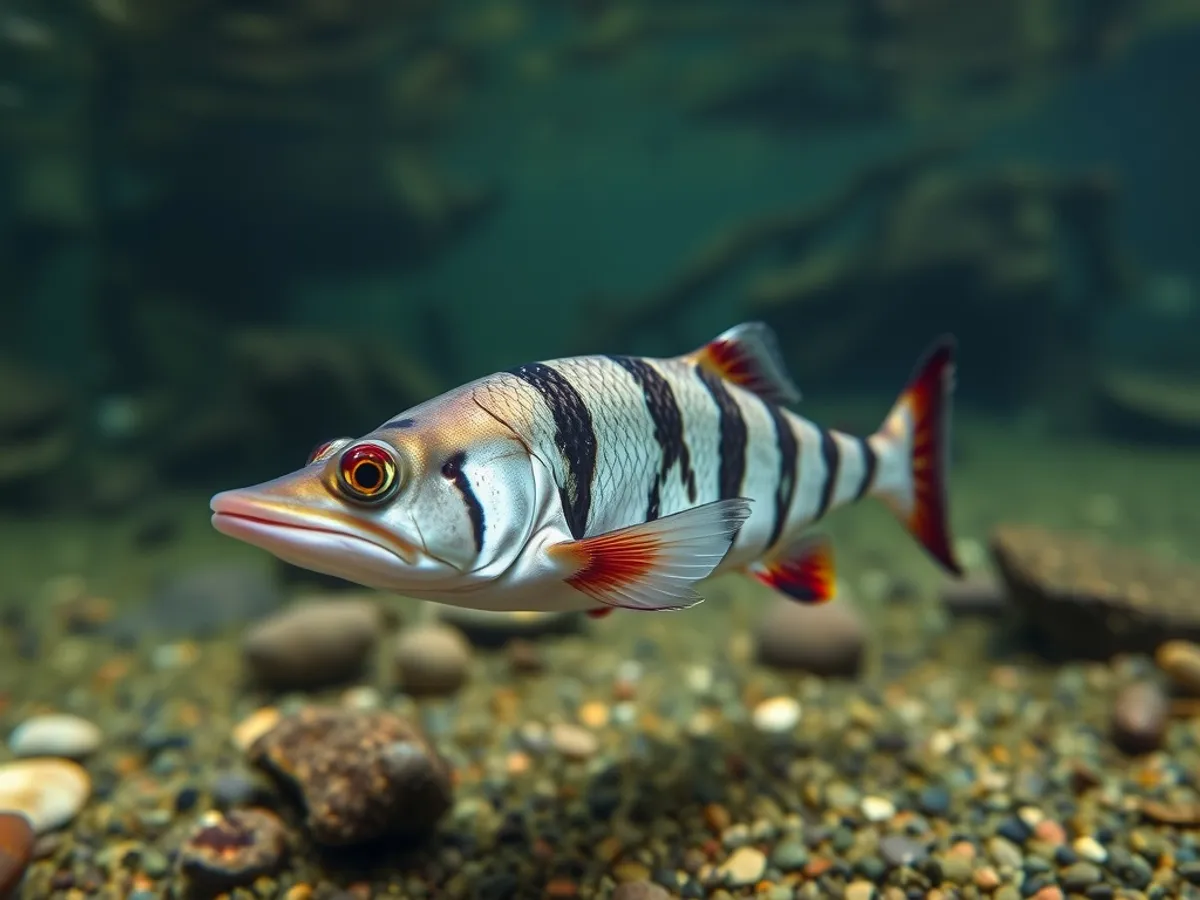
About the Clown knifefish
The clown knifefish is a large, elongated freshwater fish native to Southeast Asia, particularly Thailand, Cambodia, Laos, and Vietnam. It is easily recognized by its silvery body adorned with distinct, eye-like spots along its flanks, and its undulating, knife-shaped fin that runs along the underside of its body. Clown knifefish are nocturnal predators, using their keen sense of lateral line detection to hunt smaller fish and invertebrates in murky waters. They are popular in the aquarium trade due to their striking appearance, but can grow too large for most home tanks, reaching lengths of up to 1 meter.
Fascinating facts
Distinctive Spots
The clown knifefish is named for the series of large, eye-like spots along its body, which help deter predators by mimicking eyes.
Air Breather
This fish has a specialized swim bladder that allows it to gulp air from the surface and survive in oxygen-poor waters.
Unique Swimming
It moves using a continuous undulation of its long anal fin, enabling precise and agile movement in any direction.
Detailed description
The clown knifefish (Chitala ornata) is a large, laterally compressed freshwater fish distinguished by its elongated, knife-like body and a long, undulating anal fin that extends from mid-body to the tail, enabling highly agile, bidirectional swimming. Adults typically reach 60–100 cm in length, with exceptional specimens exceeding 120 cm and weighing up to 5 kg. Its coloration is silvery-grey with a series of prominent, dark, eye-like ocelli (spots) along the posterior half of the body, which serve as anti-predator adaptations. The dorsal fin is greatly reduced, while the pectoral fins are well-developed and aid in maneuverability. The mouth is large, terminal, and slightly upturned, equipped with small, sharp teeth suited for seizing prey. Clown knifefish possess a specialized swim bladder that functions as an accessory respiratory organ, allowing them to gulp atmospheric air and survive in hypoxic (low-oxygen) environments. Their lateral line system is highly sensitive, facilitating navigation and prey detection in turbid waters. Nocturnal by nature, they are most active during the night, often hiding among submerged roots or vegetation by day. Juveniles display more pronounced spots, which may fade or merge as they mature. In the wild, their lifespan is estimated at 8–15 years, though they can live longer in captivity under optimal conditions.
Did you know?
In some regions, clown knifefish have become invasive species, especially in Florida, USA, where they thrive in warm freshwater habitats outside their native range.
Research & sources
Wikipedia summary
The clown featherback, also known as the clown knifefish and spotted knifefish, is a nocturnal species of tropical fish with a long, knife-like body. This knifefish is native to freshwater habitats in Cambodia, China, Hong Kong, Laos, Macau, Thailand, and Vietnam, but it has also been introduced to regions outside its native range. It is one of the world's most invasive species.
Behaviour & social structure
Clown knifefish are solitary and territorial, especially as adults, and may exhibit aggression toward conspecifics or other large fish. They are crepuscular to nocturnal hunters, emerging at dusk to patrol their territory for prey. Their diet consists primarily of smaller fish, crustaceans, and aquatic insects, which they ambush using stealth and rapid strikes. The undulating motion of their anal fin allows for precise, silent movement forward and backward, aiding in stalking prey and navigating complex habitats. In captivity, they may become conditioned to feed during daylight and can be trained to accept prepared foods. Juveniles may form loose aggregations for protection, but this behavior diminishes with age. Clown knifefish are known to be jumpers, especially when startled or during feeding, and require secure tank covers in captivity. They rely heavily on their lateral line and electroreception for spatial awareness and prey detection in low-visibility conditions.
Reproduction & life cycle
Breeding in the wild typically coincides with the onset of the rainy season (May–August), when increased water levels and temperature stimulate spawning. Clown knifefish are oviparous, with females laying adhesive eggs on submerged vegetation or hard substrates. Males exhibit parental care by guarding the eggs and fanning them with their fins to ensure oxygenation and prevent fungal growth. Incubation lasts approximately 7–10 days, depending on temperature (optimal range: 26–30°C). Upon hatching, larvae remain attached to the substrate via adhesive glands for several days, absorbing their yolk sac before becoming free-swimming. Sexual maturity is generally reached at 2–3 years of age or around 40–50 cm in length. In captivity, successful breeding is rare and requires large, well-structured environments with stable water conditions.
Adaptations & survival
Chitala ornata is highly adapted to life in slow-moving, oxygen-poor waters. Its modified swim bladder allows for facultative air breathing, enabling survival in stagnant or hypoxic habitats. The elongated anal fin provides exceptional maneuverability and the ability to swim backward, a rare trait among fishes. The lateral line system is highly developed, enhancing detection of vibrations and movement in murky water. Ocelli (eye spots) on the flanks may confuse predators and reduce the risk of attack. Their cryptic coloration and nocturnal habits reduce predation risk and competition. Juveniles' schooling behavior offers additional protection during early life stages.
Cultural significance
In Southeast Asia, the clown knifefish holds cultural and economic importance. It is a popular food fish in local markets and is featured in traditional dishes. The species is also prominent in the ornamental fish trade, prized for its unique appearance and swimming style. In some regions, it is associated with folklore and is believed to bring good luck or ward off evil spirits. Its striking form has made it a subject in art and aquarium displays, but its large adult size often leads to abandonment or release, contributing to its invasive status.
Recent research
Recent studies have focused on the species' invasive ecology, particularly in Florida, where its impacts on native fish communities are under investigation. Research into its respiratory physiology has highlighted the evolutionary significance of its air-breathing swim bladder. Genetic studies have examined population structure and phylogenetic relationships within the Notopteridae family. Behavioral research has explored its electrosensory capabilities and learning in captive environments. There is ongoing interest in developing captive breeding protocols to reduce wild-caught trade and mitigate invasive risks.
Videos
Habitat
Slow-moving freshwater rivers, lakes, and swamps

Conservation
The Clown knifefish is currently classified as Least Concern on the IUCN Red List.
Threats & challenges
While the clown knifefish is classified as Least Concern by the IUCN, localized threats include habitat degradation, pollution, and overfishing for food and the aquarium trade. Invasive populations, notably in Florida and other parts of the world, have established due to aquarium releases, posing ecological risks to native species through predation and competition. In their native range, damming and waterway modification may impact breeding and feeding grounds. Despite these pressures, the species remains resilient due to its broad ecological tolerance and reproductive capacity. Monitoring is recommended in both native and introduced ranges to assess long-term population trends and ecological impacts.
Taxonomy
Scientific name
Chitala ornata
- Kingdom
- Animalia
- Phylum
- Chordata
- Class
- Actinopterygii
- Order
- Osteoglossiformes
- Family
- Notopteridae
- Genus
- Chitala
- Species
- ornata
Community notes
Share your observations about the Clown knifefish.
No community notes yet. Be the first!
Discover more wildlife
More fascinating animals from the encyclopedia.