
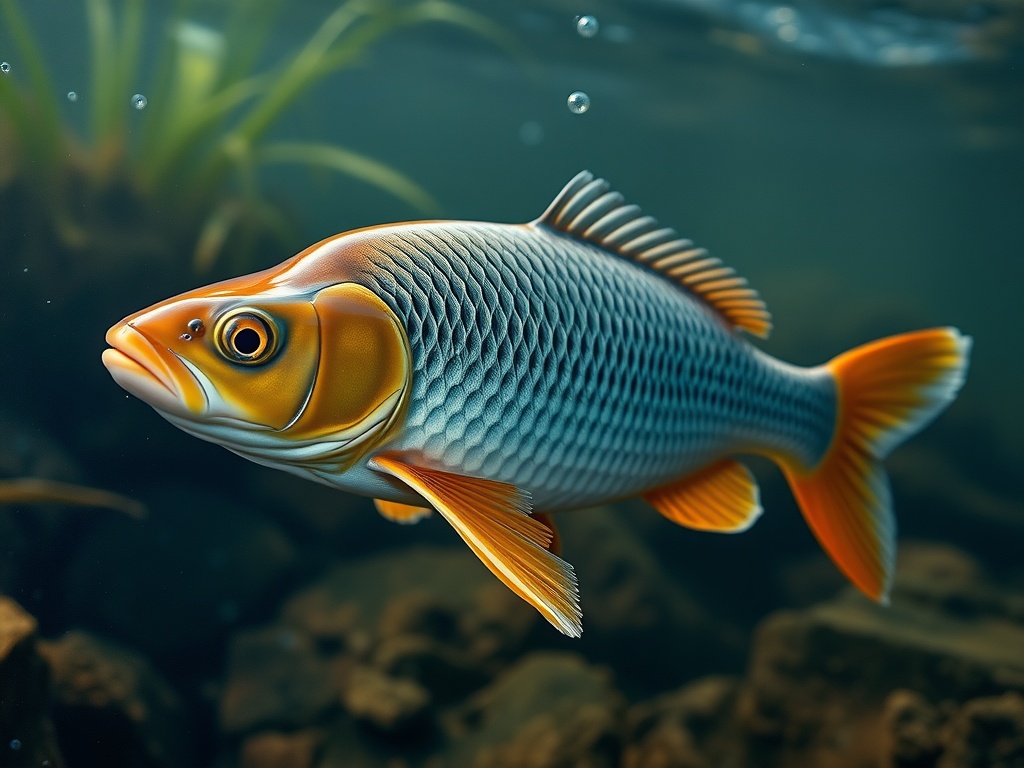
About the Common carp
Cyprinus carpio is native to the Danube and the drainages of the Black and Caspian Seas, not to East Asia as often assumed, though it was domesticated independently in China and later in medieval European monastery ponds. It has no teeth in its jaws at all: food is crushed at the back of the throat by pharyngeal teeth grinding against a horny pad in the skull, which is why carp can process snails, mussels and tough plant matter. Four barbels around a protrusible, toothless mouth let it root through soft sediment for invertebrates, and it is this rooting that makes it so destructive where it has been introduced — a dense carp population resuspends mud, uproots aquatic plants, and can flip a clear lake into a turbid, algae-dominated one. Like other members of its group it hears exceptionally well, because a chain of small bones links the swim bladder to the inner ear and turns the bladder into an eardrum. Carp tolerate low oxygen, warm water and pollution far better than most fish, survive over 20 years, and can exceed 30 kg. Koi are simply colour-selected domesticated common carp, and mirror and leather carp are scale mutants fixed by European fish farmers to make cleaning easier.
Fascinating facts
Global Traveler
Originally native to Europe and Asia, common carp have been introduced to every continent except Antarctica.
Smart Fish
Common carp are capable of learning and remembering feeding patterns, and can even distinguish between individual human faces.
Ecosystem Engineer
Their bottom-feeding habits stir up sediments, which can increase water turbidity and impact aquatic plant growth.
Detailed description
The common carp (Cyprinus carpio) is a robust, deep-bodied freshwater fish typically reaching 40–80 cm in length, though individuals can exceed 1 meter and weigh over 30 kg in optimal conditions. Its body is laterally compressed with a slightly arched back, covered in large, cycloid scales, and it features two pairs of sensitive barbels on the upper jaw used for tactile and chemical sensing. The coloration varies from brassy or golden-brown dorsally to lighter, yellowish flanks and a pale belly, though domesticated varieties (such as koi and mirror carp) display a range of patterns and scale types. Common carp possess a protrusible mouth adapted for bottom-feeding, and pharyngeal teeth capable of crushing hard-shelled prey. They have a well-developed lateral line system for detecting vibrations and changes in water pressure. Carp are highly adaptable, tolerating a wide range of temperatures (4–35°C), low dissolved oxygen, and turbid or eutrophic waters. Their lifespan can exceed 20 years in the wild, with some individuals living over 40 years in captivity. Morphologically, they are distinguished from similar cyprinids by their robust size, barbels, and scale pattern. Carp are known for their strong swimming ability and can undertake limited migrations within river systems, especially during spawning seasons.
Did you know?
Some common carp have been known to live for over 40 years in captivity, making them one of the longest-lived freshwater fish species.
Research & sources
Wikipedia summary
The common carp, also known as European carp, Eurasian carp, or simply carp, is a widespread freshwater fish of eutrophic waters in lakes and large rivers in Europe and Asia. The native wild populations are considered vulnerable to extinction by the International Union for Conservation of Nature (IUCN), but the species has also been domesticated and introduced into environments worldwide, and is often considered a destructive invasive species, being included in the list of the world's 100 worst invasive species. It gives its name to the carp family, Cyprinidae.
Behaviour & social structure
Common carp are primarily benthic feeders, foraging along the substrate for detritus, plant material, insects, crustaceans, and mollusks. They use their sensitive barbels to locate food in murky conditions, often rooting in sediments and stirring up the bottom, which can increase water turbidity. Carp are generally crepuscular, with peak activity at dawn and dusk, though they may feed throughout the day in turbid or low-light environments. Socially, they are gregarious, forming loose shoals, especially as juveniles or outside the breeding season. Adult carp may become more solitary or form smaller groups. They exhibit seasonal movements, often congregating in shallow, vegetated areas during spawning and dispersing to deeper waters in winter, where they may enter a state of reduced activity (torpor) in colder climates. Carp display complex learning behaviors and can be conditioned to respond to feeding cues, a trait exploited in aquaculture and angling.
Reproduction & life cycle
Common carp are highly fecund, with females producing between 100,000 and 500,000 eggs per kilogram of body weight during a single spawning event. Spawning typically occurs in late spring to early summer when water temperatures reach 17–23°C. Carp are broadcast spawners: females release adhesive eggs over submerged vegetation or other substrates in shallow, warm, and sheltered waters, while multiple males fertilize the eggs externally. There is no parental care; eggs hatch in 3–8 days depending on temperature. Larvae are initially planktonic, feeding on zooplankton before transitioning to benthic feeding as juveniles. Sexual maturity is reached at 2–4 years, depending on environmental conditions. In favorable habitats, carp may spawn multiple times per season.
Adaptations & survival
The common carp exhibits several adaptations for survival in variable and often degraded freshwater habitats. Its tolerance for low oxygen levels is facilitated by efficient gill structures and the ability to utilize atmospheric oxygen to a limited extent. The protrusible mouth and pharyngeal teeth enable exploitation of a wide range of food sources, including hard-shelled invertebrates and plant material. Barbels enhance foraging efficiency in turbid or low-visibility conditions. Carp can withstand significant fluctuations in temperature and water quality, including high turbidity and eutrophication. Their high reproductive output and rapid growth rate contribute to their invasive potential. Behaviorally, carp can learn to avoid predators and fishing gear, and may alter activity patterns in response to human disturbance.
Cultural significance
The common carp holds significant cultural and economic value worldwide. In East Asia, carp are symbols of perseverance and good fortune, with koi (ornamental varieties) revered in Japanese and Chinese culture. Carp are central to traditional cuisine in Central and Eastern Europe, especially as a festive dish during Christmas. In aquaculture, carp are among the most widely farmed freshwater fish, contributing substantially to global food security. Angling for carp is a popular recreational activity in Europe and Asia, with specialized fishing techniques and equipment. Carp motifs appear in art, folklore, and mythology, often representing strength, transformation, or prosperity.
Recent research
Recent research on common carp focuses on their ecological impact as invasive species, genetic diversity and population structure, disease resistance (notably to koi herpesvirus), and selective breeding for aquaculture and ornamental purposes. Genomic studies have revealed extensive genetic variation among wild, feral, and domesticated populations, with implications for conservation and management. Ecological studies have quantified the effects of carp on wetland ecosystems, including nutrient cycling and impacts on native biodiversity. Advances in biocontrol, such as genetic or immunological approaches to limit invasive carp populations, are ongoing areas of investigation.
Sources
Cyprinus carpio (Common carp): Taxonomy, Distribution and Ecology
Freyhof, J. & Kottelat, M. (2024)
scientificIUCN Red List of Threatened Species: Cyprinus carpio
International Union for Conservation of Nature (IUCN)
conservationVideos
Habitat
Freshwater rivers, lakes, and ponds

Conservation
The Common carp is currently classified as Least Concern on the IUCN Red List.
Threats & challenges
While wild populations of common carp are considered vulnerable in their native range due to habitat loss, pollution, overfishing, and genetic introgression from domesticated strains, globally the species is abundant and widespread. In many regions outside its native range, carp are a major invasive species, causing ecological damage by uprooting aquatic vegetation, increasing water turbidity, and competing with native fish for resources. Hybridization with feral or domesticated carp strains threatens the genetic integrity of native populations. Disease outbreaks, such as koi herpesvirus (KHV), can impact both wild and cultured stocks. Conservation challenges include managing invasive populations, restoring native habitats, and maintaining genetic diversity in remnant wild stocks.
Taxonomy
Scientific name
Cyprinus carpio
- Kingdom
- Animalia
- Phylum
- Chordata
- Class
- Actinopterygii
- Order
- Cypriniformes
- Family
- Cyprinidae
- Genus
- Cyprinus
- Species
- carpio
Community notes
Share your observations about the Common carp.
No community notes yet. Be the first!
Discover more wildlife
More fascinating animals from the encyclopedia.