
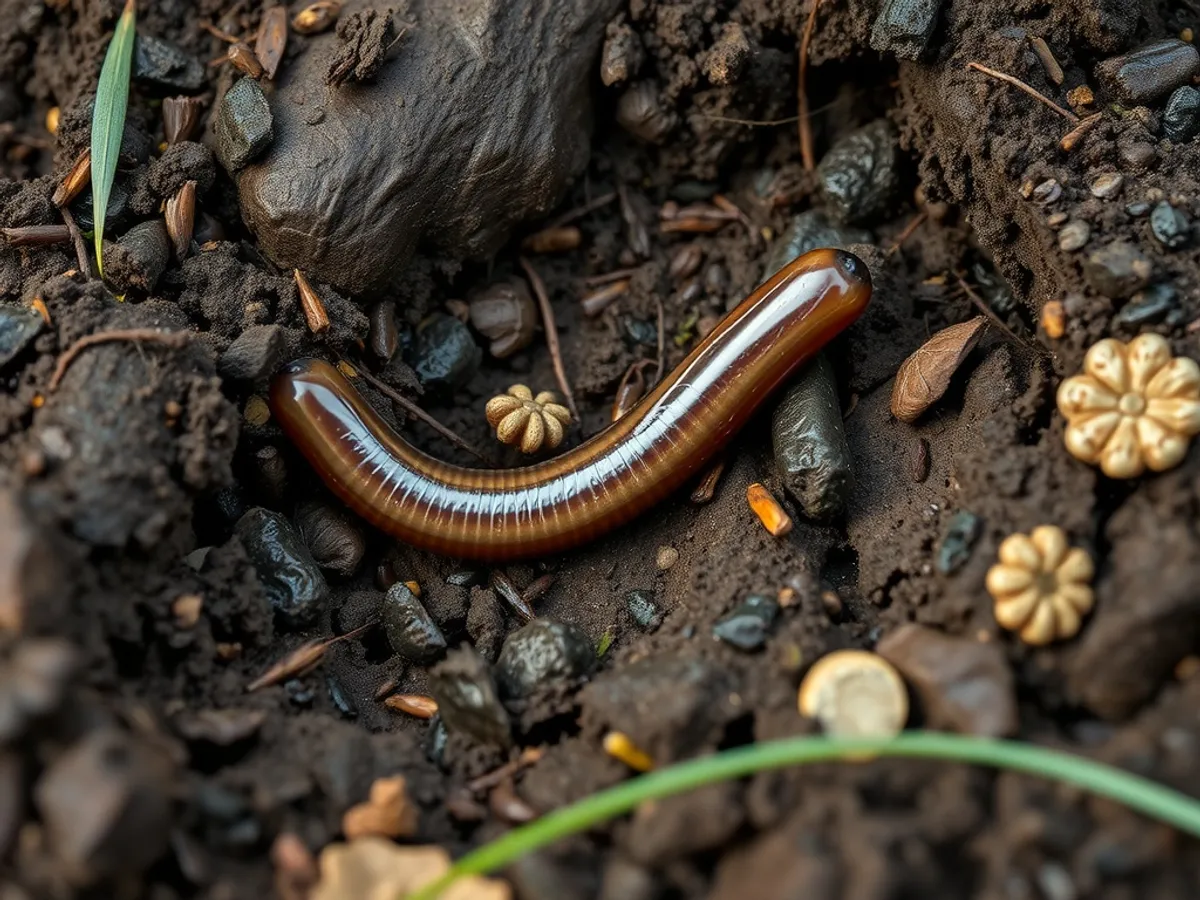
About the Common Earthworm
The Common Earthworm is a segmented invertebrate widely recognized for its vital role in enriching and aerating soil. It has a cylindrical, reddish-brown body that can grow up to 30 centimeters in length. Earthworms are detritivores, breaking down organic matter and releasing nutrients essential for plant growth. They are sensitive to light and usually remain underground, surfacing mostly at night or after heavy rains. Their presence is often a reliable indicator of healthy, fertile soil.
Fascinating facts
Soil Engineers
Common Earthworms are often called 'ecosystem engineers' because their tunneling and digestion improve soil structure and fertility.
Rain Brings Them Out
Earthworms often emerge on the surface after heavy rain to avoid drowning in waterlogged soil.
Hermaphroditic Reproducers
Each earthworm possesses both male and female reproductive organs, though they still need to mate with another worm to reproduce.
Detailed description
Lumbricus terrestris, commonly known as the Common Earthworm or nightcrawler, is a large annelid reaching lengths of 20–30 centimeters, with a cylindrical, segmented body composed of 100–120 segments. Its dorsal surface is dark reddish-brown, while the ventral side is paler, aiding in camouflage within the soil. The body is covered in a moist cuticle, essential for respiration, as earthworms lack lungs and rely on gas exchange through their skin. The prominent clitellum, a thickened, glandular band near the anterior end, is involved in reproduction and distinguishes mature individuals. L. terrestris possesses a well-developed muscular system that enables efficient burrowing, creating extensive vertical tunnels up to 2–3 meters deep. It is primarily nocturnal, emerging at night to feed and mate, and exhibits negative phototaxis, avoiding light to reduce predation risk and desiccation. The earthworm's digestive system is specialized for processing large amounts of organic detritus, with a muscular gizzard for grinding and a long intestine for nutrient absorption. L. terrestris plays a crucial ecological role as an ecosystem engineer, enhancing soil structure, aeration, and fertility through its burrowing and casting activities. Its presence is often correlated with high soil health and productivity.
Did you know?
A single earthworm can process and turn over as much as 10 pounds of soil per year.
Research & sources
Wikipedia summary
Lumbricus terrestris is a large, reddish worm species thought to be native to Western Europe, now widely distributed around the world. In some areas where it is an introduced species, some people consider it to be a significant pest for out-competing native worms.
Behaviour & social structure
Lumbricus terrestris is a solitary organism but may aggregate in favorable microhabitats with optimal moisture and organic content. It is most active at night (nocturnal), when humidity is higher and predation risk is lower. The species feeds by extending its anterior segments from the burrow to pull leaf litter and organic debris into its tunnel, where it is ingested and digested. Feeding is continuous during moist conditions but slows or ceases during drought or extreme cold, when the worm retreats deeper underground. Earthworms exhibit thigmotaxis, preferring close contact with surfaces, and are highly sensitive to vibrations, which may signal predators or rainfall. They communicate chemically, especially during mating, and can detect pheromones released by potential mates. Earthworms also play a role in bioturbation, mixing soil layers and redistributing organic matter, which benefits plant roots and soil microorganisms.
Reproduction & life cycle
Lumbricus terrestris is hermaphroditic, possessing both male and female reproductive organs, but cross-fertilization is obligatory. Mating typically occurs on the soil surface at night, often after rainfall, when two individuals align ventrally and exchange sperm. The process can last several hours. Following copulation, the clitellum secretes a mucous cocoon that slides off the worm's body, collecting eggs and stored sperm as it passes. Fertilization occurs within the cocoon, which is then deposited in the soil. Embryonic development lasts 3–4 weeks, depending on temperature and moisture, after which juvenile worms emerge. There is no parental care; juveniles are independent from hatching. Earthworms can reproduce multiple times per year, with peak breeding in spring and autumn in temperate regions.
Adaptations & survival
Lumbricus terrestris exhibits several adaptations for subterranean life. Its streamlined, segmented body and strong circular and longitudinal muscles facilitate efficient burrowing. Setae (bristle-like structures) on each segment provide grip within soil. The moist cuticle enables cutaneous respiration, while mucous secretion prevents desiccation and aids movement. The earthworm's ability to detect vibrations helps avoid predators such as moles and birds. Behavioral adaptations include nocturnal activity and retreating deep into the soil during adverse conditions (aestivation or hibernation). Its digestive system is adapted for processing large amounts of detritus, and its castings enrich the soil with nutrients. The earthworm's reproductive strategy, involving hermaphroditism and cocoon production, increases reproductive efficiency and survival in variable environments.
Cultural significance
The Common Earthworm has been recognized for centuries as a symbol of fertility and renewal due to its role in soil formation. Charles Darwin famously studied earthworms, highlighting their ecological importance in his 1881 book 'The Formation of Vegetable Mould through the Action of Worms.' In agriculture, earthworms are valued as natural soil improvers and are often used in vermicomposting to recycle organic waste. In some cultures, earthworms are used as fishing bait (nightcrawlers) and, less commonly, in traditional medicine. Their presence in soil is often seen as a sign of land health and productivity.
Recent research
Recent research has focused on the ecological impact of L. terrestris as an invasive species in North American forests, where its burrowing alters leaf litter decomposition and affects native plant communities. Genomic studies have revealed significant genetic diversity within populations, aiding understanding of adaptation and dispersal mechanisms. Studies on earthworm gut microbiota have highlighted their role in nutrient cycling and soil microbial diversity. Ongoing research is examining the effects of microplastics and pollutants on earthworm health and soil ecosystem services. Advances in soil ecology continue to underscore the earthworm's role as a keystone species in terrestrial ecosystems.
Videos
Habitat
Moist soil in grasslands, forests, gardens, and farmlands


Conservation
The Common Earthworm is currently classified as Least Concern on the IUCN Red List.
Threats & challenges
While Lumbricus terrestris is listed as Least Concern globally, local populations may be affected by soil pollution (heavy metals, pesticides), habitat loss due to urbanization, and intensive agriculture. In regions where it is introduced, such as North America, it can outcompete native earthworm species, disrupt forest floor ecosystems, and alter nutrient cycling, leading to ecological imbalances. Climate change, particularly changes in soil moisture and temperature, may impact distribution and reproductive success. Despite these challenges, the species remains widespread and abundant in most of its range.
Taxonomy
Scientific name
Lumbricus terrestris
- Kingdom
- Animalia
- Phylum
- Annelida
- Class
- Clitellata
- Order
- Haplotaxida
- Family
- Lumbricidae
- Genus
- Lumbricus
- Species
- terrestris
Community notes
Share your observations about the Common Earthworm.
No community notes yet. Be the first!
Discover more wildlife
More fascinating animals from the encyclopedia.