

Forest
Wooded areas with significant tree cover and diverse plant and animal communities.
Animals of the Forest
Species recorded in this habitat.
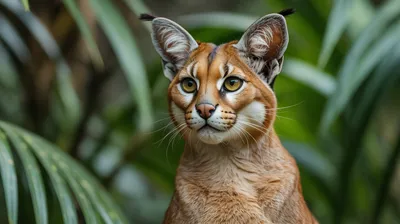
African Golden Cat
Caracal aurata
The African Golden Cat is a medium-sized, elusive wild cat native to the rainforests of Central and West Africa. It has a robust build, with a short tail and rounded ears, and its fur color ranges from golden or reddish-brown to silvery-grey, often marked with faint spots or stripes. This solitary and primarily nocturnal feline is seldom seen in the wild due to its secretive nature and dense forest habitat. African Golden Cats are skilled hunters, preying on a variety of small to medium-sized mammals, birds, and reptiles.
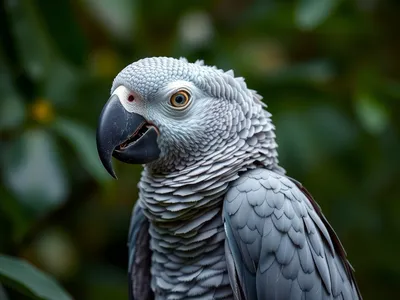
African Grey Parrot
Psittacus erithacus
The African grey is the parrot that changed what science was prepared to say about animal minds. Over three decades, Irene Pepperberg's grey, Alex, learned to label around a hundred objects, colours, shapes and materials, and — crucially — to combine those categories: shown a tray, he could answer which object was both green and three-cornered, which requires holding two attributes in mind at once. He grasped same and different as abstract concepts, and he understood none, a functional zero, which he produced spontaneously when asked which colour differed among a set of identical objects. He is also the only non-human animal on record to have asked an existential question, when he saw himself in a mirror and asked what colour he was. Greys are long-lived, often past fifty, and intensely social, which is exactly why they suffer so badly alone: a bored grey plucks out its own feathers. The demand created by that intelligence has been ruinous, and trapping for the pet trade, combined with habitat loss, has pushed the species onto the endangered list.
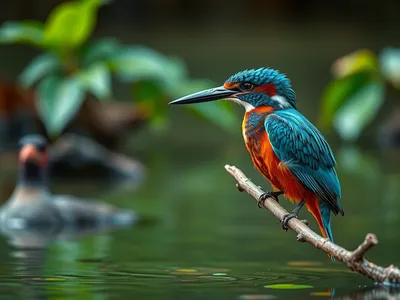
Amazon Kingfisher
Chloroceryle amazona
The Amazon Kingfisher is a medium-sized, strikingly colored bird found throughout Central and South America, especially along rivers and streams. It is recognized by its glossy green upperparts, white underparts, and the prominent white collar around its neck; males have a rufous band across the chest. This kingfisher is an agile hunter, perching quietly above water before diving headfirst to catch small fish and aquatic invertebrates. Its sharp bill and excellent vision make it a formidable predator in its freshwater habitat. The Amazon Kingfisher is a solitary bird, often seen alone or in pairs, and communicates with sharp, rattling calls.
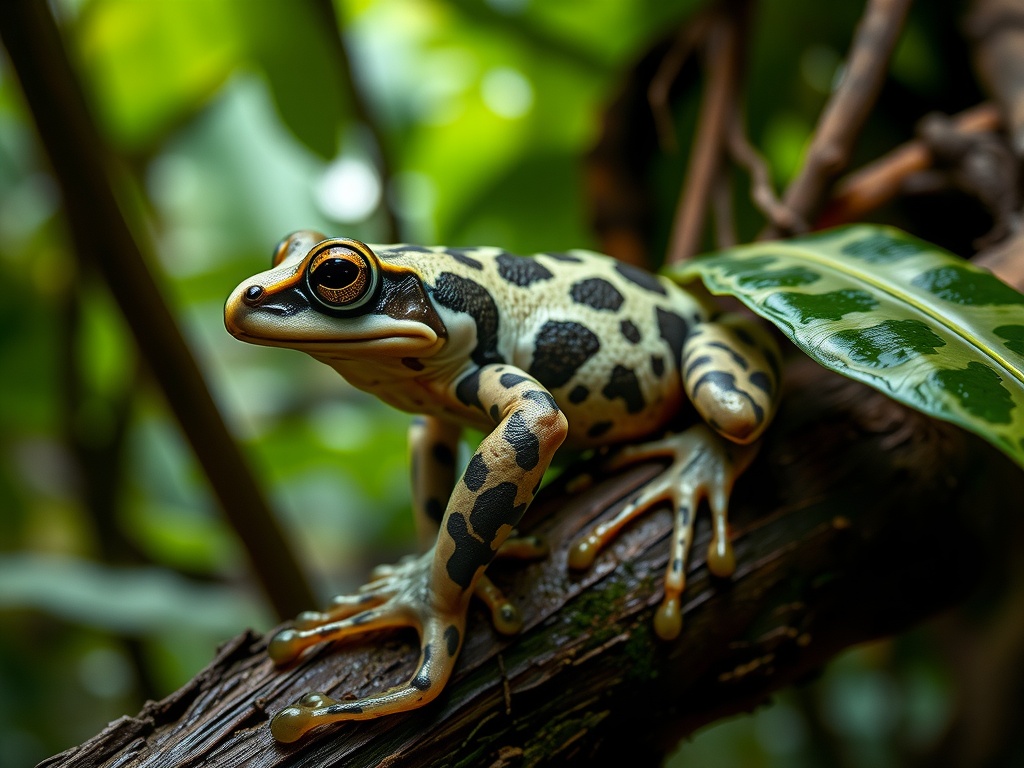
Amazon Milk Frog
Trachycephalus resinifictrix
The Amazon Milk Frog is a striking tree frog native to the Amazon Rainforest, easily recognized by its pale blue-gray body adorned with brown or black banding. This nocturnal amphibian gets its name from the milky, sticky secretion it produces when stressed, which serves as a defense against predators. They are arboreal, spending most of their life high in the rainforest canopy, and are known for their loud, distinctive calls during the rainy season. Amazon Milk Frogs thrive in humid, tropical environments and are popular in the pet trade due to their unique appearance and manageable size.

Amazon River Dolphin
Inia geoffrensis
The boto is the largest river dolphin, up to 2.5 m and 185 kg, and it is built for a forest rather than for open water. Its neck vertebrae are unfused, so it can turn its head roughly 90 degrees — useless in the sea, essential for threading between drowned trunks in the varzea flooded forest, where it hunts through the canopy of a submerged rainforest for months each year. Its flippers are broad and paddle-like for tight manoeuvring rather than speed, and its rear teeth are blunt and molar-like, letting it crush armoured catfish and even river turtles that a marine dolphin's uniform cones could not handle. The pink colouring is not pigment so much as scarring and blood vessels close to the skin: males are far pinker than females because they fight, and an old male can be almost flamingo-coloured. Male botos have been recorded carrying objects — sticks, lumps of hard clay, turtles — and thrashing them at the surface in front of females, one of the very few reported cases of object-carrying sexual display in a non-human animal.
Amazon tree boa
Corallus hortulana
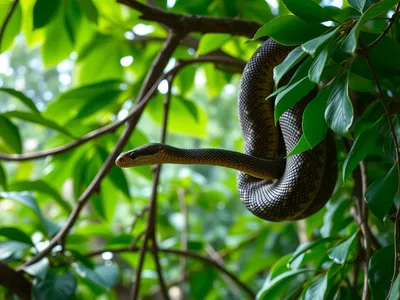
The Amazon tree boa is a slender, highly arboreal snake native to the rainforests of South America. This species exhibits remarkable color variation, with individuals ranging from bright yellow to deep red, orange, or gray, often with intricate patterns. Known for its agility, the Amazon tree boa uses its prehensile tail to navigate branches in search of prey, which includes small mammals, birds, and lizards. Though non-venomous, it is known for its defensive nature and can deliver a painful bite if threatened. Its nocturnal habits and cryptic coloration make it a master of camouflage in its dense, leafy habitat.
Amazonian Royal Flycatcher
Onychorhynchus coronatus
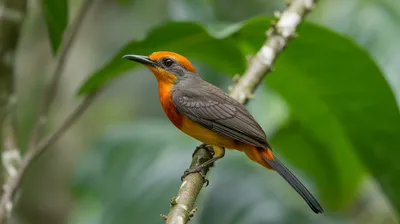
The Amazonian Royal Flycatcher is a small, insectivorous bird best known for its spectacular fan-shaped crest, which is vividly colored and usually displayed during courtship or when threatened. This bird inhabits the humid lowland forests and river edges of the Amazon Basin, often remaining inconspicuous as it forages for insects. With olive-brown upperparts and yellowish underparts, its remarkable crest—red in males and yellow to orange in females—remains mostly hidden except during displays. The species builds long, hanging nests suspended over water to protect its young from predators. Despite its striking appearance, the Amazonian Royal Flycatcher is seldom seen due to its secretive habits and preference for dense forest undergrowth.
Andean Cock-of-the-rock
Rupicola peruvianus
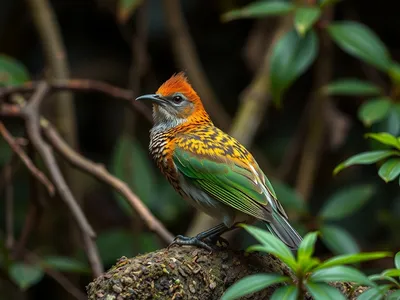
The male Andean cock-of-the-rock has a crest so extreme it is effectively a mask: a permanent, disc-shaped half-moon of feathers that projects forward over the top of the bill and hides most of it, nostrils included. It is not raised or lowered like an ordinary crest — it is simply always there, and the bird looks at the world past it. Males gather at leks, traditional display arenas in steep, humid Andean forest that can be used for decades, where a dozen or more birds bow, hop, flap and produce squealing, grunting calls at each other while females come, watch and choose. Once a female has mated she leaves, and the male contributes nothing further. She then builds a cup nest of mud and plant material glued to a shaded rock face or cave wall, often near a stream — the "rock" of the name — and raises the chicks alone. Females are a drab reddish-brown, an inevitable consequence of a system where only males are being chosen and only females need to be invisible on a nest.
Arapaima
Arapaima gigas
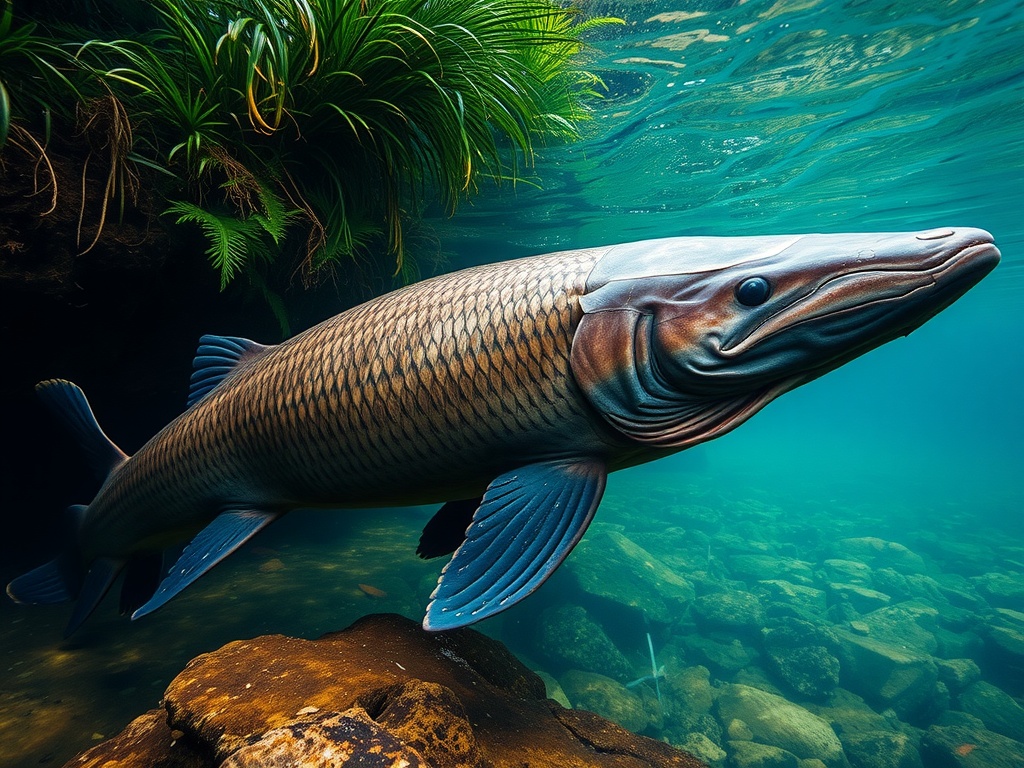
The arapaima is an air-breather that will drown if it cannot reach the surface: its swim bladder is lined with lung-like tissue and it must gulp air roughly every five to twenty minutes, an adaptation to the oxygen-starved, seasonally stagnant floodwaters of the Amazon. That single fact reshaped both its ecology and its fate — because it must surface, fishermen can count it, and because it must surface, it can be harpooned. Its scales are a materials-science celebrity: a hard, mineralised outer layer sits over a tough, corrugated inner layer of collagen fibres arranged in a twisting Bouligand structure, so a crack that starts in the brittle shell is deflected and dissipated rather than propagating. Piranha teeth cannot get through them, and engineers have copied the design for flexible body armour. Adults reach 3 m and 200 kg. Males guard the young in a shoal beneath them, and a gland on the head releases a pheromone-rich secretion that the fry actively feed on and follow.
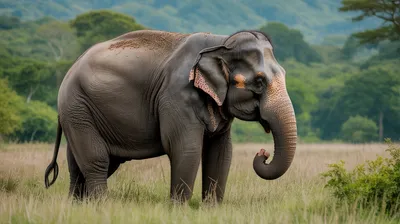
Asian Elephant
Elephas maximus
The Asian elephant differs from the African in more than ear size. Its trunk ends in a single finger-like process rather than two, so it grips by curling the tip around an object and pinning it, where an African elephant pinches with two lips. It has a twin-domed forehead, a more arched back, and — crucially — tusks that many individuals simply do not have. Females essentially never carry proper tusks, only small tushes, and a large proportion of males are tuskless too; in Sri Lanka the figure is around 90 percent, a legacy of centuries of selective removal of the tusked animals. The trunk itself contains on the order of 40,000 muscle fascicles and no bone, and it is simultaneously a nose, a hand, a hose, a snorkel and a loudspeaker. Elephants communicate with infrasonic rumbles below the range of human hearing, which travel for kilometres through air and ground, and they detect them partly through their feet. Adult males enter musth, a periodic state with testosterone levels up to sixty times baseline, marked by temporal gland secretion and dangerous aggression.
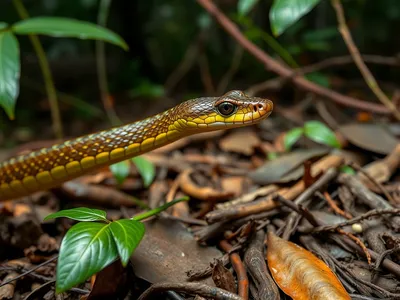
Asian Vine Snake
Ahaetulla prasina
The Asian Vine Snake is a slender, mildly venomous arboreal snake native to South and Southeast Asia. Easily recognizable by its elongated, pointed snout and brilliant green coloration, this snake is perfectly adapted for life among the foliage, where it relies on its camouflage to ambush prey. Its thin, whip-like body allows it to move gracefully through branches and leaves in search of small vertebrates, especially lizards and frogs. Although its venom is not considered dangerous to humans, it uses it effectively to subdue its prey.
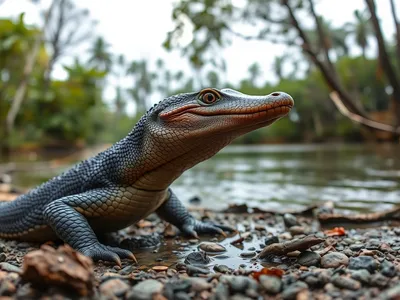
Asian Water Monitor
Varanus salvator
The Asian water monitor is the second-heaviest lizard alive, behind only the Komodo dragon, and it is one of the very few big reptiles that has done well out of human cities. It swims powerfully with a laterally flattened tail, can stay submerged for half an hour, climbs, runs, and is entirely comfortable scavenging — which is why the canals and parks of Bangkok, including Lumphini Park in the centre of the city, hold a substantial urban population living on rubbish, fish and carrion. It hunts with a deeply forked tongue feeding a Jacobson's organ, following scent trails, and it will dig up crocodile and turtle nests for eggs. Monitors turn out to have a lung anatomy nobody expected: airflow through the lung is largely unidirectional, looping in a one-way circuit like a bird's rather than tidally in and out like a mammal's, which suggests this efficient design long predates birds. Monitors also possess venom glands, though for a water monitor the real danger of a bite is mechanical damage and infection, not toxin.
Other habitats
 Global Waters
Ocean
Saltwater environments covering more than 70% of the Earth's surface, home to a vast variety of marine life.
 Polar Regions
Arctic
Cold, frozen landscapes around the North Pole with specialized wildlife adapted to extreme cold.
 Arid Regions
Desert
Arid lands with minimal rainfall, extreme temperatures, and specialized wildlife adapted to harsh conditions.
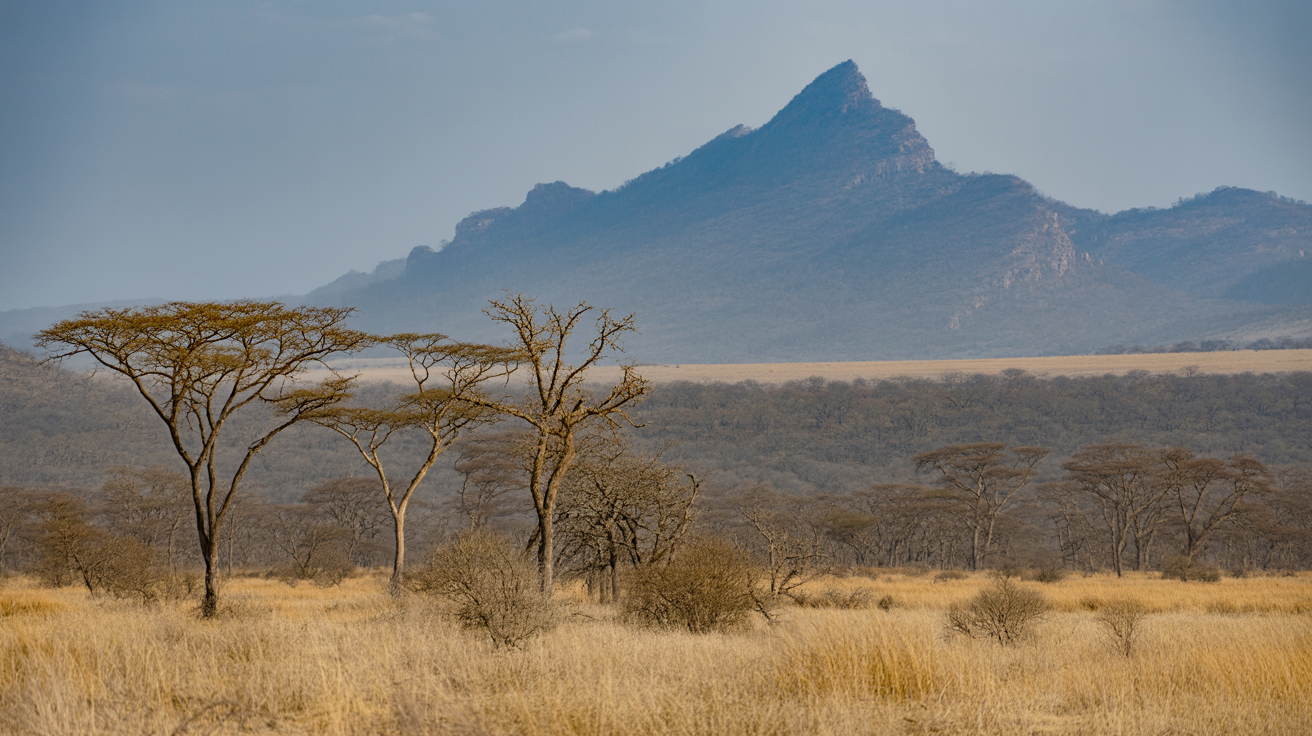 Africa
Savanna
Grasslands with scattered trees, characterized by seasonal rainfall and home to diverse grazing animals and predators.
 Various Continental Regions
Grassland
Open areas dominated by grasses rather than trees, supporting numerous herbivores and their predators.
 Global
Freshwater
Lakes, rivers, and wetlands with diverse aquatic ecosystems.