
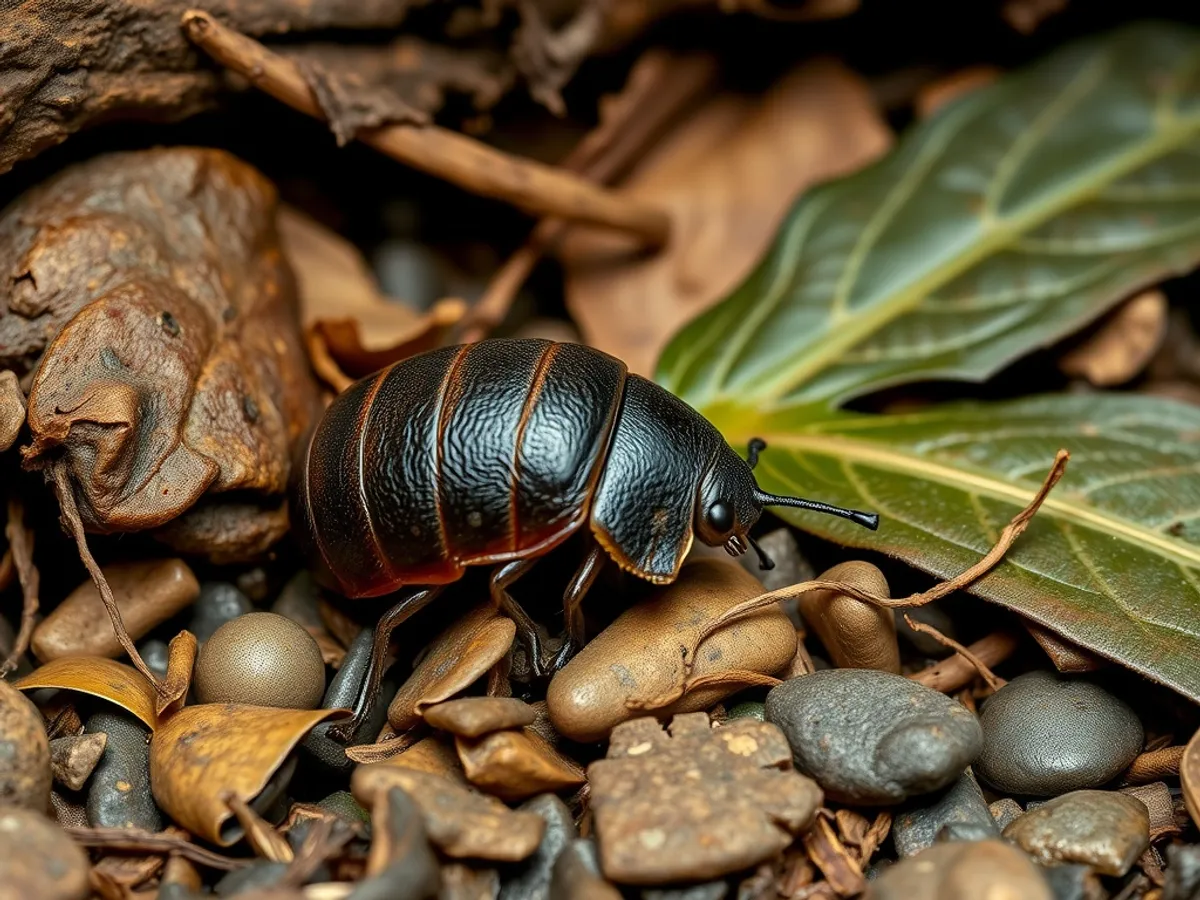
About the Common pill bug
The common pill bug, also known as the roly-poly, is a small terrestrial crustacean that is often found in moist environments like gardens, under logs, and leaf litter. It is easily recognized by its segmented, oval, grayish exoskeleton and its ability to roll into a tight ball when threatened, a behavior known as conglobation. Unlike insects, pill bugs breathe through gill-like structures and require a damp habitat to survive. They play an important ecological role by feeding on decaying organic matter, helping to recycle nutrients in the soil.
Fascinating facts
Armored Ball
When threatened, the pill bug curls into a tight ball, shielding its vulnerable underbelly from predators.
Moisture Lovers
Pill bugs require moist environments because they breathe through gill-like structures that must remain damp.
Nature's Recyclers
They are important detritivores, feeding on decaying plant material and helping recycle nutrients in the ecosystem.
Detailed description
Armadillidium vulgare, commonly known as the common pill bug or roly-poly, is a terrestrial isopod crustacean measuring 8–18 mm in length and 4–8 mm in width. Its body is oval, convex, and segmented into 12 distinct plates, with a hard, calcareous exoskeleton that provides protection and minimizes water loss. The dorsal surface is typically slate gray but can exhibit a wide range of color morphs, including marbled, orange, and albino, due to genetic variation. Pill bugs possess seven pairs of jointed legs and two pairs of antennae, though only one pair is prominent. They are most notable for their ability to roll into a tight ball (conglobation), a defense mechanism against predation and desiccation. Respiration occurs through pseudotracheae—modified gill structures located on the pleopods—which require a moist microhabitat to function efficiently. Pill bugs are primarily nocturnal, seeking shelter during the day under debris or within soil crevices to avoid desiccation. Their compound eyes are adapted for low-light environments, and their sensory antennae are highly developed for detecting chemical cues in the environment. Armadillidium vulgare is a detritivore, feeding on decaying plant matter, fungi, and occasionally living plant tissues, thus playing a crucial role in nutrient cycling and soil health. They are generally solitary but may aggregate in favorable microhabitats, especially in high humidity conditions.
Did you know?
Despite living on land, pill bugs still breathe through gills and can drown if submerged in water for too long.
Research & sources
Wikipedia summary
Armadillidium vulgare, the common pill-bug, common pill woodlouse, roly-poly, slater, doodle bug, or carpenter, is a widespread European species of woodlouse. It is the most extensively investigated terrestrial isopod species. It is native to Mediterranean Europe, but as an introduced species they have become naturalized in almost all suitable ecosystems. They are kept as pets by hobbyists for their wide range of possible color variations.
Behaviour & social structure
Common pill bugs are primarily nocturnal, becoming active at dusk and remaining so throughout the night. They exhibit thigmotaxis, preferring to remain in close contact with solid surfaces, which helps them avoid predators and desiccation. Feeding occurs mostly at night, when humidity is higher, and consists of consuming decomposing organic material, including leaf litter, wood, and occasionally fungi. They are not aggressive and do not display territoriality, but may form aggregations in moist environments, which can reduce individual water loss through collective humidity retention. When threatened by predators such as birds, amphibians, or centipedes, pill bugs employ conglobation, rolling into a ball to protect their vulnerable ventral side and appendages. They communicate chemically, using pheromones to signal aggregation sites. Pill bugs also exhibit negative phototaxis, actively avoiding light to minimize water loss and predation risk.
Reproduction & life cycle
Reproduction in Armadillidium vulgare is sexual, with distinct male and female individuals. Mating typically occurs in spring and early summer, though in mild climates, breeding can happen year-round. Males use their modified first pair of pleopods to transfer spermatophores to the female during copulation. Females brood fertilized eggs in a ventral marsupium (brood pouch), where the eggs are kept moist and protected. The incubation period lasts about 3–9 weeks, depending on temperature and humidity. Each brood may contain 20–200 eggs. After hatching, juveniles (mancae) remain in the marsupium for several days before emerging as miniature adults, bypassing a free-swimming larval stage. Females can produce multiple broods per year, and limited parental care is provided by the female during the brooding period. Sexual maturity is reached after 1–2 years, with a typical lifespan of 2–4 years in the wild.
Adaptations & survival
Armadillidium vulgare has evolved several adaptations for terrestrial life. Its ability to conglobate is unique among terrestrial isopods and provides both physical protection and reduces evaporative water loss. The exoskeleton is heavily calcified, offering defense against predators and desiccation. Pseudotracheae allow for gas exchange in air, but require high humidity, restricting the species to moist microhabitats. Behavioral adaptations include nocturnality and aggregation, both of which minimize water loss. The species can tolerate a wide range of temperatures and salinities, contributing to its cosmopolitan distribution. Genetic plasticity has led to a variety of color morphs, some of which may confer camouflage or other selective advantages. Additionally, pill bugs can accumulate and tolerate heavy metals, making them useful bioindicators for soil pollution.
Cultural significance
The common pill bug is a familiar creature in many cultures, often featured in children's games and folklore due to its distinctive rolling behavior. It is known by various colloquial names, such as roly-poly, slater, and doodle bug. In some regions, pill bugs are kept as pets or used in educational settings to teach about invertebrate biology and decomposition. Their ability to accumulate heavy metals has led to their use in environmental monitoring and soil health assessments. While not traditionally used in medicine or cuisine, their ecological role as decomposers is widely recognized and valued.
Recent research
Armadillidium vulgare is a model organism in studies of terrestrial isopod biology, particularly in research on adaptation to land, reproductive strategies, and symbiosis. Recent studies have focused on their relationship with Wolbachia bacteria, which can manipulate host reproduction and influence population dynamics. Genomic analyses have revealed insights into the evolution of terrestriality in crustaceans, including gene families involved in cuticle formation and water regulation. Pill bugs are also used in ecotoxicology to assess soil contamination by heavy metals and pesticides. Ongoing research investigates their microbiome, immune responses, and potential as bioindicators for environmental monitoring.
Videos
Habitat
Moist terrestrial environments, such as under logs, rocks, and leaf litter


Conservation
The Common pill bug is currently classified as Least Concern on the IUCN Red List.
Threats & challenges
Currently, Armadillidium vulgare faces few significant threats and is classified as Least Concern by conservation authorities. Its adaptability to disturbed habitats, such as gardens and urban areas, has facilitated its global spread. However, local populations may be affected by prolonged drought, habitat destruction, and pesticide use. Climate change poses a potential long-term threat by altering moisture regimes critical for their survival. In some regions, competition with invasive isopod species may impact local abundance. Despite these challenges, the species remains widespread and abundant, with stable population trends.
Taxonomy
Scientific name
Armadillidium vulgare
- Kingdom
- Animalia
- Phylum
- Arthropoda
- Class
- Malacostraca
- Order
- Isopoda
- Family
- Armadillidiidae
- Genus
- Armadillidium
- Species
- vulgare
Community notes
Share your observations about the Common pill bug.
No community notes yet. Be the first!
Discover more wildlife
More fascinating animals from the encyclopedia.