
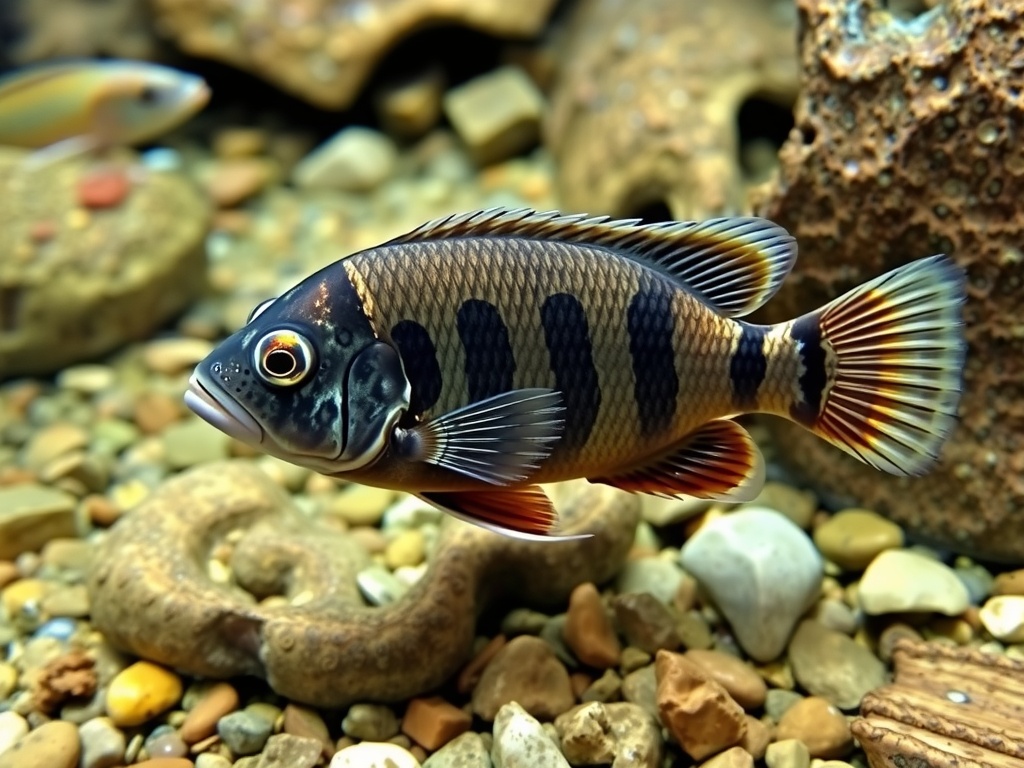
About the Convict cichlid
The convict cichlid is a small, robust freshwater fish native to Central America, known for its distinctive black vertical stripes resembling a prison uniform. Highly territorial and intelligent, convict cichlids are popular in the aquarium trade due to their hardiness and fascinating parental behaviors. They exhibit complex social interactions and are well-studied for their aggressive defense of territory and fry. Males and females are both actively involved in guarding eggs and raising their young, making them exemplary model organisms for research on fish behavior.
Fascinating facts
Parental Care
Both male and female convict cichlids participate equally in caring for eggs and fry, making them one of the few fish species with true biparental care.
Habitat Flexibility
Convict cichlids are highly adaptable and can live in a variety of water conditions, including different pH levels and temperatures.
Territorial Behavior
They are known for their fierce territorial defense, especially during breeding, often chasing away much larger fish to protect their nest.
Detailed description
The convict cichlid (Amatitlania nigrofasciata) is a small, laterally compressed freshwater fish, typically reaching 10–12 cm (4–5 in) in standard length, with males occasionally growing slightly larger than females. Its most distinctive feature is the series of 8–9 bold, black vertical bars set against a pale gray to bluish body, giving rise to its common name. Sexual dimorphism is evident: males are generally larger, with longer dorsal and anal fins, and may develop a nuchal hump, while females often display more intense coloration, especially an orange or reddish flush on the belly during breeding. Convict cichlids possess robust jaws and pharyngeal teeth adapted for crushing a variety of food items. Their eyes are large and positioned laterally, aiding in the detection of both predators and rivals. The species is renowned for its high intelligence and complex social behaviors, including advanced parental care and territoriality. In the wild, they inhabit rocky streams and lakes with moderate to fast currents, often taking shelter among submerged rocks and crevices. Their adaptability allows them to tolerate a wide range of water conditions, including variations in temperature (20–30°C), pH (6.5–8.0), and hardness. Convict cichlids are highly territorial, especially during breeding, and exhibit pronounced aggression toward conspecifics and other fish. Their resilience, ease of breeding, and behavioral richness have made them a model organism in ethological research and a staple in the aquarium trade.
Did you know?
Unlike most fish, convict cichlid fathers actively share duties like fanning and guarding the eggs alongside the mothers.
Research & sources
Wikipedia summary
The convict cichlid is a fish species from the family Cichlidae, native to Central America, also known as the zebra cichlid. Convict cichlids are popular aquarium fish and have also been the subject of numerous studies on fish behaviour.
Behaviour & social structure
Convict cichlids are diurnal, spending daylight hours actively foraging, defending territories, and engaging in social interactions. They are omnivorous, feeding on a diverse diet of aquatic invertebrates, insect larvae, plant matter, algae, and detritus. In the wild, they often sift through substrate and graze on biofilm. Territoriality is a hallmark of their behavior; both sexes vigorously defend their chosen territory, especially during the breeding season. Aggressive displays include lateral presentations, fin flaring, and jaw locking. Social hierarchies are established through ritualized combat and displays. Pair bonds are strong and often monogamous, with both parents cooperating in nest site selection, egg care, and fry defense. Daily routines involve periods of foraging interspersed with vigilance and maintenance of territory boundaries. In captivity, they may display increased aggression if space is limited or if there are insufficient hiding places.
Reproduction & life cycle
Convict cichlids are biparental substrate spawners, forming stable monogamous pairs. Breeding can occur year-round in suitable conditions, with a preference for warmer water (24–28°C). Courtship involves ritualized displays, cleaning of a chosen spawning site (often a rock or cave), and mutual fin displays. Females lay 100–300 adhesive eggs in a single clutch, which are fertilized externally by the male. Incubation lasts 3–5 days, after which larvae (wigglers) remain attached to the substrate for another 5–7 days, absorbing their yolk sacs. Both parents guard the eggs and fry, fanning them to ensure oxygenation and removing debris or dead eggs. Once free-swimming, the fry are herded by the parents and fiercely protected from predators. Parental care can last several weeks, with both parents participating in feeding, defense, and guidance of the young. This advanced parental investment is rare among fishes and a key reason for their use in behavioral studies.
Adaptations & survival
Convict cichlids exhibit several adaptations for survival in variable freshwater habitats. Their laterally compressed bodies and strong pectoral fins allow for agile maneuvering among rocks and swift currents. The robust pharyngeal jaws enable them to exploit a wide range of food sources, from hard-shelled invertebrates to plant material. Their coloration provides effective camouflage among rocks and submerged debris. Behavioral adaptations include pronounced territorial aggression, rapid establishment of social hierarchies, and sophisticated biparental care, which increases offspring survival rates. Their tolerance for a broad spectrum of water parameters (temperature, pH, hardness) enables them to colonize diverse environments, including disturbed or artificial habitats. Rapid growth and early sexual maturity (as young as 4–6 months) further enhance their colonizing potential.
Cultural significance
Convict cichlids hold significant value in the aquarium hobby due to their hardiness, ease of breeding, and engaging behaviors, making them a popular choice for both novice and experienced aquarists. They are frequently used in educational settings to demonstrate fish behavior, parental care, and aggression. In scientific research, they serve as a model organism for studies on animal behavior, neurobiology, and evolutionary ecology. There is no known traditional or mythological significance in indigenous cultures, but their role in science and education is substantial.
Recent research
Convict cichlids have been the focus of extensive research in ethology, particularly regarding parental care, aggression, and social learning. Studies have elucidated the hormonal and neural mechanisms underlying biparental care, with findings relevant to vertebrate parenting evolution. Recent research has explored their cognitive abilities, including spatial learning, problem-solving, and social recognition. The species is also used in studies of sexual selection, mate choice, and the effects of environmental stressors on behavior and physiology. Ongoing research investigates the genetic basis of coloration, aggression, and adaptation to novel environments, providing insights into rapid evolution and speciation in cichlids.
Sources
Amatitlania nigrofasciata (Convict Cichlid): Natural history and behavior
K. R. Barlow (2000)
scientificAmatitlania nigrofasciata: The IUCN Red List of Threatened Species 2020
Lyons, T.J., Matamoros, W.A., Angulo, A. (2020)
conservationVideos
Habitat
Freshwater rivers, streams, and lakes with rocky substrates

Conservation
The Convict cichlid is currently classified as Least Concern on the IUCN Red List.
Threats & challenges
In their native range (from Guatemala to Costa Rica), convict cichlids are not currently considered threatened and are classified as Least Concern by NatureServe. However, localized threats include habitat degradation from deforestation, pollution, and water extraction. Their adaptability has allowed them to establish invasive populations in regions outside their native range, such as Australia, the United States, and parts of Asia, where they may compete with native species and disrupt local ecosystems. Overcollection for the aquarium trade is not considered a significant threat due to their prolific breeding. Climate change may pose future risks by altering freshwater habitats. Conservation challenges primarily involve managing invasive populations and monitoring habitat quality in native regions.
Taxonomy
Scientific name
Amatitlania nigrofasciata
- Kingdom
- Animalia
- Phylum
- Chordata
- Class
- Actinopterygii
- Order
- Cichliformes
- Family
- Cichlidae
- Genus
- Amatitlania
- Species
- nigrofasciata
Where to see a convict cichlid
1 zoo and aquarium in 1 country are recorded as keeping this species.
Community notes
Share your observations about the Convict cichlid.
No community notes yet. Be the first!
Discover more wildlife
More fascinating animals from the encyclopedia.