
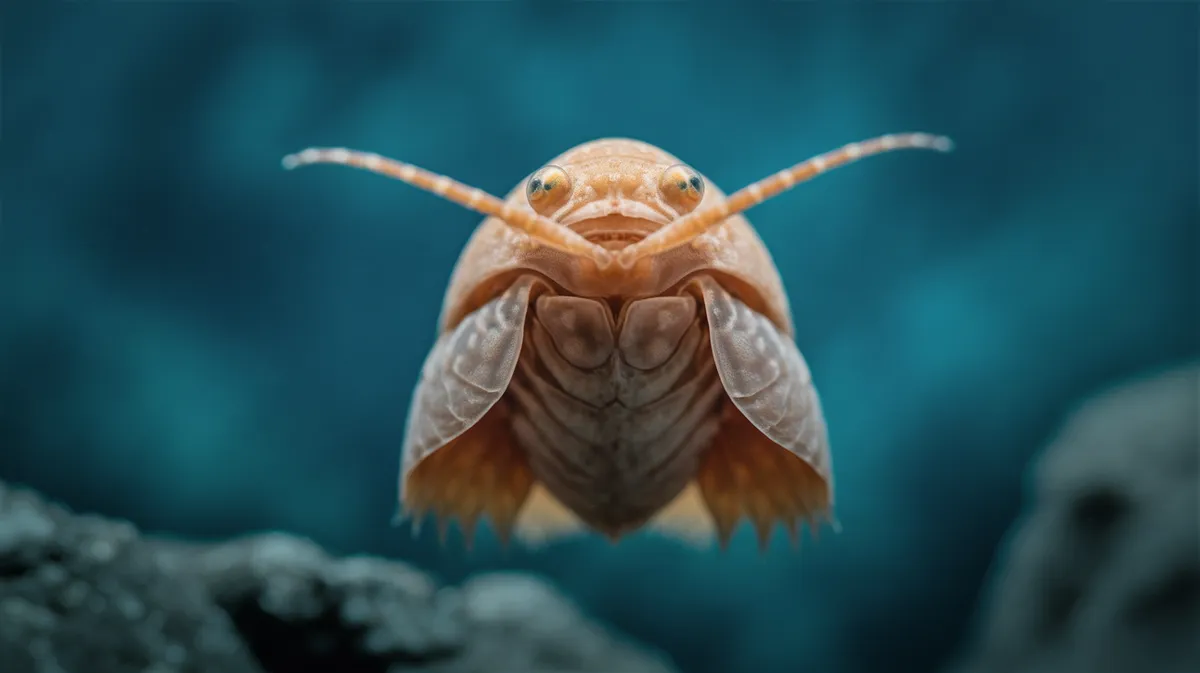
About the Deep-sea amphipod
The deep-sea amphipod is a small crustacean adapted to life in the extreme depths of the world's oceans, often found several kilometers below the surface. It has a laterally compressed, translucent body with long antennae and robust legs, allowing it to scavenge organic debris on the ocean floor. These amphipods are highly resilient, capable of surviving under immense pressures and near-freezing temperatures. Their adaptations make them key members of the deep-sea ecosystem, where they play an important role in recycling nutrients.
Fascinating facts
Extreme Depths
Eurythenes gryllus has been observed at depths exceeding 10,000 meters, enduring some of the highest pressures found on the planet.
Giant for an Amphipod
Some deep-sea amphipods can reach lengths of over 14 centimeters, making them giants compared to their shallow-water relatives.
Nature's Recycler
They play a critical role in breaking down and recycling organic material, helping keep the deep-sea ecosystem healthy.
Detailed description
Eurythenes gryllus is a large, cosmopolitan deep-sea amphipod, typically measuring 4–8 cm in length, though individuals exceeding 14 cm have been recorded, making it among the largest amphipods in the world. Its laterally compressed, semi-translucent body is segmented and covered by a thin, flexible exoskeleton, with coloration ranging from pale white to pinkish hues, depending on depth and diet. The head bears two pairs of long, sensitive antennae used for detecting chemical cues and vibrations in the water, crucial for locating food in the darkness of the deep sea. Robust, spiny pereopods (walking legs) enable it to traverse soft sediments and scavenge efficiently, while powerful gnathopods (claw-like appendages) are used for tearing apart carrion. Eurythenes gryllus is primarily benthopelagic, meaning it can swim above the seafloor as well as crawl upon it, displaying remarkable mobility for a deep-sea invertebrate. Its digestive system is adapted for processing a wide range of organic matter, from whale falls to smaller detritus. The species exhibits a slow metabolism, a common trait in deep-sea fauna, which allows it to survive long periods between meals. Morphological studies have revealed cryptic diversity within what was once considered a single species, with genetic analyses indicating the presence of several distinct lineages adapted to different oceanic regions and depths. Eurythenes gryllus is a key detritivore in abyssal and hadal ecosystems, playing a vital role in nutrient cycling and energy transfer within these extreme environments.
Did you know?
Deep-sea amphipods have been found inside the Mariana Trench, one of the deepest parts of the ocean on Earth.
Research & sources
Behaviour & social structure
Eurythenes gryllus is primarily a solitary scavenger, exhibiting opportunistic feeding behavior. It is highly responsive to chemical signals released by decaying organic matter, often aggregating in large numbers at food falls such as dead fish, squid, or cetacean carcasses. Upon arrival, individuals may display competitive interactions, using their gnathopods to fend off rivals and secure feeding positions. They are capable of rapid, agile swimming when attracted to food sources, but otherwise tend to move slowly across the seafloor. Eurythenes gryllus is largely nocturnal in its activity patterns, though the perpetual darkness of the deep sea renders this distinction less meaningful. It is sensitive to vibrations and water currents, which may aid in detecting both food and potential threats. Social interactions are generally limited to feeding aggregations and mating encounters, with little evidence of cooperative behavior. The species exhibits a remarkable ability to withstand long periods of food scarcity, entering a state of reduced activity and metabolic depression when resources are limited.
Reproduction & life cycle
Reproductive strategies in Eurythenes gryllus are adapted to the challenges of the deep sea. Mating is believed to be seasonal in some populations, with peaks in reproductive activity potentially linked to episodic food falls or seasonal fluxes of surface-derived organic matter. Males locate receptive females using chemosensory cues, and copulation involves the transfer of spermatophores. Females brood their eggs within a ventral marsupium (brood pouch) until hatching, providing protection from predation and environmental stress. Brood sizes can range from several dozen to over a hundred eggs, depending on female size and environmental conditions. Embryonic development is relatively slow, reflecting the low temperatures and metabolic rates of the deep sea, with incubation periods estimated at several months. Upon hatching, juveniles are miniature versions of adults and are immediately independent, with no further parental care. The species is iteroparous, capable of reproducing multiple times over its lifespan, which may extend several years.
Adaptations & survival
Eurythenes gryllus exhibits a suite of adaptations for life in the abyssal and hadal zones. Its exoskeleton is thin and flexible, reducing the risk of structural damage under immense hydrostatic pressures (up to 1,100 atmospheres). Cellular membranes contain high levels of unsaturated fatty acids, maintaining fluidity at near-freezing temperatures. The amphipod’s hemocyanin-based respiratory pigments are highly efficient at oxygen binding, supporting survival in low-oxygen environments. Sensory adaptations include elongated antennae and chemoreceptors for detecting food over long distances in darkness. Metabolic rates are extremely low, enabling survival during prolonged periods of food scarcity. The species is also capable of storing large amounts of lipids, providing energy reserves. Genomic studies have revealed gene duplications related to DNA repair and protein stability, likely conferring resistance to pressure-induced cellular damage. Behavioral flexibility, including both benthic and pelagic foraging, allows Eurythenes gryllus to exploit a wide range of food resources.
Cultural significance
Eurythenes gryllus has limited direct significance in human culture due to its inaccessible habitat. However, it has become a symbol of the resilience and adaptability of life in Earth’s most extreme environments. The species is frequently featured in documentaries and scientific literature as an example of deep-sea biodiversity and adaptation. It serves as a model organism in studies of pressure adaptation, biogeography, and the impacts of deep-sea pollution. In recent years, its discovery in the Mariana Trench with ingested microplastics has highlighted the reach of human impact, making it an emblem in discussions about ocean conservation.
Recent research
Recent research has focused on the cryptic diversity within Eurythenes gryllus, with molecular phylogenetic studies revealing that what was once considered a single cosmopolitan species is actually a complex of several genetically distinct lineages, each adapted to specific ocean basins and depth ranges. Notably, a new species, Eurythenes plasticus, was described in 2020 after individuals were found with microplastics in their digestive tracts. Ongoing studies are investigating the physiological and genomic mechanisms underlying pressure adaptation, including the expression of unique proteins and membrane lipids. E. gryllus is also used as a bioindicator for deep-sea pollution, with research documenting the accumulation of persistent organic pollutants and microplastics in its tissues. Advances in deep-sea exploration technology, such as remotely operated vehicles (ROVs) and environmental DNA (eDNA) sampling, are enabling more detailed studies of its distribution, population structure, and ecological roles.
Sources
Global phylogeography and genetic diversity of the deep-sea amphipod Eurythenes gryllus
Havermans, C. et al. (2013)
scientificThe cosmopolitan deep-sea amphipod Eurythenes gryllus: genetic, morphological, and ecological diversity
Havermans, C., et al. (2013)
scientificVideos
Habitat
Abyssal and hadal zones of deep ocean trenches

Conservation
The Deep-sea amphipod is currently classified as Least Concern on the IUCN Red List.
Threats & challenges
Currently, Eurythenes gryllus faces few direct threats due to its remote habitat and broad distribution. However, deep-sea mining, climate change, and increasing deposition of anthropogenic pollutants (such as microplastics and persistent organic pollutants) in the deep ocean are emerging concerns. Studies have detected microplastics in the digestive tracts of deep-sea amphipods, including E. gryllus, raising questions about the long-term impacts of pollution on deep-sea food webs. Ocean acidification and deoxygenation may also alter the structure of abyssal ecosystems, potentially affecting food availability and reproductive success. Despite these concerns, the species is currently listed as Least Concern by the IUCN, with stable population trends. Its resilience is attributed to its wide distribution, high dispersal ability, and generalist feeding habits. Continued monitoring is necessary as human activities in the deep sea expand.
Taxonomy
Scientific name
Eurythenes gryllus
- Kingdom
- Animalia
- Phylum
- Arthropoda
- Class
- Malacostraca
- Order
- Amphipoda
- Family
- Eurytheneidae
- Genus
- Eurythenes
- Species
- gryllus
Community notes
Share your observations about the Deep-sea amphipod.
No community notes yet. Be the first!
Discover more wildlife
More fascinating animals from the encyclopedia.