
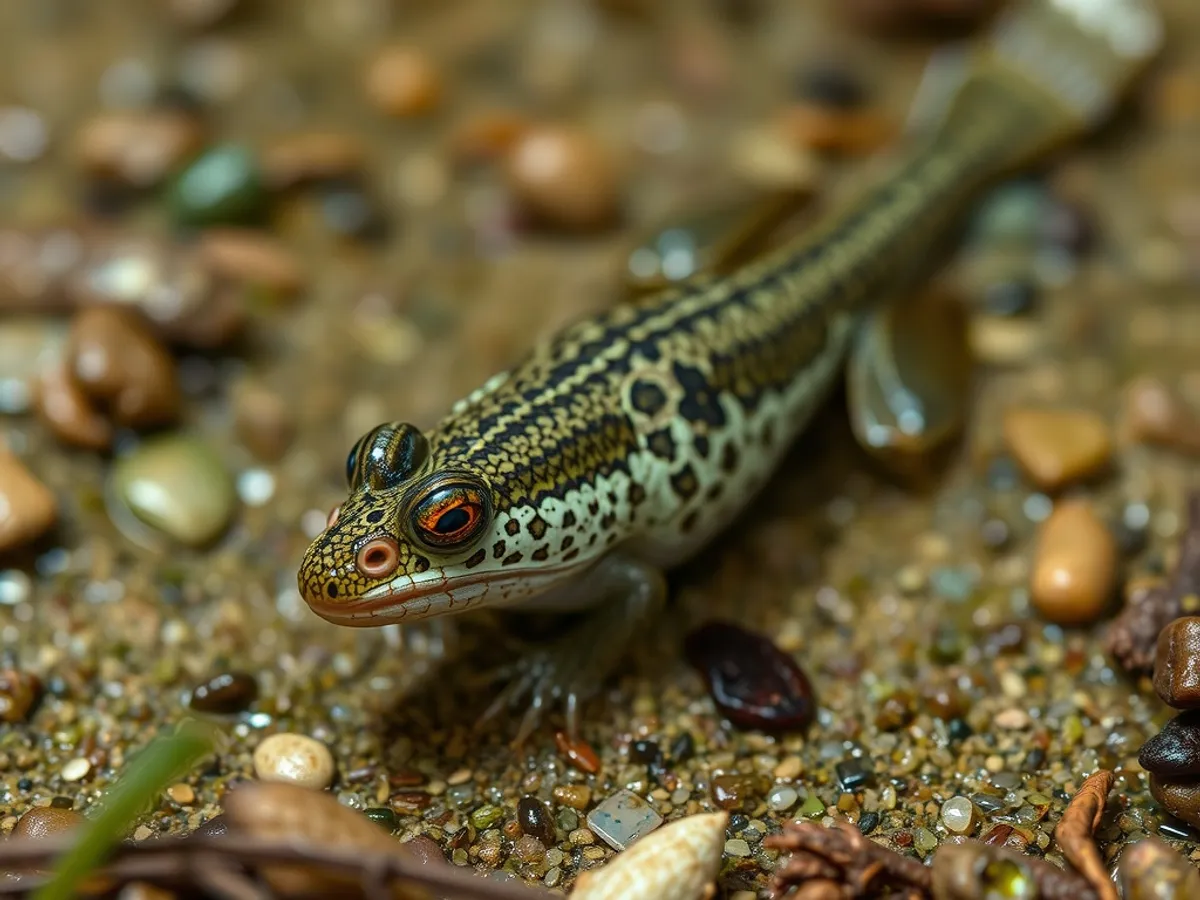
About the Dragon Goby
The Dragon Goby is a unique, eel-like fish known for its elongated, slender body and iridescent, metallic sheen. Native to brackish and coastal waters of the western Atlantic, this species is often admired for its dragon-like appearance, with a long dorsal fin and distinctive face. Dragon Gobies are primarily nocturnal and prefer to burrow in soft, muddy substrates where they can find food and shelter. While they may look intimidating, they are peaceful and shy, making them a fascinating addition to aquariums for experienced keepers. Their feeding habits and delicate nature require special attention to water quality and diet.
Fascinating facts
Dragon-Like Appearance
Named for their dragon-like look, these gobies have elongated bodies and long dorsal fins that give them a mythical appearance.
Nocturnal Lifestyle
Dragon Gobies are mostly active at night, when they search for food along the muddy bottoms of their habitats.
Brackish Water Dweller
They thrive in brackish water environments, such as estuaries and river mouths, but can tolerate a range of salinity levels.
Detailed description
The Dragon Goby (Gobioides broussonnetii), also known as the Violet Goby, is a strikingly elongated, eel-like fish that can reach lengths of up to 61 cm (24 inches), though most individuals are commonly found between 30–40 cm. Its body is laterally compressed and covered in small, iridescent scales that give it a metallic violet or blue sheen, particularly under certain lighting conditions. The head is blunt and broad, with a distinctive downturned mouth lined with numerous fine, comb-like teeth adapted for sifting detritus and microorganisms from the substrate. The dorsal fin is long and ribbon-like, running nearly the length of the back, and the pelvic fins are reduced, aiding in its burrowing lifestyle. Dragon Gobies possess reduced eyesight, relying more on tactile and chemical cues to navigate their often turbid, low-visibility habitats. They are primarily nocturnal, emerging at dusk to forage along muddy estuary bottoms. Socially, they are solitary or loosely gregarious, typically avoiding direct competition through spatial separation. Their coloration and cryptic behavior provide camouflage against predators. Reproduction involves external fertilization, with females depositing adhesive eggs in sheltered crevices or burrows. The species is highly tolerant of fluctuating salinities, an adaptation to the dynamic environments of estuaries and river mouths.
Did you know?
Dragon Gobies are capable of surviving in both brackish and freshwater environments, though their health is best maintained in slightly salty water.
Research & sources
Wikipedia summary
The violet goby is a species of goby native to marine, fresh and brackish waters near the Atlantic coast of North and South America from South Carolina in the United States of America, to northern Brazil. It prefers bays, estuaries and river mouths with muddy substrates. It is often marketed as the dragon goby or dragon fish.
Behaviour & social structure
Dragon Gobies are benthic foragers, spending much of their time partially buried in soft mud or silt, where they sift through the substrate for organic matter, algae, and small invertebrates. Their feeding is primarily crepuscular and nocturnal, reducing predation risk and competition with diurnal species. They exhibit a slow, undulating swimming motion, often using their pectoral fins to stabilize themselves while probing the substrate with their sensitive mouths. Social interactions are minimal; individuals may share overlapping territories but rarely display aggression unless competing for confined shelter. When threatened, they rapidly retreat into burrows or under debris. In aquaria, they are known to be shy and reclusive, often hiding during daylight hours and becoming more active at night.
Reproduction & life cycle
Gobioides broussonnetii exhibits oviparous reproduction, with spawning typically occurring during the warmer months when water temperatures rise and food availability increases. Males and females engage in brief courtship displays, after which females lay clusters of adhesive eggs in protected locations such as burrows, crevices, or among submerged roots. Fertilization is external. There is limited evidence of parental care; after spawning, adults generally abandon the eggs. The incubation period is temperature-dependent, usually lasting 5–7 days. Upon hatching, larvae are planktonic, drifting with currents until they settle to the substrate and begin their benthic lifestyle. Sexual maturity is reached at approximately 1–2 years of age.
Adaptations & survival
Dragon Gobies are highly adapted to estuarine environments with fluctuating salinity and oxygen levels. Their elongated, flexible bodies and reduced pelvic fins facilitate burrowing and maneuvering through soft substrates. The presence of comb-like teeth allows efficient sifting of fine detritus and microorganisms. Reduced pigmentation and eyesight are common in turbid or low-light environments, and their lateral line system is well-developed for detecting vibrations and chemical signals. Physiologically, they possess efficient osmoregulatory mechanisms, enabling survival in both fresh and brackish waters. Their nocturnal habits and cryptic coloration reduce predation risk and competition.
Cultural significance
While not of major commercial importance, Dragon Gobies are popular in the ornamental fish trade due to their unique appearance and docile nature. In some cultures, their dragon-like features have inspired local folklore and aquarium hobbyist nicknames such as 'dragon fish.' There is no significant evidence of traditional subsistence or medicinal use. Their presence in public aquaria and private collections has increased awareness of estuarine biodiversity.
Recent research
Recent research has focused on the osmoregulatory physiology of Gobioides broussonnetii, revealing sophisticated mechanisms for coping with rapid salinity changes. Studies on their feeding ecology have highlighted their role in nutrient cycling within estuarine ecosystems. Ongoing genetic analyses are clarifying relationships within the Oxudercidae family and the evolutionary origins of their unique morphological traits. Conservation assessments continue to monitor population health in response to habitat modification and climate change.
Videos
Habitat
Brackish estuaries, coastal lagoons, and river mouths

Conservation
The Dragon Goby is currently classified as Least Concern on the IUCN Red List.
Threats & challenges
Currently classified as 'Least Concern' by the IUCN, Dragon Gobies face localized threats from habitat degradation, pollution, and alteration of estuarine environments due to urbanization, agriculture, and dam construction. Overharvesting for the aquarium trade is not considered a significant threat at present, but unsustainable collection could impact local populations. Climate change and associated sea-level rise may alter estuarine salinity regimes, potentially affecting distribution and reproductive success. Despite these challenges, the species' broad range and adaptability contribute to stable population trends.
Taxonomy
Scientific name
Gobioides broussonnetii
- Kingdom
- Animalia
- Phylum
- Chordata
- Class
- Actinopterygii
- Order
- Gobiiformes
- Family
- Gobiidae
- Genus
- Gobioides
- Species
- broussonnetii
Community notes
Share your observations about the Dragon Goby.
No community notes yet. Be the first!
Discover more wildlife
More fascinating animals from the encyclopedia.