
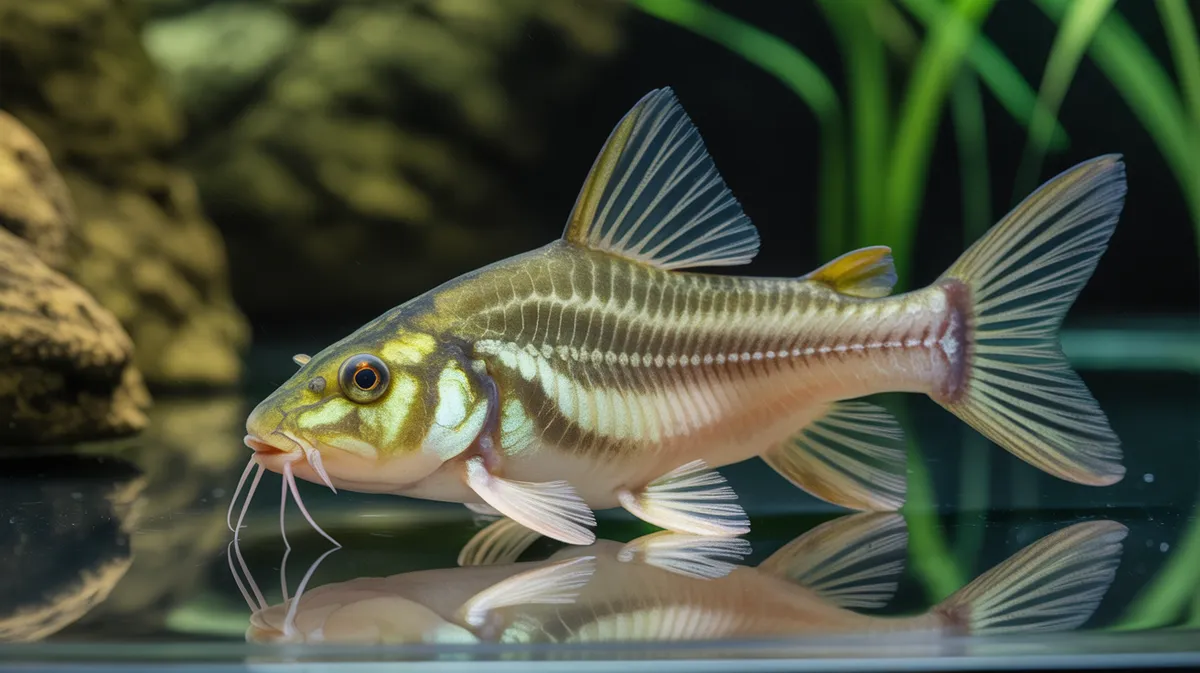
About the Emerald Catfish
The Emerald Catfish, also known as the Green Corydoras or Brochis splendens, is a small, peaceful freshwater fish native to the slow-moving rivers and streams of the Amazon Basin in South America. It is well-known for its striking metallic green coloration, which gives it an emerald-like sheen under aquarium lighting. This bottom-dwelling species is a popular choice among aquarists due to its hardy nature, gentle temperament, and fascinating schooling behavior. Emerald Catfish are social fish that thrive in groups and spend much of their time sifting through substrate in search of food.
Fascinating facts
Brilliant Coloration
Their shimmering emerald-green coloration is the result of microscopic platelets in their skin reflecting light, rather than pigment.
Social Schoolers
Emerald Catfish are highly social and should be kept in groups of six or more to exhibit their natural schooling behavior and reduce stress.
Surface Breathers
They possess a modified intestine that allows them to breathe atmospheric air, a useful adaptation for oxygen-poor waters.
Detailed description
The Emerald Catfish (Corydoras splendens), sometimes referred to as Brochis splendens, is a robust, medium-sized member of the Callichthyidae family, typically reaching 6–8 cm (2.4–3.1 in) in standard length, with some individuals growing slightly larger in optimal conditions. Its most distinctive feature is the iridescent, metallic green coloration along the flanks and back, which is accentuated by golden or bronze hues under certain lighting. The body is deep and laterally compressed, with a high, arched dorsal profile and a pronounced, sail-like dorsal fin containing 10–12 rays—more than most Corydoras species. The ventral surface is pale, and the fish possesses two rows of overlapping bony plates (scutes) that provide protection. The head is broad with a blunt snout, and three pairs of sensitive barbels surround the mouth, aiding in substrate foraging. Emerald Catfish are gregarious and display complex social behaviors, often forming tight shoals of 6–20 individuals in the wild. They are benthic foragers, spending much of their time sifting through fine sand or detritus for food. Their respiratory system is adapted to low-oxygen environments, allowing them to gulp atmospheric air and absorb oxygen through the highly vascularized lining of their intestine. In their native Amazonian habitats, they inhabit slow-moving, shallow waters with dense vegetation and leaf litter, which provide both cover and feeding grounds. Their peaceful temperament and tolerance for a range of water conditions make them a mainstay in community aquaria. Sexual dimorphism is subtle, with females generally larger and rounder, especially when gravid.
Did you know?
Emerald Catfish can gulp atmospheric air from the water’s surface, allowing them to survive in low-oxygen environments.
Research & sources
Behaviour & social structure
Emerald Catfish are diurnal but exhibit peak activity during dawn and dusk (crepuscular periods). They are highly social, displaying coordinated shoaling behavior that reduces predation risk and enhances foraging efficiency. Individuals communicate through tactile cues and chemical signals, often seen nudging or swimming in parallel. When feeding, they use their barbels to detect edible particles, rooting through soft substrates and occasionally stirring up detritus. Their diet in the wild consists of insect larvae, small crustaceans, worms, and organic debris, with opportunistic consumption of plant matter. In captivity, they readily accept a variety of prepared foods, including sinking pellets and frozen invertebrates. They are non-aggressive, rarely displaying territoriality, but may establish loose hierarchies within groups. When startled, they may dart to the water surface to gulp air or quickly burrow into the substrate. Resting behavior involves lying motionless on the substrate or among plant roots, often in close proximity to conspecifics.
Reproduction & life cycle
Breeding in Corydoras splendens typically coincides with the onset of the rainy season in their native range, triggered by changes in water chemistry and temperature. Courtship involves a characteristic 'T-position,' where the male presents his body perpendicular to the female, who then collects sperm in her mouth before fertilizing the eggs. Females lay adhesive eggs (usually 100–200 per spawning event) on submerged vegetation, roots, or aquarium glass. There is no parental care post-spawning; adults do not guard the eggs or fry. Incubation lasts 3–5 days at 24–26°C (75–79°F), after which the larvae are free-swimming and begin feeding on microfauna. Sexual maturity is typically reached at 8–12 months. In captivity, successful breeding is often induced by simulating rainy season conditions—lowering water temperature and performing large water changes.
Adaptations & survival
Emerald Catfish possess several notable adaptations for survival in fluctuating Amazonian waters. Their bony scutes provide defense against predators and abrasive substrates. The presence of three pairs of barbels enhances their ability to locate food in turbid or dark environments. A key adaptation is their facultative air-breathing ability: they can supplement gill respiration by gulping air at the surface, absorbing oxygen through the intestinal lining—a trait advantageous in hypoxic (low-oxygen) waters. Their cryptic coloration and reflective scales help them blend into dappled light environments, reducing predation. Social shoaling behavior increases vigilance and confuses predators. Additionally, their eggs are adhesive, allowing them to be deposited in concealed locations, increasing offspring survival.
Cultural significance
While not prominent in indigenous folklore, Emerald Catfish have gained considerable cultural significance in the global aquarium hobby, symbolizing peacefulness and community. Their hardy nature and attractive appearance have made them a favorite among aquarists worldwide, often featured in educational programs about Amazonian biodiversity. In some South American localities, small catfish species are occasionally used as bait or minor food sources, but Corydoras splendens is primarily valued for ornamental purposes. Their popularity has contributed to increased awareness of Amazonian aquatic ecosystems.
Recent research
Recent molecular studies have clarified the taxonomic distinction between Corydoras splendens and closely related Brochis species, with genetic evidence supporting their placement within the Corydoras genus. Research on their air-breathing physiology has provided insights into evolutionary adaptations to hypoxic environments, with studies documenting the structure and function of their intestinal respiratory surfaces. Behavioral research has explored their social dynamics, demonstrating the benefits of shoaling for stress reduction and foraging success. Ongoing studies are examining the impact of environmental pollutants on their reproductive success and larval development, highlighting their potential as bioindicators for freshwater ecosystem health.
Sources
Phylogeny and Classification of the Corydoradinae (Siluriformes: Callichthyidae)
Reis, R.E. et al. (2016)
scientificRevision of the genus Brochis (Siluriformes: Callichthyidae) with a description of a new species
Reis, R.E. (1997)
scientificVideos
Habitat
Freshwater rivers and streams


Conservation
The Emerald Catfish is currently classified as Least Concern on the IUCN Red List.
Threats & challenges
Currently assessed as Least Concern by the IUCN, Corydoras splendens faces localized threats from habitat degradation, particularly deforestation, agricultural runoff, and water pollution in the Amazon Basin. Over-collection for the aquarium trade has not significantly impacted wild populations, but unsustainable harvesting in some regions could pose future risks. Climate change and associated alterations in rainfall patterns may affect breeding cycles and habitat availability. Despite these challenges, the species remains widespread and resilient, with stable population trends reported in most areas. Conservation efforts focus on habitat preservation and promoting sustainable collection practices.
Taxonomy
Scientific name
Corydoras splendens
- Kingdom
- Animalia
- Phylum
- Chordata
- Class
- Actinopterygii
- Order
- Siluriformes
- Family
- Callichthyidae
- Genus
- Corydoras
- Species
- splendens
Community notes
Share your observations about the Emerald Catfish.
No community notes yet. Be the first!
Discover more wildlife
More fascinating animals from the encyclopedia.